Japan's Running Boom Is Different From What You Think — Here's Why
The first time I ran through Tokyo at 6 a.m. on a weekday, I felt like I was part of a small and slightly eccentric subculture. That was…
Japan's Running Boom Is Different From What You Think — Here's Why
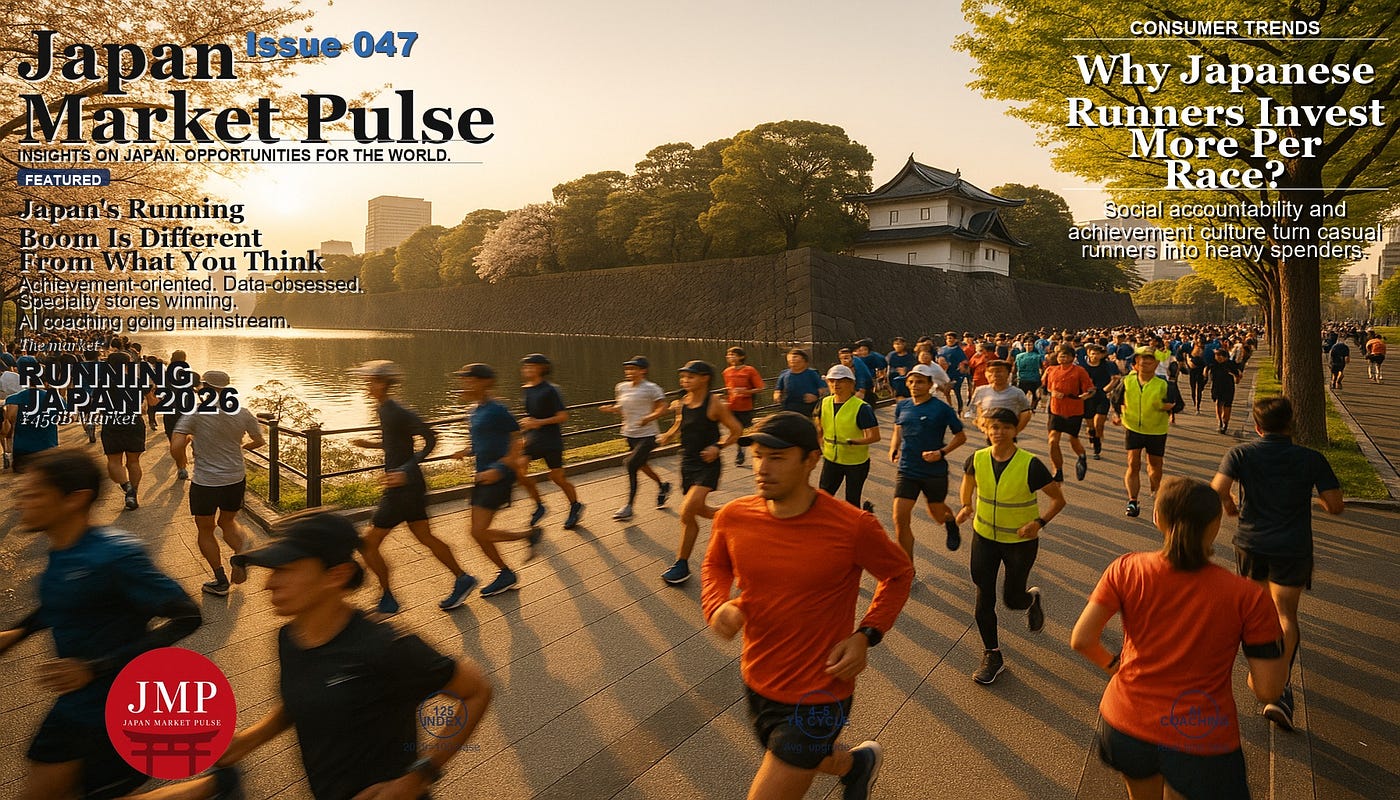
The first time I ran through Tokyo at 6 a.m. on a weekday, I felt like I was part of a small and slightly eccentric subculture. That was about ten years ago. Now, running along the Imperial Palace moat on a Tuesday morning feels like merging onto a highway — steady streams of runners in both directions, most of them wearing better shoes than I own, many of them tracking data on devices strapped to wrists and arms that would have seemed like athletic overkill not long ago.
Something has shifted in Japan’s relationship with running. And it is not just the visible phenomenon of more people on more paths. It is a structural change in how a very large consumer market thinks about fitness, about personal identity, and about how they spend discretionary income. For business operators paying attention to Japanese consumer trends, it is one of the more interesting stories in the country right now.
The Numbers Behind the Crowd

Japan’s running market has been growing steadily for years, with a significant post-pandemic acceleration. Participation in organized road races — 5Ks, half marathons, full marathons, trail ultramarathons — has recovered strongly from the event cancellations of 2020 and 2021, and the numbers have surpassed pre-pandemic levels in most categories.
More significant than overall participation growth is the profile of new participants. The most recent data on marathon and half-marathon first-timers reveals a pattern that market analysts have been calling structural rather than cyclical. First-time race participants are younger than they were ten years ago. The proportion of women among new runners is higher than in any previous period. And — perhaps most importantly for anyone thinking about market longevity — the average new participant is entering the sport with more disposable income and more intention to invest in equipment, training, nutrition, and experience than their predecessors.
This is not the running boom of the 1980s, when jogging was something middle-aged men did in gray cotton tracksuits. This is a running boom driven by an aesthetic and identity component — running as a visible commitment to self-improvement, as a social activity, as a passport to events and communities and travel that non-runners do not access. The Tokyo Marathon waitlist regularly runs into the hundreds of thousands. Getting in is an accomplishment in itself.
Alpen’s Strategic Bet

One of the clearest signals of how seriously the sports retail industry is taking this shift comes from Alpen, one of Japan’s largest sporting goods chains. Alpen has been in the business of broad-format sporting goods retail for decades — ski equipment, golf clubs, general fitness gear, seasonal outdoor wear. That model worked well when category generalists could cover enough of any sport to be useful.
What Alpen is doing now represents a deliberate pivot. The company has been opening dedicated running stores — single-category specialty formats that go deep on running footwear, apparel, and accessories, staffed by people with genuine running expertise, equipped with gait analysis tools, and positioned as community resources rather than pure retail transactions.
The timing is not accidental. Alpen is responding to a problem that every multi-sport generalist faces in a market where category specialists are winning: in running, the customer who is serious about the sport will not buy from someone who cannot discuss the difference between a stability trainer and a neutral cushioning shoe, explain what drop height means for their gait, or help them understand the tradeoffs between two shoes at similar price points. That customer — and it is an increasing proportion of the running market — needs a specialist.
The specialty running store format has worked in other markets. In the United States, chains like Fleet Feet and specialty independents have maintained loyal customer bases even as Amazon and big-box retailers have taken category share in almost every other product segment. The reason is service: the customer who comes in for a gait analysis and a fitting conversation comes back, refers friends, participates in store-organized group runs, and becomes a community node rather than a transaction.
Japan’s running consumer has proven willing to pay for that relationship. The average spend per participant in Japanese road races — across entry fees, travel, accommodation, gear, nutrition, and coaching — is substantial and growing. The market is not price-sensitive at the upper end; it is experience-sensitive and expertise-sensitive.
The Technology Layer

What makes Japan’s running market specifically interesting from a technology standpoint is the degree to which Japanese runners — and the companies serving them — have embraced data integration.
The most sophisticated Japanese running apps do not just track pace and distance. They aggregate weather forecasts layered against specific race course sections, identify optimal hydration timing based on conditions, map aid station locations and predicted crowd density, and generate real-time race strategy adjustments. There is an audience in Japan for running technology that goes considerably deeper than the average sports tracking app in Western markets.
This demand reflects something deeper about Japanese consumer culture: the comfort with, and indeed enthusiasm for, systematic optimization of personal activities. Japanese productivity culture — which has its problems and its critiques — has long expressed itself through ritual and data. The runner who charts every kilometre split and cross-references it against heart rate variability data is applying the same instinct that generates detailed personal household finance spreadsheets and meticulous food diaries.
AI is entering this space at multiple levels. Personalized training plan generation based on physiological data and goal parameters. Predictive injury risk assessment. Weather-adaptive route suggestions. Nutritional timing recommendations integrated with race-day logistics. The Japanese market is not just early-adopting these technologies; in some cases it is driving their development, because the user base is demanding enough to create a product improvement loop.
Wearable technology penetration among Japanese runners is high and continues to grow. Devices that would have been considered performance-monitoring overkill a decade ago — continuous heart rate monitoring, blood oxygen saturation tracking, VO2 max estimation — are standard features that entry-level running watch buyers now expect. The Japanese running consumer upgrades devices regularly and pays attention to specs in ways that drive premium positioning strategies.
Why Japanese Runners Are Not Like American Runners

Understanding the Japanese running consumer requires setting aside assumptions built on other markets.
In the United States, running culture is closely associated with health and weight management motivations. In Japan, those motivations exist but are secondary to what might be called achievement culture — the completion of something difficult as proof of personal discipline and growth. The marathon, specifically, is culturally coded as a serious undertaking, a test rather than an activity. Completing a marathon in Japan earns genuine social recognition among peers, family, and sometimes workplace colleagues in ways that are more muted in other markets.
This has downstream effects on how the market develops. Achievement-oriented runners invest heavily in preparation. They hire coaches, join running clubs, travel to races, and purchase equipment with an attention to quality that is driven by a desire not to fail at something they have publicly committed to. The social accountability dimension — the fact that running a race is a legible public commitment — inflates investment across the entire participation ecosystem.
Club running, specifically, has become a significant driver of market behavior. Running clubs in Japan are not just groups of friends who jog together. They are organized communities with regular training schedules, coaching structures, entry-level orientations, and in some cases their own races and events. Corporate running clubs — organized through workplaces — are common. They have evolved into something between a wellness program and a professional networking activity, with companies investing in running participation as both an employee wellbeing initiative and a culture-building exercise.
The club dynamic also creates demand for category products that wouldn’t exist without it. Club-branded apparel. Coordinated gear selections. Group entries to major races that require social logistics. Travel packages that combine race participation with tourism for members who travel to run outside their home city.
The International Brand Opportunity
For global sports and fitness brands, Japan’s running boom presents an opportunity that is worth analyzing carefully rather than approaching with standard international expansion assumptions.
The Japanese running consumer responds strongly to technical credibility. A brand that has a genuine story in elite or high-performance running — a partnership with a leading athlete, a development connection to a national running program, footwear that has visible representation at major international races — translates that credibility into consumer trust at the premium end of the market.
Carbon-plated race shoes, which have transformed marathon performance globally, have been adopted by Japanese recreational runners at rates that track international trends. The consumer who will never run a sub-three-hour marathon nonetheless wants the technology that enables it — both for the marginal performance benefit and for what it signals about how seriously they take the sport.
Nutrition is another under-served category. Running nutrition — gels, electrolyte drinks, recovery supplements — exists in Japan but is less developed as a specialty category than the footwear and apparel market. Japanese runners are attentive to nutrition quality and willing to pay premium prices for products that are backed by credible research and positioned for the serious participant.
Trail running, specifically, is growing faster than road running in some Japanese markets. The country’s topography is exceptional for the discipline — the mountainous terrain across most of the country provides trail running environments that are difficult to match in flat urban markets. Brands with genuine trail running credibility are well-positioned as the segment grows.
What the Alpen Bet Tells You About the Broader Shift
Returning to Alpen’s specialty running store expansion: the decision to cannibalize, in a sense, your own generalist format by pulling running out of it and treating it as a distinct business is not made lightly. Alpen has running product on the floor of every multi-sport store it operates. Creating separate specialty stores means those existing stores lose some of their running category authority, and the new specialty stores need to justify their economics independently.
The fact that Alpen made this call tells you something about the demand signal they were seeing. The specialty format is winning enough of the serious running customer that the investment makes sense. And the serious running customer — the one who needs a fitting conversation, who will come back seasonally as their goals evolve, who refers community members — is worth the investment in depth.
For market entry analysis: Japan’s specialized retail model suggests that in categories where expertise is valued, the depth play outperforms the breadth play. This applies beyond running. Categories where the Japanese consumer is achievement-oriented, where the purchase has identity implications, and where technical performance is evaluable tend to produce markets where specialists win and generalists lose share.
The running boom is a case study in how a consumer category can bifurcate — high-engagement participants creating a premium segment that supports specialty retail, expertise-driven service, and technology investment, while low-engagement casual participants stay with generalists. Understanding which segment of any Japanese consumer market you are serving is the foundational strategic question.
Running in Japan is not just about faster times and better shoes. It is about what the Japanese consumer does when they decide to get good at something. And that pattern repeats across dozens of categories that are worth your attention.
If you’re interested in this topic, the Japanese market more broadly, or what KETCHUPs is working on, we’d love to hear from you — please reach out via our contact form.
Japan Market Pulse is a weekly read on what the Japanese consumer-tech, food, and mobility markets are choosing to do, written for international operators who want to know what is happening before it shows up in the global trade press.
Subscribe at ketchups.co/japan-market-pulse.
Japan Market Pulse is a weekly read on what the Japanese consumer-tech, food, and mobility markets are choosing to do, written for international operators who want to know what is happening before it shows up in the global trade press. Subscribe at ketchups.co/japan-market-pulse.
Originally published at https://ketchups.co on July 3, 2026.
메타데이터
- post_id
- 2d9d64d7b17d
- slug
- japans-running-boom-is-different-from-what-you-think-here-s-why-2d9d64d7b17d
- url
- https://medium.com/@kaihori/japans-running-boom-is-different-from-what-you-think-here-s-why-2d9d64d7b17d
- canonical_url
- https://medium.com/@kaihori/japans-running-boom-is-different-from-what-you-think-here-s-why-2d9d64d7b17d
- author_url
- https://medium.com/@kaihori
- status
- ok
- fetched_at
- 2026-07-15 07:25:57