The Federated AI Paradox: Beyond the Black Box Models
Supply Chain AI Governance: Navigating the Federated Paradox with TRUST and SHAPE Frameworks.
The Federated AI Paradox: Beyond the Black Box Models
Supply Chain AI Governance: Navigating the Federated Paradox with TRUST and SHAPE Frameworks.
I’ve stood inside a million-square-foot distribution center at 4 AM watching a wave release go wrong. The WMS said 47,000 units were slotted for pick. The RF scanners showed 43,200. The labor plan assumed 52,000: three systems, three numbers, zero agreement on reality.
That memory comes back every time I hear a supply chain vendor claim their AI is “trained on decades of data.” Because I know where that data actually lives — and it’s not where their pitch deck says it is.
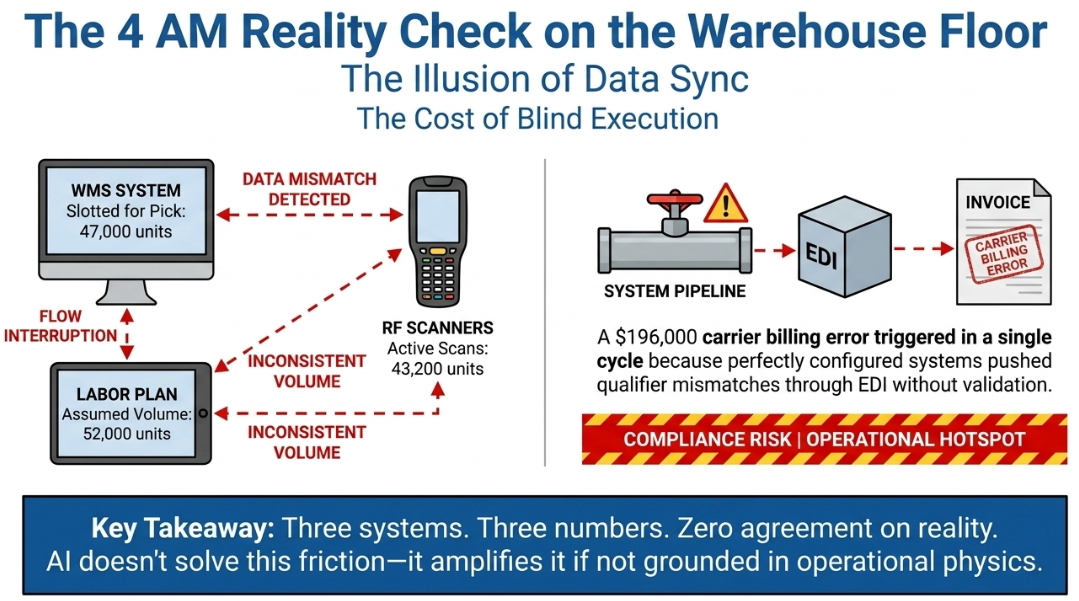
The illusion of Data Sync & The Cost of Blind Execution
That gap - between what vendors claim and what their architecture actually delivers is what I call the Federated AI Paradox. And after 20+ years building enterprise supply chain systems, deploying WMS across multi-site operations, and now architecting an AI-native commerce platform from scratch, I’ve adopted two complementary frameworks that expose exactly where it breaks down: TRUST (Transparency, Responsibility, Unified Data, Security, Traceability) for governance and compliance, and SHAPE (Standard Operating Procedures, Human in the Loop, Arbitrage, Profitability, Execution) for operational execution.
Together, they reveal why production-grade cross-customer federated intelligence is realistically projected for 2028–2030, not 2026–2027 — and why most C-suites obsessing over “Execution” are blind to the high-stakes friction occurring where governance meets operations. Governance is not a blocker to execution; it is the infrastructure that allows execution to scale.
The Three-Layer Data Reality Nobody Talks About
When a vendor says “decades of data advantage,” they’re conflating three very different things. I know this because I’ve seen all three layers from the inside.
Layer 1 (Accessibility — Dark): On-premises data (70–80% of the installed base).
Every implementation I’ve touched was a snowflake — custom pick-path logic, customer-specific slotting rules, labor standards calibrated to that specific workforce in that specific facility. That data resides in the customer’s data center, behind their firewall, and is managed by their DBA. The vendor has zero access. When that vendor now claims AI trained on “decades of data,” I want to ask: which decades? Which data? Because I know for a fact that the richest operational data in the industry — the pick-path telemetry from a high-volume grocery DC processing 300,000+ cases per day — is sitting on an AS/400 behind a VPN that the vendor’s cloud team has never seen.
Layer 2 (Accessibility — Isolated): Cloud instances (20–30% converting).
Even customers who’ve migrated to the cloud typically run in dedicated, single-tenant instances or logically isolated environments. The customer controls data replication and retention. There is no publicly disclosed mechanism at most major vendors for aggregating data across customers. The cloud offers cleaner infrastructure, but the same data walls remain.
Layer 3 (Accessibility — Bounded): Domain knowledge.
This is what vendors actually have: institutional knowledge about how warehouses, orders, and transportation work, encoded in algorithms. Slotting optimization that knows heavy items go to waist-height picks. Labor models that account for travel time between zones. Wave release logic that balances carrier cutoff times against pick density. I’ve watched these algorithms save clients millions. But it’s expertise in code, not a proprietary data lake training cross-customer AI models.
Anyone who’s operated at the intersection of WMS, TMS, and OMS configuration and warehouse floor reality understands this distinction intuitively. The question is whether investors and customers understand it too.
The TRUST × SHAPE Framework: Where Governance Meets the Warehouse Floor
I adopted TRUST and SHAPE as interlocking frameworks — one governing what the AI knows, the other governing what the AI does. When you apply each pillar to the question of federated AI, the challenges become concrete. Not abstract compliance exercises, but the kind of problems that cost real money on real warehouse floors.

The Federated AI Paradox infographic — Bridging Governance and Operations in Supply Chain

TRUST × SHAPE Intersection Matrix — 25 Intersection Points for Federated Supply Chain AI
The TRUST Framework: Governance and Compliance
TRUST serves as the compliance layer for supply chain AI, addressing the legal mandates — GDPR, EU AI Act, SOC 2, ISO 42001 — that will determine which vendors survive the next regulatory cycle and which get caught flat-footed.
T - Transparency
When an AI agent recommends a slotting configuration for your DC, can you trace whether that recommendation came from your data, anonymized peer data, or the vendor’s general algorithms? The EU AI Act (Article 13), which applies to high-risk systems from August 2026, requires interpretability.
Here’s what transparency looks like on an actual warehouse floor: the supervisor needs to know why the system is suggesting moving SKU 4,217 from Zone C to Zone A. If the answer is “because a model trained on 200 other warehouses says so,” that supervisor — the person who knows that Zone A floods when it rains and the HVAC can’t handle temperature-sensitive product — has no basis to evaluate the recommendation. Transparency isn’t an abstract principle. It’s the difference between a system that warehouse operators trust and one they work around.
R - Responsibility
Under GDPR Article 5(1)(b), data collected for warehouse management cannot be repurposed by the vendor for cross-customer AI training without explicit consent. But responsibility goes deeper than legal compliance.
I’ve seen what happens when an optimization algorithm gives bad advice. A retailer once lost $196,000 in a single UPS billing cycle because a system configuration pushed qualifier mismatches through EDI without validation. No AI caught it. No human caught it. The system was working exactly as configured — which was the problem. When the AI is wrong, someone has to own the outcome. In a federated model where Retailer A’s patterns influence Retailer B’s recommendations, the accountability chain becomes murky in ways that no contract I’ve seen addresses adequately.
U-Unified Data
Operational data varies wildly across verticals, and naive aggregation doesn’t improve AI quality — it degrades it.
Here’s the operational reality: a grocery DC running 50,000 SKUs with cold chain, expiration management, and FIFO requirements generates fundamentally different data patterns than a fashion fulfillment center processing 40% returns with seasonal velocity spikes. I’ve configured both. The slotting logic is different. The labor models are different. The wave release patterns are different. FIFO requirements in grocery stores have no equivalent in fashion. Expiration date management doesn’t exist in the automotive industry. If you train one model across all three without sophisticated domain segmentation, the model gets worse, not better — because a grocery DC’s optimization patterns actively mislead the model when applied to fashion fulfillment.
S - Security
SOC 2 Type II is the enterprise baseline, but it was designed for transactional data processing, not AI model training. Known vulnerabilities in federated learning — gradient inversion attacks, membership inference attacks — can potentially reconstruct individual training data from shared model parameters.
The practical risk is this: if you’re a 3PL running on the same platform as your competitor, and the shared model’s gradients can be reversed to infer your picks-per-hour or cost-per-order benchmarks, your competitive intelligence just leaked through a vector your security team hasn’t modeled. Ask your vendor about differential privacy, secure aggregation, and whether they’ve conducted adversarial testing. If the answer is vague, the security architecture isn’t ready.
T - Traceability
GDPR Article 17 — the right to erasure — creates what I call the unlearning impossibility. If a customer’s data trained a federated model and that customer exercises their right to deletion, you must prove that their data no longer influences the model. In neural network architectures, gradient contributions can’t be surgically removed without retraining from scratch — a computationally expensive operation called “machine unlearning” that remains an unsolved research problem at enterprise scale in 2026.
You cannot simultaneously maintain a continuously learning federated model and satisfy the right to erasure. The math doesn’t work. Not yet.
The SHAPE Framework: Operational Execution
TRUST governs the rules. But rules without operational discipline are just documentation. SHAPE ensures that AI governance functions effectively where it matters most — on the warehouse floor, across the transportation network, and throughout the order lifecycle.
S - Standard Operating Procedures
AI doesn’t replace SOPs — it complicates them. When I implemented WMS across multi-site operations, every facility had SOPs calibrated to their specific workflows: how picks are batched, when replenishment triggers fire, and how exceptions are escalated. AI agents making autonomous decisions must operate within these SOPs, not around them.
The critical question for federated AI: whose SOPs govern the model? If the AI learned optimization patterns from a facility running 24/7, three-shift operations, and then recommends those patterns to a facility running single-shift, 5 days a week, the SOP mismatch creates operational chaos. Standard Operating Procedures are the guardrails that keep AI grounded in physical reality — and every warehouse’s reality is different.
H - Human in the Loop
After two decades in this industry, I can tell you with certainty: the warehouse floor is not ready for fully autonomous AI. Not because the AI isn’t capable, but because the operating environment is too variable. Trucks arrive late. Inventory counts drift. Workers call in sick. Conveyor belts jam. The RF scanner battery dies at the worst possible moment.
Human-in-the-loop isn’t a weakness in the system — it’s a design requirement. The question is where the human intervenes. I use a dollar-impact framework calibrated by decision magnitude:
- Under $2,000 (AI-Autonomous): Carrier selection, pick-path optimization.
- $2,000–$20,000 (AI-Assisted with human approval): Wave release changes, labor reallocation.
- Above $20,000 (Human-led with AI input): Inventory write-offs, SLA renegotiations, facility layout changes.
Federated AI models that learn from cross-customer data should amplify human judgment, not replace it. And here’s the feedback loop most systems miss: when an experienced operator overrides the AI and the outcome is better — Maria in Zone B picks 30% faster than the model predicts, the night shift has a different rhythm than days — does the system learn from that? Or does it keep recommending the same thing tomorrow?
A - Arbitrage and Tradeoffs
Here’s something most AI governance frameworks miss entirely: the economic incentive structure. In the supply chain, arbitrage happens at every decision point — the spread between the cheapest carrier and the fastest, the gap between optimal slotting and the slotting that minimizes labor disruption, the difference between the theoretically perfect wave release and the one that actually gets trucks out on time.
AI models optimized purely on efficiency miss the arbitrage that experienced operators exploit instinctively. A warehouse manager who knows that Carrier B’s 2 PM pickup is actually 2:45 PM — because that driver always runs late — will batch differently than the AI suggests. That’s not inefficiency. That’s operational intelligence that no federated model can capture unless it’s learning from the execution outcomes, not just the plan.
Arbitrage also applies to the data itself: whose data is more valuable in a federated model? A customer with highly optimized operations contributes more training signal than one with poor data quality. Is there a value-sharing mechanism? A pricing differential? The economics of federated data are entirely unaddressed in the market today.
P - Profitability, Performance, Planet, and the 3P’s
Performance metrics in supply chain AI cannot be one-dimensional. AI that increases throughput by 15% while simultaneously increasing carrier spend by 22% is an optimization failure dressed as a productivity win. Every AI recommendation needs to be scored against its full impact through the 3P governance model:
Profit: Does the AI improve margin — not just revenue? Did total landed cost go down or up? I’ve seen recommendations that look brilliant on a throughput dashboard and catastrophic on a P&L statement.
Planet: Supply chain accounts for over 60% of most companies’ carbon footprint. AI optimizing for speed without considering route emissions is solving yesterday’s problem. The EU’s Corporate Sustainability Reporting Directive (CSRD) means supply chain AI will soon need to trace environmental impact alongside financial performance. ESG compliance is tightening — not relaxing.
People Process Governance: The humans running warehouses aren’t interchangeable units. Labor optimization AI that treats them as such will face pushback from operations teams who understand that Maria in Zone B picks 30% faster than average, that the night shift has a different rhythm than the day shift, and that the temporary labor pool in Q4 needs different task-assignment logic than the permanent crew. People-centric process governance means the AI adapts to the workforce — not the other way around.
E - Execution and Efficiency
The final pillar is where everything comes together — and where most AI governance frameworks fall silent. Governance documents don’t ship orders. Execution does.
A slotting recommendation that takes four hours to compute is irrelevant when the next wave releases in 20 minutes. A carrier selection model that requires 3 API calls and 2 seconds of latency per order is unacceptable when you’re processing 50,000 orders per day.
Execution efficiency in federated AI means the intelligence must be distilled into models that run at operational speed — sub-second inference at the edge, not round-trip queries to a central model. This is architecturally hard, and it’s where most federated AI visions break down in practice. The vendors who build for production speed — not demo speed — are the ones whose AI will actually get used on the warehouse floor.
Strategic Checklist for AI Vendor Evaluation
Supply chain leaders should use the following questions to distinguish between “PowerPoint governance” and genuine architectural readiness:
- Source Attribution: Can the system distinguish between per-instance intelligence (learned from my data) and cross-customer patterns (learned from aggregated data)?
- Legal Basis: What specific GDPR legal basis — consent, legitimate interest, or contractual necessity — is used for cross-customer data processing?
- Data Provenance: If 70–80% of the installed base is on-prem, how is the “AI advantage” actually being trained?
- Adversarial Testing: How does the vendor prevent competitive intelligence leakage via gradient inversion attacks?
- Machine Unlearning: What is the technical mechanism for fulfilling a “right to erasure” request within a trained federated model?
- SOP Integration: Does the AI operate within existing facility-specific procedures or autonomously recommend changes to them?
- Economic Value: Is there a value-sharing mechanism for customers whose high-quality data disproportionately improves the federated model?
- Inference Latency: Does the model run at operational speed (sub-second at the edge) or require round-trip queries to a central model?
If your vendor answers these with specifics — architectural details, contractual terms, test results — they’re ahead of 95% of the market. If the answers are vague, the governance architecture isn’t ready. And governance that isn’t ready will fail at the worst possible moment.
What Comes Next
The path to production-grade supply chain AI requires a dual focus: compliance (TRUST) and the physical realities of the warehouse floor (SHAPE). Organizations that implement these frameworks now will be positioned to handle the 2026 regulatory deadlines and the anticipated shift toward federated intelligence by 2028–2030.

Own the Architecture
But knowing the right frameworks is only half the battle. The other half is knowing the right questions — the ones that separate vendors with real governance from vendors with slides about governance.
In the next article in this series, I’ll expand these 8 checklist items into 18+ detailed questions — organized by TRUST and SHAPE pillar, each with operational context that explains exactly why the answer matters and what a good answer sounds like versus a bad one. These are the questions I wish someone had given me before I spent years learning the hard way, which vendors could deliver and which were hoping nobody would ask.
If you’ve ever sat in a vendor demo and felt something was missing but couldn’t name what — that’s the gap these frameworks are designed to expose.
Padhu Raman is CEO & Co-Founder of Osa Commerce, an AI-native unified commerce platform connecting 440+ systems across WMS, OMS, and fulfillment execution. He serves on the Commerce Operations Foundation Vendor Advisory Board, is an IAPP AI Governance Professional (AIGP) candidate, and has spent 20+ years in enterprise supply chain technology — from WMS deployment and EDI compliance to multi-site operations across retail, 3PL, and manufacturing. He developed the TRUST and SHAPE governance frameworks from direct operational experience at Manhattan Associates, Bosch, and Infosys.
Connect: LinkedIn | Medium | Osa Commerce
This article is part of a series on AI governance in supply chain commerce. Previous: “The 5 Pillars of AI-Driven Supply Chain Decisions.” Next: “18 Questions Every Supply Chain Leader Should Ask Their AI Vendor.”
메타데이터
- post_id
- 2da08dd8f6b9
- slug
- the-federated-ai-paradox-beyond-the-black-box-models-2da08dd8f6b9
- url
- https://medium.com/dad-supply-chain/the-federated-ai-paradox-beyond-the-black-box-models-2da08dd8f6b9
- canonical_url
- https://medium.com/dad-supply-chain/the-federated-ai-paradox-beyond-the-black-box-models-2da08dd8f6b9
- author_url
- https://medium.com/@padhuraman
- status
- ok
- fetched_at
- 2026-06-09 15:37:30






