The Next Content Revolution Won’t Be About Writing. It Will Be About Understanding.
For the past decade, content teams have been optimizing for production.
The Next Content Revolution Won’t Be About Writing. It Will Be About Understanding.

For the past decade, content teams have been optimizing for production.
Better briefs. Better workflows. Better SEO tools. Better writers. Better editorial processes.
And yet, despite all these improvements, many organizations continue to struggle with the same problem:
Traffic arrives. Users leave. Conversions stagnate.
The common response is to look at rankings, landing pages, forms, funnels, or CTAs.
But what if we’re looking in the wrong place? What if the real problem starts much earlier?
Reference in my Linkedin post here.
Content Has a Conversion Problem
Most content teams are measured on traffic. Most CRO teams are measured on conversions. As a result, content and conversion are often treated as separate disciplines.
One team’s job is to attract users. Another team’s job is to convert them. But users don’t experience separate teams. They experience a journey.
A prospective customer rarely wakes up ready to buy. They have questions. They have doubts. They have objections. They have fears. And until those questions are answered, no amount of optimization will consistently move them forward.
I saw this play out at a global study-abroad platform I worked with, let’s call it Globestep. Their guide on “Best Countries to Study MBA Abroad” ranked #1 for months. Traffic was excellent. Applications were not. When we finally sat down with the counseling team’s call recordings, the pattern was obvious: the page answered “which country” beautifully, but said almost nothing about visa rejection rates, loan eligibility, or what happens if your application gets stuck mid-process. Those were the actual blockers. The content was correct. It just wasn’t useful at the moment the user needed it most.
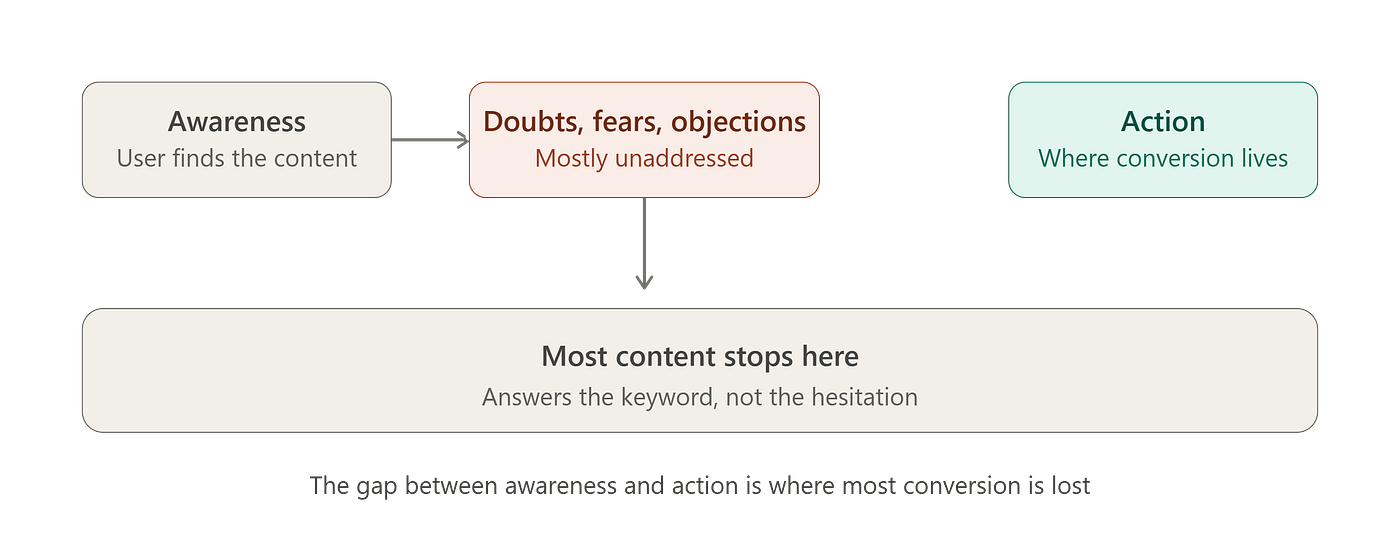
The reality is that content often acts as the bridge between awareness and action. Yet many organizations still treat content primarily as a publishing function rather than a decision-enablement function.
The Hidden Cost of Creating Great Content
Creating genuinely useful content is expensive. Not because writing is difficult. Because understanding is difficult.
Before a single word is written, teams often need to study competitors, identify content gaps, analyze customer conversations, understand user pain points, map search intent, define brand positioning, create content structures, review drafts, edit for clarity, maintain consistency, add internal pathways, and align with conversion goals.
The writing itself is often the smallest part of the process. The real value lies in the thinking that happens before and after the draft.
Early in my career at a hyperlocal listings business I’ll call CityFinder, we briefed a “writer” with everything: target keyword, word count, competitor links, internal linking plan. On paper, the brief was airtight. The piece still underperformed for months. It wasn’t until someone went back and read three weeks of customer support tickets that we found the real gap: users weren’t confused about what the service did, they were confused about who pays first in a local services transaction. No keyword tool surfaces that. No competitor audit surfaces that. Only listening to actual humans does.
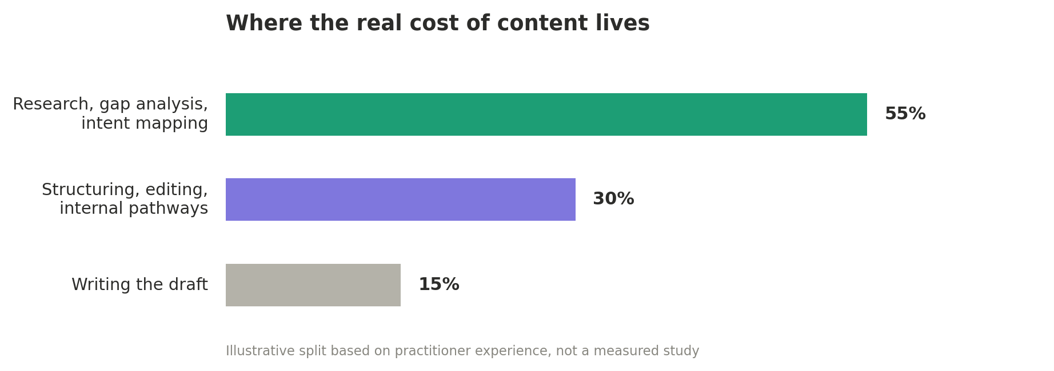
The challenge is that this thinking usually lives inside the heads of experienced strategists, researchers, editors, and content leaders. It doesn’t scale easily.
Why Most AI Content Discussions Miss the Point
The current conversation around AI tends to focus on writing. Can AI write articles? Can AI replace writers? Can AI generate content at scale?
These are the wrong questions. Writing has never been the bottleneck. Understanding has.
I tested this directly. I asked an AI tool to write a piece on “how to choose a student loan provider abroad.” What it produced was fluent, well-structured and technically accurate — interest rates, eligibility criteria, repayment terms, all correct. It just wasn’t useful, because it answered the keyword instead of the anxiety behind it. Real applicants weren’t comparing rate sheets. They were terrified of co-signing a loan their parents couldn’t afford if the visa got rejected. The AI answered the question that was typed. It missed the question that was meant.
The best content professionals don’t create value because they can write faster. They create value because they understand users better. They know which questions matter, which objections prevent action, where competitors fall short and how to connect a user’s problem with a brand’s solution.
The most valuable part of content creation isn’t typing words onto a page. It’s making sense of human behavior.
The Opportunity: AI as a Content Strategist’s Teammate
This is where AI becomes interesting. Not as a replacement for writers. Not as a replacement for strategists. Not as a replacement for editors. But as a system that can help replicate parts of their thinking process.
Imagine a system that can surface recurring user concerns, identify gaps in existing content ecosystems, analyze competitive blind spots, understand brand positioning, challenge weak arguments, suggest stronger narratives, maintain editorial consistency and connect content to business outcomes.
Here’s what that actually looks like in practice. At Globestep, we fed an AI system a year’s worth of anonymized support chat logs and review snippets. It surfaced something the content team had never written about: a recurring fear among applicants from certain regions about losing their deposit if their visa was delayed past the intake date. One strategist turned that single insight into a short, plainly written FAQ section addressing deposit protection. It wasn’t clever. It wasn’t keyword-rich. It addressed a fear no one had named out loud. That one section measurably reduced drop-off on the application page — because it removed the actual reason people were hesitating, not a guessed one.
Suddenly, AI is no longer functioning as a writer. It’s functioning as an assistant researcher, strategist, editor and critic. The role of human experts becomes even more important. They provide judgment, creativity, context, and the unique insights that no model can generate independently. AI simply helps scale the groundwork.
The Future Belongs to Teams That Understand Users Better
The organizations that win the next phase of content won’t necessarily publish the most. They won’t necessarily have the biggest content teams. And they won’t necessarily use the most advanced language models.
They will be the organizations that understand their users better than everyone else. Because understanding creates relevance. Relevance creates trust. Trust creates action. And action creates business results.
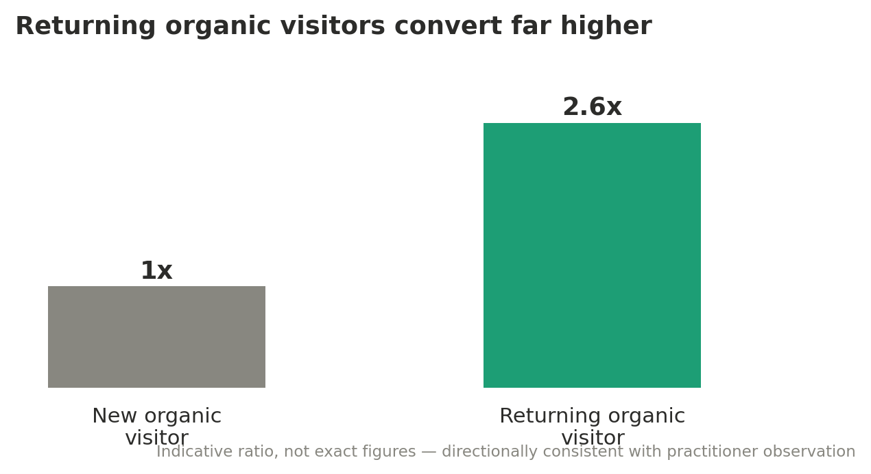
Here’s a number most content teams don’t track, but should: returning organic visitors convert at significantly higher rates than new ones. Not because they’re more “qualified” in some abstract sense, but because they’ve already had their early objections answered. The first visit builds understanding. The second visit converts on the back of it. Most SEO strategies are built entirely around acquiring that first visit and almost none are built around earning the second. If understanding is the real competitive advantage, retention is where you can actually measure whether you have it.
The future of content is not a battle between humans and AI. It is a collaboration between human judgment and machine-assisted understanding.
The winners will be the teams that use technology not to replace expertise, but to amplify it. Because in an era where everyone can generate content, understanding becomes the ultimate competitive advantage.
I’d love to know where you land on this. If you’ve seen a piece of content nail the “understanding” gap or AI completely whiff it, drop your thoughts at searchicas@gmail.com. The best ones might just become the next case study.
메타데이터
- post_id
- 2dab46697ce4
- slug
- the-next-content-revolution-wont-be-about-writing-it-will-be-about-understanding-2dab46697ce4
- url
- https://medium.com/mixed-marketing-technology/the-next-content-revolution-wont-be-about-writing-it-will-be-about-understanding-2dab46697ce4
- canonical_url
- https://medium.com/mixed-marketing-technology/the-next-content-revolution-wont-be-about-writing-it-will-be-about-understanding-2dab46697ce4
- author_url
- https://medium.com/@myinspiration
- status
- ok
- fetched_at
- 2026-06-21 07:44:09



