Same Inputs, Opposite Outcomes
Why AI compounds for some companies — and quietly backfires for others
Same Inputs, Opposite Outcomes
Why AI compounds for some companies — and quietly backfires for others
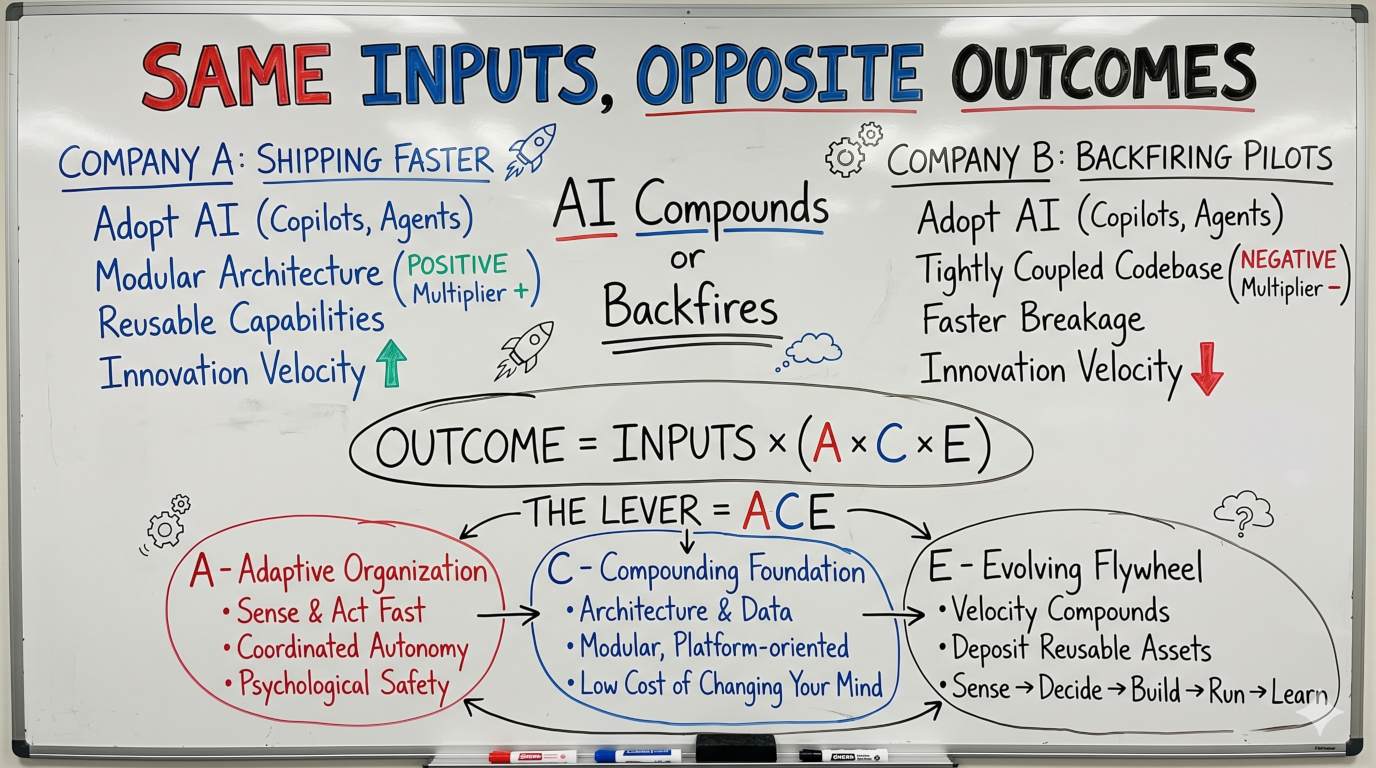
Two companies adopt the same technology in the same year.
Same cloud provider. Same shift to microservices. Same AI tooling — the coding assistants, the agent frameworks, the model APIs everyone is wiring up right now. Comparable talent. Comparable budgets.
Eighteen months later, one of them is shipping faster than it ever has. Each new capability makes the next one cheaper to build. AI has spread out of engineering into support, into sales, into the product itself.
The other has a drawer full of promising pilots, a cloud bill that keeps climbing, and a quiet suspicion that none of it has actually changed the pace of the business. The codebase is harder to reason about than it was two years ago. “AI” has become a word that makes the senior engineers tense up.
Same inputs. Opposite outcomes.
If you have spent any time inside technology transformations, you have seen both of these companies. You may have worked for both. The uncomfortable part is that from the outside, at the start, they looked nearly identical. Same strategy decks. Same vendor logos. Same ambition.
So what separates them?
The question underneath the architecture
Over the past months I have written three posts about what I call the North Star Architecture.
The first — *From Strategic Theater to a Scalable Growth Engine* — argued that architecture, not cloud adoption, determines innovation velocity, and laid out a five-layer model for building a platform where innovation compounds instead of crawling.
The second — The Five-Layer Architecture in the Age of Agentic AI — took that model into a world where the actors are no longer only human, and asked what holds and what bends when software starts initiating its own actions.
The third — *The Platform Isn’t the Product. The Operating Model Is.* — moved from the architecture to the people consuming it, and argued that a platform nobody adopts accelerates nothing.
Three angles. One spine.
But underneath all three, readers kept asking a version of the same question — and it is exactly the question the two companies above force into the open:
Why does the same architecture pay off for one organization and stall in another?
The five layers are identical on both whiteboards. The cloud is the same. Increasingly the AI is the same. The architecture explains what good looks like. It does not, on its own, explain why two organizations holding the same blueprint end up in different universes.
That answer lives one level down. Not in what you build — in the thing that decides whether what you build compounds.
Tools are not the lever
Here is the trap, and almost every transformation walks straight into it.
We treat the technology as the cause. “We adopted cloud.” “We’re an AI-first company now.” “We moved to Kubernetes.” Each one is framed as if the tool itself produces the result.
It doesn’t. The same tool produces wildly different results depending on what it gets multiplied by.
It helps to be almost crude about this and write it as an equation:
outcome = inputs × lever
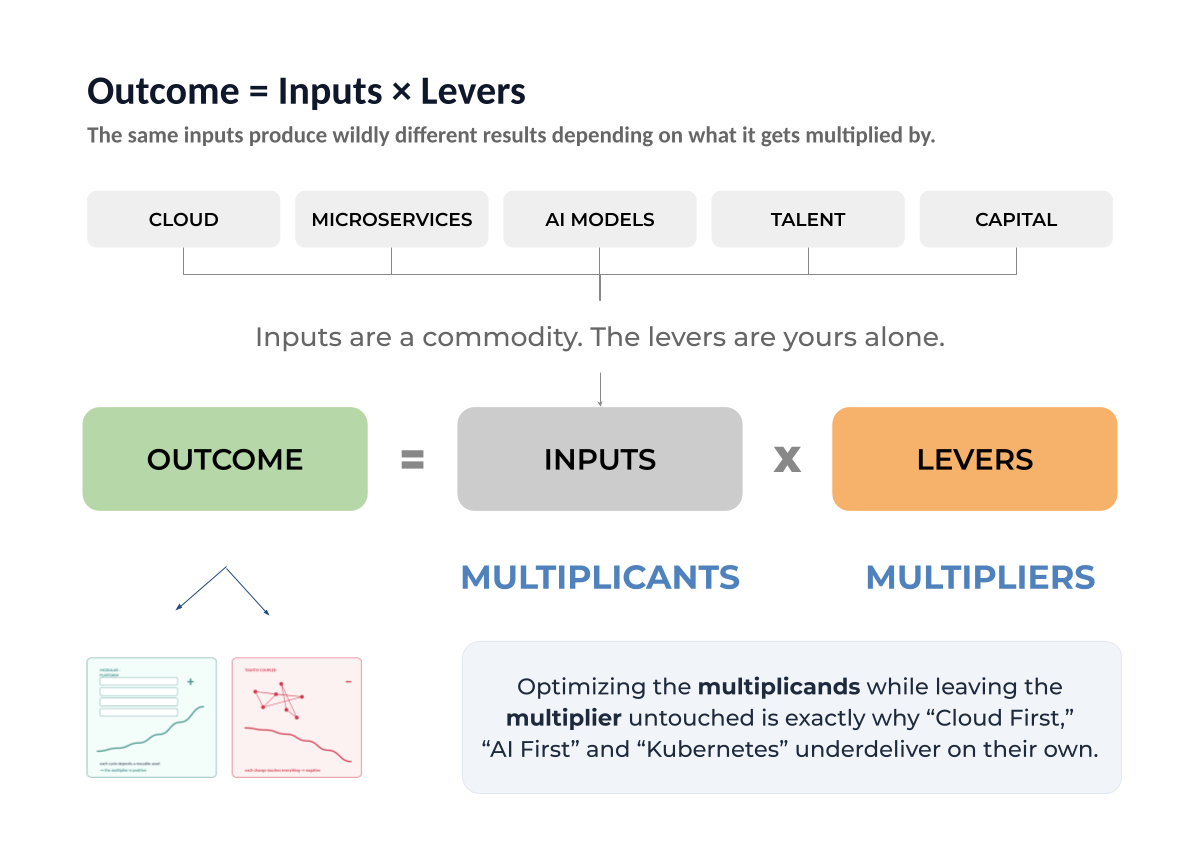
The inputs are the things every transformation buys: cloud, microservices, AI models, agent frameworks, talent, capital. In 2026 these are essentially a commodity. Your competitor can buy the identical stack by Friday. Inputs are necessary. They are never the differentiator, because everyone has them.
The lever is what each unit of input gets multiplied by inside your organization. It is the reason the same euro of AI spend compounds in one company and evaporates in another.
The mistake nearly everyone makes is to keep optimizing the inputs — buy more tools, adopt the newer model, add the shinier framework — while leaving the lever untouched. That is why “Cloud First,” “AI First,” and “Kubernetes” so reliably underdeliver on their own. They scale the part that was never the constraint.
So what is the lever actually made of?
In every engagement, when I strip it down, it comes apart into three drivers. I call them ACE.
A · C · E
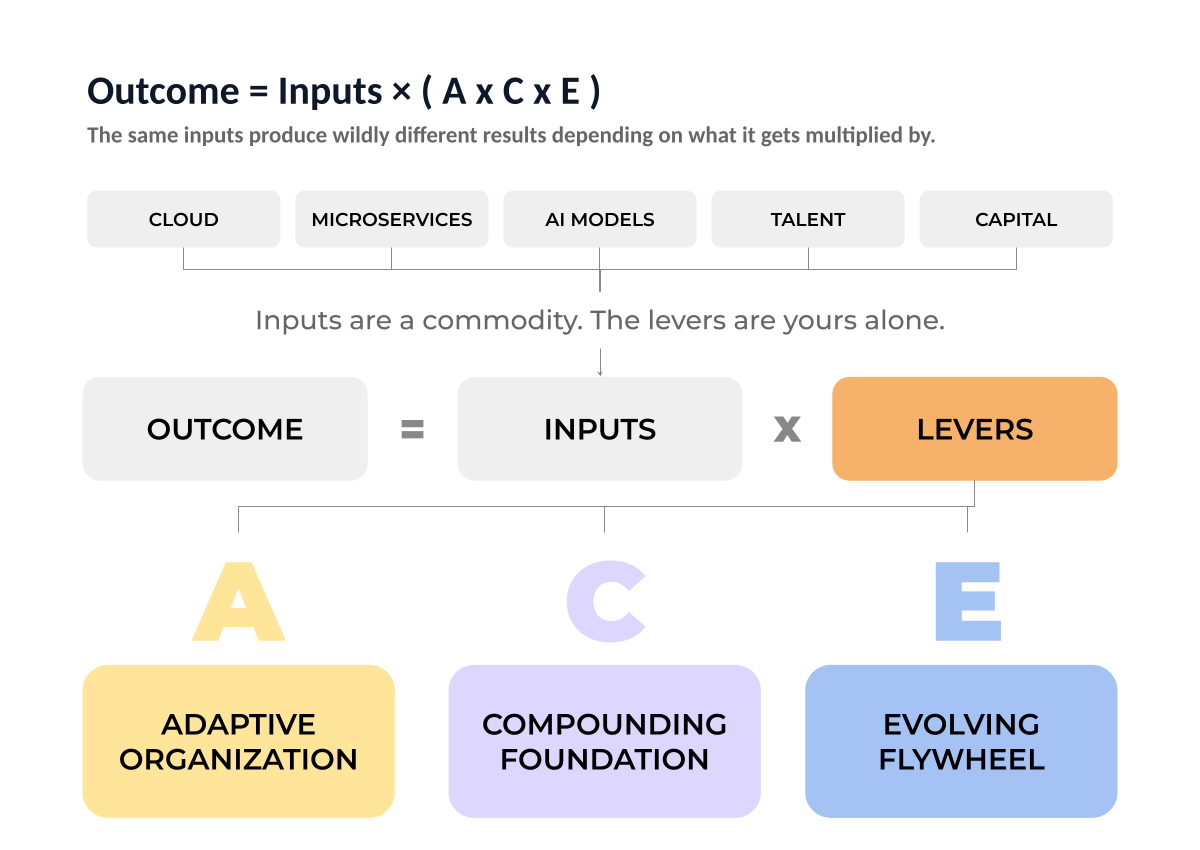
A — Adaptive Organization. The human system that senses and acts faster than the world around it changes.
C — Compounding Foundation. The technical substrate — architecture and data — that turns each cycle into a reusable asset instead of disposable work.
E — Evolving Flywheel. The motion: the loop that actually turns, and measurably improves, every time around.
Written back into the equation:
outcome = inputs × (A × C × E)
The order is deliberate. A is the container everything else runs in. C is the substrate it runs on. E is the motion the first two produce. Let me take them one at a time — and then explain why I multiply them instead of adding them, because that choice turns out to be the whole point.
A — Adaptive Organization
Org design beats the org chart — and the stack.
Most organizations are optimized for control, not adaptation. They are built on a quiet assumption inherited from a century of industrial management: that the people who decide and the people who do are different people, separated by six or seven layers of hierarchy.
Every one of those layers sits between a signal and a response. And every layer degrades the signal a little and slows the response a lot. By the time a customer truth that a frontline engineer saw on Monday reaches someone empowered to act on it, it is Thursday, it is third-hand, and it has lost the detail that made it matter.
An adaptive organization does the opposite. It pushes decisions to where the signal arrives. Coordinated autonomy — teams empowered at the edge, aligned by outcomes rather than instructions. Leadership that obsesses over the outcome and stays out of the method. Decisions made at the speed of signal, not the speed of the approval chain.
Two things make this work that are easy to dismiss as soft. Psychological safety is not a wellbeing nicety here — it is the precondition for experimentation, and experimentation is how the loop learns. A team that cannot afford to be wrong cannot learn fast. And cognitive load as a design constraint — you cannot hand a team more than it can hold and still expect it to move quickly.
I put A first because it is the ceiling on everything else. A brilliant architecture inside a six-layer approval hierarchy still moves at the speed of the hierarchy. The org is the container; nothing inside it moves faster than the container allows.
When A is weak, here is what AI does to you. It lands as faster shadow IT. Your teams generate more code, spin up more pilots, produce more divergence — and none of it reaches a decision any quicker than before. You have accelerated the doing and left the deciding exactly as slow as it was. The gap just fills up with more half-finished work.
C — Compounding Foundation
Architecture sets the sign. Tools only set the size.
This is where the architecture trilogy lives — and where one sentence does most of the work:
Architecture sets the sign of the multiplier.
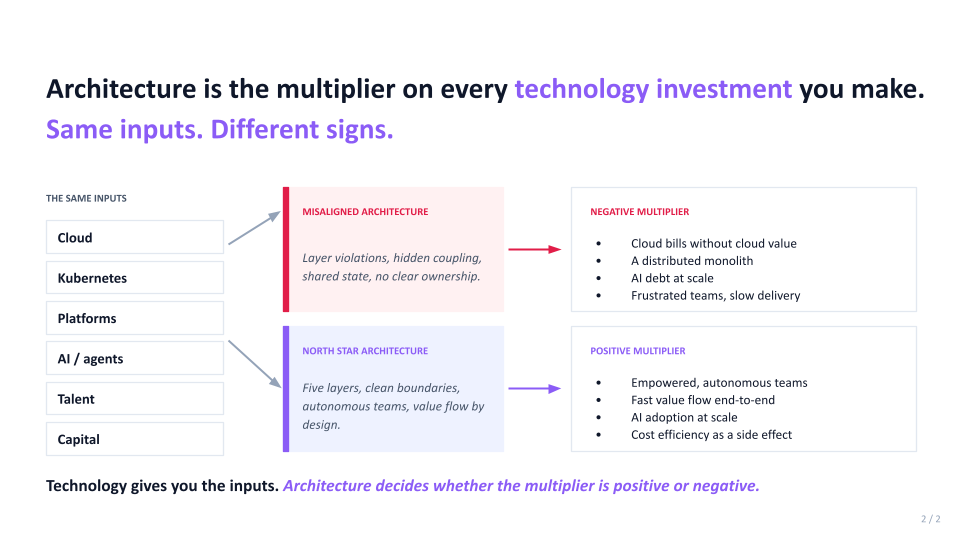
A modular, platform-oriented architecture makes the multiplier positive. Capabilities become reusable. Integrations become predictable. Data accumulates value across products. Every cycle deposits something the next cycle can build on — so each new feature is easier to ship than the last, and innovation compounds.
A tightly coupled architecture makes the multiplier negative. Every change touches everything. Every integration is bespoke. Adding more tooling to that system does not speed it up — it produces breakage faster. You can lift a monolith into the cloud, and you still have a monolith, now with a larger bill.
Sitting alongside the architecture is the data foundation. In the original post I argued that AI is not something you add later — it emerges once a strong data foundation already exists. In the agentic era the inverse bites harder: agents are only as good as the data beneath them. A weak foundation does not merely limit AI. It produces agents that confidently do the wrong thing.
The rest of C is the discipline that keeps the sign positive: reuse by default, usable by any actor — human or agent — that needs it; and guardrails and governance built in rather than bolted on. This, incidentally, is where trust actually lives. Trust is not a fourth driver floating above the model. The behavioural side of it lives in A, as psychological safety; the structural side lives here in C, as governance. Naming it separately just hides where the work has to happen.
All of C reduces to a single property: a low **cost of changing your mind**. A good foundation makes reversing a decision cheap. A bad one makes every decision a one-way door — and an organization that cannot afford to change its mind cannot afford to learn.
When C is weak, you get the negative-multiplier company: AI poured onto a coupled codebase, accelerating toward the wall. More tooling, faster mess.
E — Evolving Flywheel
Velocity compounds. Scale only adds.
A and C are potential. E is whether anything actually turns.
Every organization runs the same loop, whether it names it or not: Sense → Decide → Build → Run → Learn, and back to Sense. The only questions that matter are how fast and how cheaply it turns — and whether each turn leaves something behind.
That last part is what makes it a flywheel rather than a hamster wheel. Every turn should deposit a reusable asset: a capability, a dataset, and now, increasingly, intelligence itself. An agent that handles support learns which knowledge holds up. An agent that manages deployments learns which patterns precede incidents. Captured properly, that learning makes the next turn cheaper. The platform stops merely accumulating capabilities and starts accumulating intelligence — and intelligence, unlike infrastructure, compounds without an obvious ceiling.
You measure the whole thing with one number: innovation velocity — how fast an idea becomes customer value.
Two properties govern how the flywheel turns. It moves at the rate humans can metabolize change, not the rate the technology theoretically allows — which is the deep reason you cannot big-bang your way to any of this. And it widens: internal first, then product, then ecosystem. A use case that only ever serves the team that built it is a cost. One that generalizes to another team, then reaches the customer, then lets partners build on it, is an asset. So design every AI use case from day one so that someone else could reuse it.
There is an agentic twist worth stating plainly. When execution becomes cheap — and AI is making execution very cheap — the bottleneck does not disappear. It moves upstream, from execution to clarity. The constraint on the flywheel stops being “can we build it” and becomes “can we decide well and fast enough to keep it fed” — which lands you right back in A and C.
When E is weak, you get the company with a thousand pilots and zero platforms. Plenty of motion. No accumulation. Every initiative starts from scratch because nothing the last one produced was ever designed to be reused.
Why I multiply instead of add
The arithmetic is not decoration. The choice between adding and multiplying is the argument.
If these three drivers were additive, a weak one would only lower the total a little. You could compensate for a rigid organization with a beautiful architecture. In practice you cannot — and multiplication is why. A near-zero driver collapses the entire product, no matter how strong the other two. A world-class data platform inside an organization that takes four months to approve a decision produces exactly one thing: a world-class data platform nobody can act on fast enough to matter.
And then there is the sign. Architecture, through C, can make the multiplier negative — and a negative multiplier is the genuinely dangerous case, because it is invisible at year one and brutal at year three. More inputs make a negative multiplier worse, faster. This is the precise mechanism by which an AI investment backfires. You did not fail to adopt AI. You successfully amplified a system that was already subtracting value.
That reframes the entire job. The work was never to maximize the multiplicands. It is to get the multiplier above one — and ideally well above one — before you pour inputs into it.
This is the engine the trilogy was missing
Step back and the three earlier posts rearrange themselves.
The architecture posts were really about C — how to make the multiplier’s sign positive and keep it there.
The agentic post was about what happens to C and E when the actors change. Agents do not alter the lever. They multiply it. Which is exactly why agentic AI is so unforgiving: it amplifies whatever your ACE already is. A high multiplier, and agents compound it. A low or negative one, and agents accelerate the damage with remarkable efficiency.
The operating-model post was really about A — meeting teams where they actually are, so the organization can adopt and adapt instead of resisting.
ACE is the connective tissue between all three. It is the answer to the question the trilogy kept provoking but never quite named: why the same five layers compound in one company and gather dust in another.
How to read your own multiplier
You do not need a maturity model for this. You need three honest questions, one per driver, and the willingness to dislike the answers.
A. How many layers sit between the person who first sees a signal and the person empowered to act on it? Where does work get redone because it was aligned too late?
C. When you change your mind about a decision made six months ago, is that cheap or catastrophic? And could an agent safely reason over your data foundation today — or would it confidently invent the parts that are missing?
E. Name your last three AI initiatives. How many produced something a second team actually reused? If the answer is zero, you have motion without a flywheel.
The point of the questions is not a score. It is to find which driver is closest to zero — because that is the one capping everything else, and in my experience it is almost never the one the budget is currently pointed at.
The North Star, one level down
The North Star Architecture told you where to go. ACE explains why some organizations get there and some don’t, holding the very same map.
The temptation, always, is to buy another input. A newer model, a bigger platform, one more framework. It feels like progress because it is visible and it is purchasable.
But you cannot buy your way across a sub-one multiplier. You can only redesign it.
So stop optimizing the multiplicands. Fix the multiplier.
That is the difference between the two companies I opened with. Not the tools.
It was never really the tools.
This is the fourth piece in the North Star series. The first three — the five-layer north star architecture, its agentic extension, and the operating model beneath it — describe what to build and who owns it. This one is about the lever that decides whether any of it compounds. A later piece will put the full picture together as a single operating system.
메타데이터
- post_id
- 2db05dfd908f
- slug
- same-inputs-opposite-outcomes-2db05dfd908f
- url
- https://medium.com/@dirkherrma/same-inputs-opposite-outcomes-2db05dfd908f
- canonical_url
- https://medium.com/@dirkherrma/same-inputs-opposite-outcomes-2db05dfd908f
- author_url
- https://medium.com/@dirkherrma
- status
- ok
- fetched_at
- 2026-07-30 06:41:52




