The Last Year Hollywood Believed in Cinema
Twenty-five years ago, as a freshly landed immigrant, I made weekly pilgrimages to local multiplexes. Little did I know I was living…
The Last Year Hollywood Believed in Cinema
Twenty-five years ago, as a freshly landed immigrant, I made weekly pilgrimages to local multiplexes. Little did I know I was living through the final golden age of American cinema. 1999 was the singularity year — Hollywood at its creative and commercial peak, blissfully unaware that the downhill slide was about to begin. Back then, movies could still surprise, provoke, and haunt you for weeks. And we, the audience, still knew how to appreciate that.
That year delivered a lineup that still defines what we think of as “great cinema.” *The Matrix flipped not just sci-fi but reality itself. [Fight Club](https://www.imdb.com/title/tt0137523/) became a generational manifesto for the disillusioned. [American Beauty](https://www.imdb.com/title/tt0169547/) dissected suburban ideals with surgical precision. [Office Space](https://www.imdb.com/title/tt0151804/) mocked corporate culture a decade before it became universally loathed. [The Green Mile](https://www.imdb.com/title/tt0120689/) made even cynics cry. And Kubrick’s [Eyes Wide Shut](https://www.imdb.com/title/tt0120663/)* served as both his swan song and the final masterpiece of auteur cinema.
And that was just the tip of the iceberg. Shyamalan’s *The Sixth Sense taught us to rewatch everything for hidden clues. [The Blair Witch Project](https://www.imdb.com/title/tt0185937/) invented found footage and viral marketing in one go. [Austin Powers: The Spy Who Shagged Me](https://www.imdb.com/title/tt0145660/) cheerfully buried serious spy dramas. [The Mummy](https://www.imdb.com/title/tt0120616/) proved blockbusters could be fun without pretensions. [Star Wars: The Phantom Menace](https://www.imdb.com/title/tt0120915/) disappointed fans but launched the CGI era. [Being John Malkovich](https://www.imdb.com/title/tt0120601/) made surrealism mainstream. [Magnolia](https://www.imdb.com/title/tt0175880/)* lasted three hours and dared you to leave.
There was more: *Three Kings with Clooney, [Analyze This](https://www.imdb.com/title/tt0122933/) with De Niro in a comedy, [Wild Wild West](https://www.imdb.com/title/tt0120891/) with Will Smith as a cowboy-rapper, another Bond film [The World Is Not Enough](https://www.imdb.com/title/tt0143145/). [Toy Story 2](https://www.imdb.com/title/tt0120363/) matured animation. [American Pie](https://www.imdb.com/title/tt0163651/) cemented teen comedy. Burton’s gothic [Sleepy Hollow](https://www.imdb.com/title/tt0162661/) decapitated with flair. [The Talented Mr. Ripley](https://www.imdb.com/title/tt0134119/) gave us a charming sociopath. [Run Lola Run](https://www.imdb.com/title/tt0130827/) brought German experimentalism to the mainstream. Kevin Smith’s [Dogma](https://www.imdb.com/title/tt0120655/) got banned by the Catholic Church (which obviously helped ticket sales). [Cruel Intentions](https://www.imdb.com/title/tt0139134/) showed that teens could be just as twisted as adults. [10 Things I Hate About You](https://www.imdb.com/title/tt0147800/)* gave us a romcom with Shakespeare and Heath Ledger. Every month delivered something bold, bizarre, or brilliant.
It’s ironic that 1999 was also the year Netflix was founded — as a humble DVD-by-mail service. No one guessed this modest Californian startup would one day help kill not just movie theaters, but the entire culture of shared cinematic experience. Even the word “spoiler” got its modern meaning then, as internet forums turned film discussion into bloodsport. Before that, spoiling a plot was just rude, not a crime against art.
After each movie, we’d argue like philosophers. The Matrix triggered metaphysical debates. Fight Club spurred talk about masculinity in crisis. American Beauty made us question the American Dream. Cheap wine flowed. Ideas multiplied. Back then, cinema felt like an art form that could still change the world. And maybe it could. Films sparked week-long debates that leapt from theater to café to apartment to dial-up bulletin boards.
If we try to pinpoint when things went south, a few milestones stand out. First, the tech revolution. In The Matrix, CGI served the story; soon, it became the story. Directors fell in love with effects and forgot content. Second, commercialism hit critical mass. Studios started trusting focus groups and marketing analytics over artistic instinct. Every movie became a franchise starter or a cinematic universe segment. Third, streaming changed everything. Films stopped being events. They became background noise. We shifted from a culture of experience to a culture of consumption.
The 2000s gave us X-Men, Harry Potter, The Lord of the Rings. Great films, sure. But they built the foundation for today’s franchise mania. Hollywood learned how to spin one hit into twenty spin-offs. The Marvel Cinematic Universe became the ultimate industrial entertainment complex. In 1999, a blockbuster cost around $55M. Today: over $200M. And no, inflation didn’t quadruple. Most of that money goes to marketing, stars, and endless reshoots.
The auteur — once cinema’s soul — is now a relic. Kubrick, Scorsese, Coppola, Fincher… their time is over. Movies today are committee-built, algorithm-approved, producer-managed. Even when a talented director gets funding, they work under strict corporate guidelines. Vision gives way to compliance. In 1999, Fight Club could punch society in the face without HR repercussions. Today, every line of dialogue gets screened for ideological allergens.
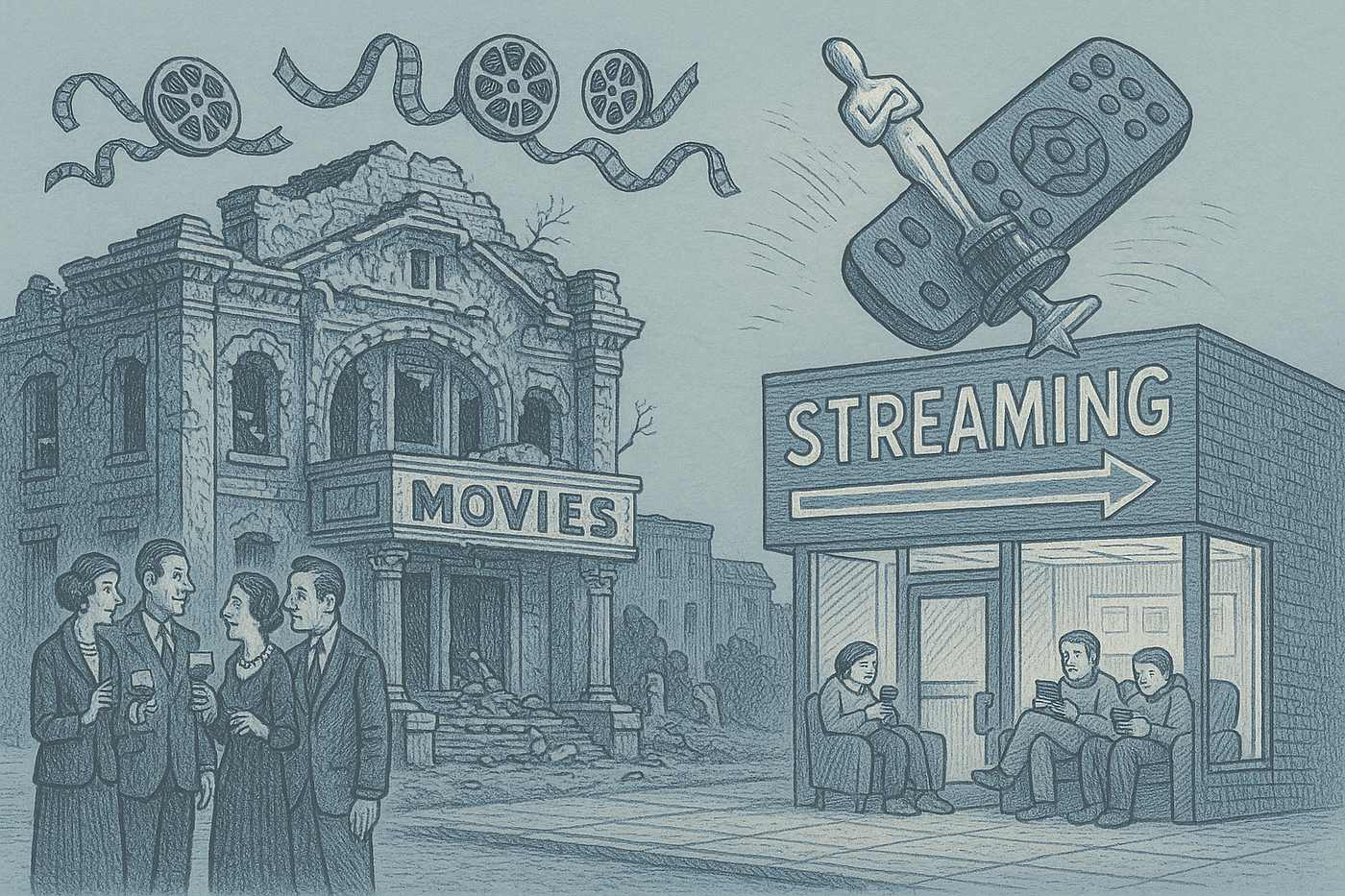
This isn’t nostalgia for a perfect past. But back then, artists had room to provoke, to experiment. Now, one stray word can end a career. The irony? The push for inclusivity led to homogenization. Everything’s safe, sanitized, eerily identical. Streaming services didn’t just kill theaters (COVID finished that job). They killed the shared experience of cinema itself. We used to watch the same movies and argue about them. Now each of us gets algorithmically personalized snack-sized content. Cultural reference points are vanishing. The cinema used to be a temple. Streaming turned it into a drive-thru.
1999 was the last year cinema still believed in big ideas. Postmodernism was still playful, not yet devoured by its own irony. Today, every film is an ironic take on another ironic take. Meta-on-meta, until sincerity vanishes completely. Is there hope? Indie films still produce masterpieces — but the audience is niche. Arthouse theaters cling to life. The mainstream prefers the cozy glow of formula.
Maybe the problem isn’t with cinema. Maybe it’s with us. We’ve forgotten how to be grateful viewers. We want amusement, not revelation.
Or maybe 1999 was a statistical fluke — one miraculous collision of talent, timing, and culture. Time will tell. Until then, we can still do what no algorithm has banned (yet): invite an old friend over, pour some decent wine, and pop The Matrix or Fight Club into a dusty DVD player. Because some movies don’t age — they deepen. And as long as we can still feel that thrill before the lights dim, still sit through two hours without checking our phone, still argue until dawn about what it all meant — then the spirit of that golden age isn’t quite dead yet.
Generated with the help of a glorified spoiler machine.
메타데이터
- post_id
- 2dbce4d5cda4
- slug
- the-last-year-hollywood-believed-in-cinema-2dbce4d5cda4
- url
- https://medium.com/@cyberecoder/the-last-year-hollywood-believed-in-cinema-2dbce4d5cda4
- canonical_url
- https://medium.com/@cyberecoder/the-last-year-hollywood-believed-in-cinema-2dbce4d5cda4
- author_url
- https://medium.com/@cyberecoder
- status
- ok
- fetched_at
- 2026-06-14 11:28:49