Every Eye Tells a Story: Saga 5 — From Reality to Reels: The REELS Syndrome Taking Over a…
There was once a time I woke up to a beautiful seaside view and wanted to just take in the sight of the sea meeting the sky at the horizon…
Every Eye Tells a Story: Saga 5 — From Reality to Reels: The REELS Syndrome Taking Over a Generation
There was once a time I woke up to a beautiful seaside view and wanted to just take in the sight of the sea meeting the sky at the horizon, and lose myself gasping in the beauty of it!

Today I see kids waking up to that sight outside, looking for their phones beside, scrolling, Instagramming, chasing the perfect photograph, and crafting the perfect reel.
The importance has shifted from the perfect moment to capturing the perfect reel to get the maximum views.
We live in an age where children can identify influencers more easily than constellations, spend hours looking at a screen six inches away, yet rarely look at the horizon a kilometre away.
Our screens are capturing our attention while quietly shortening our attention span. In an age where elections can be influenced by thirty-second clips and governments can rise or fall on viral narratives, reels have become far more than entertainment. They deliver sharp spikes of dopamine, slowly replacing history with headlines and reality with algorithms.

AI GENERATED
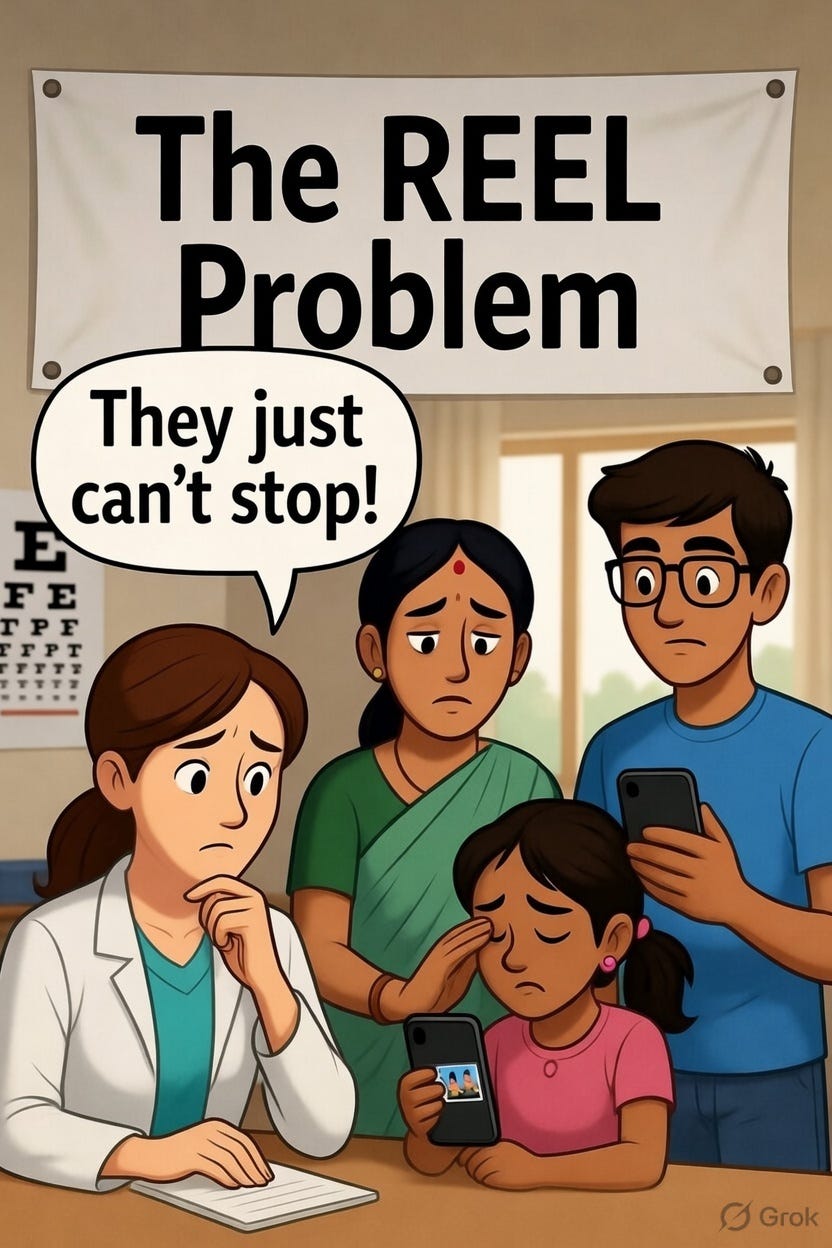
As I was reflecting on this new world order, the door of my clinic swung open. In walked seven-year-old Latika and her fifteen-year-old brother Abhinav with their mother—two children separated by eight years of age, yet united by the same modern affliction.
The REEL Problem
AI GENERATED
As I sat across from them, little Latika clutched her mother’s phone with the devotion previous generations reserved for teddy bears. Her thumbs continued swiping with a muscle memory that would have impressed a professional pianist. Abhinav, meanwhile, kept peeking at his own screen every few seconds, as though some national emergency might unfold in the thirty seconds he spent talking to me.
I understood what their complaints would be even before their mother could begin explaining.
But I let the mother get her anxiety out. “Ma’am, Latika keeps rubbing her eyes and Abhinav’s glass power has been increasing. I get worried and tell them to keep the phones away for a while but they just seem consumed by it. By the end of the day both of them complain that their eyes burn and it becomes red and starts watering quite often.” I nodded. This was a story I had begun hearing far too often. The Reel Problem wasn’t just about time wasted. It was about identity forged in algorithms, self-worth measured in hearts, and reality edited into 15-second fragments. I turned to the children. “What if,” I asked gently, “we tried one day without reels? Just one sunrise you watch with your own eyes instead of through a lens?” Abhinav looked skeptical. Latika whispered, “But then how will people know it happened?” I knew that question would stay with me long after they left. Somewhere between preserving memories and broadcasting them, an entire generation seemed to have forgotten that some moments are meant to be lived before they are shared.
I smiled, while I realised, this wasn’t going to be an easy conversation….
The problem wasn't the phones.
It never is.
The problem was our relationship with them.
Somewhere along the way, screens had stopped being tools and had become companions. Reels had stopped being entertainment and had become a way of experiencing life itself.
Busting the Myths
I looked towards Abhinav and asked, “Why is it so important? To stay relevant with your peers?”
He nodded immediately. “Of course. Else it gives me FOMO—Fear of Missing Out—and anxiety.”
“Of course,” I replied with a smirk. “Does the anxiety go away when your eyes burn, water, and beg for some mercy from you to give them a little rest?”
“Is something wrong with my eyes?” Abhinav asked, suddenly concerned.
At that moment, I knew I had his attention.
“Not yet,” I replied calmly. “But if you keep exploiting your eyes, they will eventually punish you back.”
I leaned forward slightly.
“Our eyes are designed to function in a very particular way. Every time we blink, a fresh layer of tears spreads across the surface of the eye, lubricating it, nourishing it, and keeping it comfortable.”
“But when you're glued to reels, games, or endless scrolling, your blink rate drops dramatically. Instead of blinking 10–15 times a minute, many people blink less than half as often—and many of those blinks are incomplete.”
Abhinav had stopped looking at his phone.
“When that happens, your tear film begins to evaporate faster than it can be replenished. The surface of the eye dries out, and that's when the burning, grittiness, redness, and irritation begin.”
“But then I end up blinking more… and the burning doesn't stop even if I wash my eyes,” he interrupted anxiously.
I smiled again.
“That is actually one of the most common misconceptions.”
“Washing your eyes may feel good temporarily, but it doesn't truly lubricate them. In fact, frequent washing can further disturb the delicate tear film that protects the surface of your eye.”
“Your eyes are smarter than you think. When they begin to dry out, they try to compensate. They make you blink more. They produce more tears. They do everything they can to maintain comfort and reduce friction.”
“That's why your eyes water even when they're dry.”
Abhinav looked puzzled.
“The irony is that watering is often a sign of dryness. Your tear glands go into overdrive trying to compensate for excessive evaporation. Unfortunately, these tears don't solve the underlying problem.”
I paused briefly.
“These are the early warning signals that our eyes communicate to us.”
“The trouble begins when we choose to ignore them.”
I could see both children hanging on to every word.
Then I turned towards Latika.
She looked up at me innocently and asked, “So will I also get glasses like anna?” ( brother in Tamil)
I held her tiny hands and smiled.
“Not necessarily.”
“But if you spend more time outdoors, play more, and give your eyes regular breaks from screens, you'll be giving them the best chance to stay healthy.”
Her face immediately brightened.
I smiled and asked, “So will you go to bed tonight without asking your mother for the phone?”
She nodded enthusiastically.
I high-fived her.
Then I turned back towards Abhinav, who still looked worried.
“Doctor, will scrolling also increase my glass power?”
“Dry eyes are only the beginning,” I replied gently.
“Excessive near work contributes to the elongation of the eyeball. That's one of the reasons we're seeing a sharp rise in myopia among children and teenagers today.”
“Hours of screens, reduced outdoor activity, and prolonged near focus are changing the way an entire generation's eyes develop.”
“But remember, Abhinav, reels are designed to capture one thing—your attention.”
“The longer you stay, the more valuable you become to the platform.”
“They are not interested in your eye health, your sleep, your creativity, or your peace of mind.”
“A healthier lifestyle, more outdoor time, better sleep, and mindful screen use won't just help your eyes. They'll help you think more clearly, reduce anxiety, and build confidence that doesn't depend on likes, views, or followers.”
I paused before adding,
“The most successful people I know don't spend all day consuming content. They spend their time creating, learning, building, and experiencing life. Social media is a tool for them—not a place they live in.”
“And the effects aren't limited to the eyes.”
“Reels are designed to reward short bursts of attention. Over time, many children find it harder to sit through a chapter of a book, a classroom lesson, or even a conversation without reaching for a screen.”
“The eyes suffer first—but they are rarely the only thing affected.”
Abhinav nodded slowly.
The fidgety, slightly smug teenager who had walked into my clinic seemed quieter now, lost in thought.
For the first time since he had entered, his attention wasn't on a screen.
It was on himself.
And somehow, that little victory made me smile.
The Remedy and Remission
The mother looked relieved, but still uncertain.
"So what do we do, Doctor?" she asked. "I can't completely stop them from using screens. School itself happens on tablets sometimes."
I nodded.
That was the reality of the world we lived in. This wasn't about banning technology. It was about teaching balance before screens became the centre of childhood.
1. Treat the Dryness First
"The immediate problem is digital eye strain and dry eyes," I explained.
"I'll prescribe lubricating eye drops for both of them. These help restore the tear film and reduce the burning, irritation, and watering."
I turned towards the children.
"And don't underestimate cold compresses. They are not just grandmother's remedies. They soothe the eye surface and provide tremendous relief after prolonged screen use."
2. Follow the 20-20-20 Rule
Then I looked directly at Abhinav.
"If screens are unavoidable for studies, follow one simple rule."
"The 20-20-20 Rule."
"Every 20 minutes, look at something 20 feet away for at least 20 seconds."
"Our eyes were never designed to stare continuously at something six inches away for hours. They need breaks just like the rest of us."

AI GENERATED
3. Blink. Then Blink Again.
I demonstrated a slow blink.
Both children laughed.
"No, seriously," I said.
"When we're watching reels, gaming, or scrolling, our blink rate drops dramatically. Make a conscious effort to blink fully and frequently."
"A proper blink is nature's way of refreshing your eyes."
4. Outdoor Time Is Medicine
This was the point I wanted them to remember.
"Outdoor activity isn't a luxury anymore. It's medicine."
I pointed towards the window.
"Natural light, distance viewing, running around, cycling, playing games, watching birds, trees, clouds and sunsets—these are all part of how a child's eyes are meant to function."
"We now know that children who spend more time outdoors have a lower risk of worsening myopia."
I turned towards Latika.
"Your eyes were designed to look at horizons, not just notifications."
She smiled.

AI GENERATED
5. Create Healthy Screen Boundaries
Then I addressed their mother.
"You don't have to fight a war against phones. Most parents lose that battle."
Instead, create boundaries.
• No phones during meals.
• No screens one hour before bedtime.
• Encourage hobbies that don't involve screens.
• Schedule outdoor play as seriously as tuition classes.
• Keep phones away during family conversations.
"Children don't learn from instructions. They learn from examples."
The mother smiled sheepishly.
She knew exactly what I meant.

AI GENERATED
6. Protect Their Sleep
"And finally, protect their sleep."
"Late-night scrolling doesn't just strain the eyes."
"It affects the brain."
"The endless stimulation and bright screens delay sleep, reduce sleep quality, and make concentration harder the next day."
"Poor sleep worsens eye strain, headaches, irritability, anxiety, and even academic performance."
"It's another vicious cycle."
Then I leaned back and delivered the most important message of all.
"I don't want them to fear technology."
"I want them to learn balance."
"Watch a reel. Then watch a sunset."
"Play a game. Then play outside."
"Capture a memory if you want."
I looked towards Latika.
"But don't forget to live it first."
For the first time that afternoon, nobody reached for a phone.
As I watched the three of them leave my clinic, chatting and smiling without screens in hand, I couldn’t help but smile too. In that small moment, it felt like the beginning of recovery — not just for their eyes, but for the way they would learn to see the world again.
Every eye truly does tell a story. Sometimes, the most powerful ones are the ones that finally look up from the screen.
It’s always a beautiful day to save more eyes 👁️🗨️👁️🗨️👁️🗨️👁️🗨️👁️🗨️
And in this case even preserve the function of more frontal lobes 😌😉
With this I conclude Saga 5, Stay tuned for my blogs on medium and https://ko-fi.com/eyedocpriya.
Saga 6 coming up soon…..
메타데이터
- post_id
- 2dbe0ef3c46e
- slug
- every-eye-tells-a-story-saga-5-from-reality-to-reels-the-reels-syndrome-taking-over-a-2dbe0ef3c46e
- url
- https://medium.com/@harrysfan/every-eye-tells-a-story-saga-5-from-reality-to-reels-the-reels-syndrome-taking-over-a-2dbe0ef3c46e
- canonical_url
- https://medium.com/@harrysfan/every-eye-tells-a-story-saga-5-from-reality-to-reels-the-reels-syndrome-taking-over-a-2dbe0ef3c46e
- author_url
- https://medium.com/@harrysfan
- status
- ok
- fetched_at
- 2026-06-27 10:07:59




