The Five Purposes of AI in Public Services
From transactions to relationships — and why the fifth purpose matters most
The Five Purposes of AI in Public Services
From transactions to relationships — and why the fifth purpose matters most
Most conversations about AI in government fixate on transactions: faster forms, quicker decisions, fewer calls. If we let IT vendors set the agenda, that’s where most investment will go — turning public services into ever more transactional, machine-like operations.
But AI can do far more than optimise workflows. Used well, it can also support relational work: the human conversations, judgments and trust that sit at the heart of social care, health, housing, education and policing.
Right now, though, AI activity in many organisations feels fragmented: a scattergun mix of pilots, proofs of concept and disconnected experiments. Even when many AI projects are cheap, they still burn through the real scarce resources of transformation; staff time, leadership attention and trust.
So how can public service leaders stay in control, making sure AI adoption is coherent, ethical, integrated with wider service reform, and focused on better outcomes and real savings?
It starts with being clear about what you are using AI for.
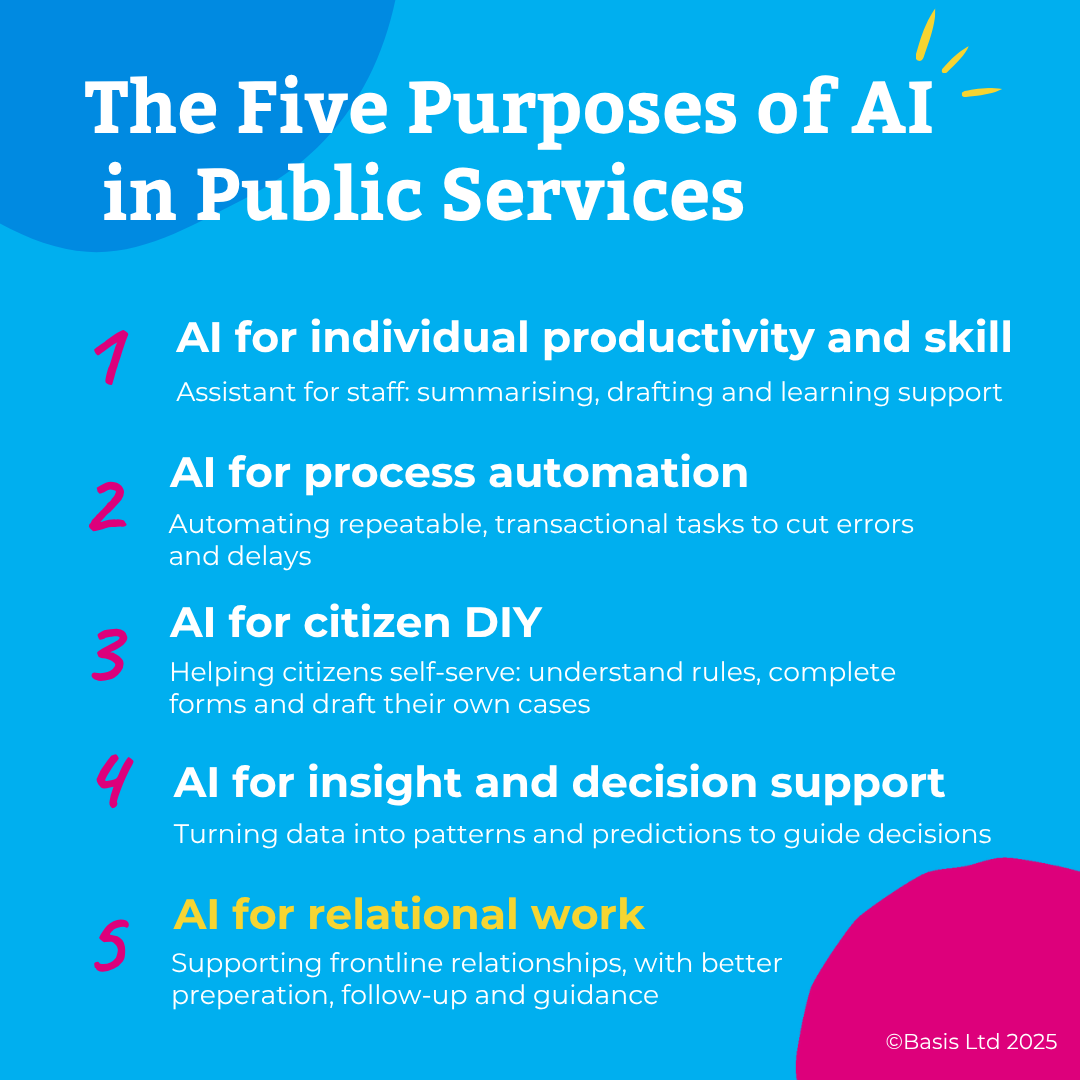
In our work, we see five distinct purposes for AI in public services. Many vendors will naturally gravitate to the more transactional ones. If public service leaders aren’t deliberate, the fifth purpose — AI that actively supports relational work — is the one that risks being forgotten.
A shifting landscape
The ground has moved. Generative AI platforms are evolving so fast that the traditional advantage of software vendors — proprietary code and deep technical skill — is disappearing. Anyone can now build an application on top of a large language model.
What matters now isn’t who can code faster, but who can apply AI more intelligently. And that advantage sits inside the public sector: the people who understand services, pain points and the moments that matter to residents.
Yet many IT providers are flooding into councils with “AI expertise”, selling solutions in search of problems — often with a narrow focus on transactional use cases. Public service leaders, by contrast, increasingly see AI as a way to create more space and time for relational work and, in some cases, to support that work directly.
Being clear which of the five purposes you are pursuing changes everything: how you design and develop AI, where it fits in your service and organisational transformation, and how it ultimately benefits both the organisation and citizens.
In the good examples that follow, the technology is chosen because it fits the problem and purpose — not the other way round. Some are built on large language models; others use machine vision, speech recognition or structured prediction.
Starting with the problem and the purpose helps avoid jumping to a shiny solution that doesn’t match the work, however impressive the demo might look.
Five Purposes — and good examples
1️⃣ AI for individual productivity and skills
AI can act as an assitant for professionals - summarising meetings, drafting emails, or preparing reports. When used well, it reduces burnout, frees time, and strengthens human contact.
- Barnsley Council rolled out Microsoft Copilot to over 2,000 staff, backed by a “Flight Crew” of internal champions. Social workers report hours saved each week — time redirected back to families, not forms.
- Peterborough City Council captured the expertise of a veteran occupational therapist by training a bespoke chatbot, Hey Geraldine, to answer colleagues’ questions in her style. In six weeks, it handled 1,200 conversations, saving 300 staff hours.
- Ealing Council’s use of Magic Notes in adult social care automated visit write-ups, freeing 44 % of staff time and cutting assessment waits dramatically.
Each example shows technology augmenting - not replacing- human expertise.
2️⃣ AI for process automation (transactional services)
The classic space for automation: transactional, repeatable, rule-based work. The goal is to make everyday services simpler, faster and with less errors thereby reducing the failure demand.
- Westminster City Council’s “Report It” assistant uses image recognition to classify fly-tipping, graffiti or noise reports. It correctly categorises 86 % of cases and halves the time to submit a report.
- Swindon’s “Simply Readable” tool turns standard text into Easy Read formats using generative AI — reducing production costs from £600 to pennies per document and completion times from weeks to minutes.
Automation done right means fewer forms, fewer errors, and faster help for residents.
3️⃣ AI for insight and decision support
Public organisations hold immense amounts of untapped data. AI can uncover patterns, risks and relationships that help people make better judgments.
- North Yorkshire Council built an AI insight engine that reads years of case data and visualises a child’s support network — enabling social workers to see hidden connections and intervene earlier.
- Kent County Council, working with Maidstone, developed predictive analytics to identify residents at risk of homelessness. The model is 84 % accurate, allowing officers to step in proactively; homes receiving early contact were almost 100 times less likely to become homeless.
Here, AI is not about efficiency, but effectiveness — allowing more data driven decisions.
4️⃣ AI for citizen DIY
AI can also help citizens directly, offering more tailored support than a standard website. Chatbots are a classic example: they can cut call volumes, help people understand rules and complete forms, and support them to make their own case.
- Royal Borough of Kensington and Chelsea and others use an AI “parking expert” that chats with motorists in 40+ languages, 24/7. It explains parking rules and evidence requirements and, where someone meets cancellation criteria, helps draft a challenge letter — particularly useful for people with low literacy or mental health difficulties.
- Housing Helper, an AI chatbot developed with the Centre for Homelessness Impact and now being trialled by Southwark Council, gives instant housing advice in over 100 languages. It asks about someone’s situation, signposts trusted information, and can draft letters to landlords or councils so tenants can assert their rights earlier.
5️⃣ AI for relational work
Perhaps the most exciting — and least discussed — frontier. AI can help frontline workers strengthen relationships with citizens, not weaken them.
- Citizens Advice faced surging demand as cost-of-living pressures grew. Their AI assistant Caddy helps advisers draft accurate, plain-English advice using verified sources, reviewed by supervisors before use. The result? Advice delivered twice as fast, with advisers twice as likely to feel confident in their answers. It’s AI in the background — enabling more human, empathetic conversations on the frontline.
Relational work is where trust is built and where many of the hardest public-service problems live. AI should protect and amplify that work, not crowd it out.
Public services hold the power
Every major wave of technology, from the web to blockchain, has begun with a rush of vendors and a fog of possibility. AI is no different. What is different is where the real value sits. It won’t come from inventing the next algorithm, but from translating potential into practice through iterative, co-designed projects rooted in the realities of frontline work.
The public sector doesn’t need to chase every shiny AI demo. It needs to curate, test and learn — staying agnostic about tools but very clear about purpose.
Each AI initiative should sit inside a wider programme of service and organisational transformation, not off to the side as an experiment.
When leaders are explicit about which of the five purposes they’re pursuing, it becomes much easier to decide what to invest in, what to stop, and what to scale. And to keep relational work at the centre, not as an afterthought.
If councils and public bodies harness AI with the same creativity, care and public purpose they bring to everything else, the next generation of services won’t just be more efficient or more digital.
They’ll be more human — for the people who rely on them, and for the people who deliver them.
🧭 About the authors
Megan Davies works with public sector teams to explore problems, test improvements and bring people with them through change. She focuses on social impact, innovation and technology, drawing on experience in startups, team learning and applied problem solving.
Aaron Teater is passionate about designing systems and services that improve people’s lives. With a combination of firsthand experience and training in public sector innovation, he loves working with teams to turn theory into action.
Dennis Vergne works across the UK public sector helping organisations design practical, human-centred transformations. He writes about the intersection of transformation, relational service design, and change management in modern government.
© Basis Ltd, 2025
#AIinGovernment #DigitalTransformation #PublicSectorInnovation #relationalworking #relationalservicedesign #LocalGovernment #EthicalAI
메타데이터
- post_id
- 2dbf0f50fedb
- slug
- the-five-purposes-of-ai-in-public-services-2dbf0f50fedb
- url
- https://medium.com/@dennis_vergne/the-five-purposes-of-ai-in-public-services-2dbf0f50fedb
- canonical_url
- https://medium.com/@dennis_vergne/the-five-purposes-of-ai-in-public-services-2dbf0f50fedb
- author_url
- https://medium.com/@dennis_vergne
- status
- ok
- fetched_at
- 2026-07-27 13:21:04