Complete Guide to Form I-140: The Core Stage of U.S. Employment-Based Green Card (2026 Updated)
Article Abstract:As the core application document within the U.S. employment-based immigration system, Form I-140 determines the approval…
Complete Guide to Form I-140: The Core Stage of U.S. Employment-Based Green Card (2026 Updated)
Article Abstract:As the core application document within the U.S. employment-based immigration system, Form I-140 determines the approval results of EB-1, EB-2, EB-3 and all related employment-based immigration categories. Based on the latest official policies released by USCIS in 2026, this article conducts an in-depth analysis of the admission requirements for each I-140 category and the detailed rules for PERM labor certification exemptions. It also summarizes common application mistakes made by applicants, interprets the implicit review standards for EB-1A and the updated quantitative approval criteria for NIW, and sorts out practical solutions covering priority date planning and premium processing. Tailored for researchers, entrepreneurs, senior corporate executives and professional specialists, this guide helps applicants fully understand the complete application logic of Form I-140.
In the field of U.S. employment-based immigration, the Form I-140 review process has long been the biggest obstacle for most foreign applicants pursuing a green card. Whether applicants are top-tier scientific researchers, senior executives of multinational corporations, or skilled professionals with specialized expertise, the approval result of Form I-140 directly affects the overall immigration plan and serves as an indispensable core part of the green card application process. In accordance with the 2026 updated USCIS review policies, Law offices of Brian Jiang(蒋百庚律师事务所) systematically breaks down the underlying approval logic of Form I-140, elaborates on eligible applicant groups and application thresholds of mainstream immigration categories, lists high-risk application errors, and provides feasible priority date optimization strategies to help applicants select the most suitable immigration solution and advance their green card application efficiently.
1. What Is Form I-140? Why It Is a Mandatory Step for Employment-Based Green Cards
Form I-140 (Immigrant Petition for Alien Worker) is an official legal form designated by the United States Citizenship and Immigration Services (USCIS). It is used to verify whether foreign applicants meet the admission qualifications for permanent resident status based on employment and confirm whether applicants’ credentials match the corresponding employment-based immigration categories. This document constitutes an unavoidable core review procedure for three mainstream employment-based immigration paths: EB-1, EB-2 and EB-3.
In short:An approved Form I-140 means USCIS officially recognizes an applicant’s qualifications and allows them to proceed with subsequent green card procedures. Once the I-140 petition is denied, all follow-up operations including priority date reservation and I-485 status adjustment will be terminated immediately, which demonstrates its decisive strategic importance in immigration applications.
2. Main I-140 Application Categories for 2026: Eligible Groups & PERM Labor Certification Comparison
Each Form I-140 immigration category varies greatly in admission threshold, review difficulty, application cost, processing cycle and country-specific priority date. Combined with the application data and official approval feedback of Chinese mainland applicants over the past three years, the core parameters of four mainstream employment-based immigration categories are sorted out below for quick reference:
(Attachment: Comparison Chart of Four Core U.S. Employment-Based I-140 Immigration Categories)
According to industry application statistics over the past five years, EB-1A Extraordinary Ability and EB-2 NIW (National Interest Waiver) have become the top choices for domestic applicants, thanks to flexible application conditions, no mandatory employer sponsorship and wide eligibility coverage. For applicants born in Chinese mainland and India who are restricted by country quotas and long backlogs, applying for EB-1A or NIW based on personal professional credentials is the optimal solution to bypass lengthy waiting periods and shorten the green card acquisition cycle.
3. Complete I-140 Application Process for 2026: 5 Practical Steps for Beginners
A standardized application procedure is the foundation for improving the I-140 approval rate. The entire application system is divided into five core stages with independent review focuses that complement each other. The detailed steps are as follows:
- Determine the Optimal Category & Customize Application Strategies: A single applicant’s professional credentials may qualify for multiple immigration categories, and this stage determines the upper limit of the entire application. It requires comprehensive professional evaluation covering the applicant’s educational background, professional achievements, industry track and current immigration status (H1B/OPT), so as to select the solution with the highest cost performance and approval probability.
- Collect & Organize Supporting Documents: Taking the most popular EB-1A program as an example, applicants need to satisfy at least three of the ten official review criteria. Common supporting materials include industry authoritative awards, exclusive reports from mainstream media, original scientific research achievements and commercial landing projects, as well as professional peer review experience. The key to document preparation is to build a closed-loop evidence chain to prove that the applicant belongs to the elite and scarce group within the corresponding industry, instead of simply stacking irrelevant materials.
- Fill out Official Forms & Compile Petition Letters: The petition letter acts as the core carrier of the I-140 petition and the critical legal document for demonstrating the applicant’s value to immigration officers. Given the limited review time for each case, a well-structured petition letter compliant with immigration laws with quantified professional achievements can effectively reduce the risk of Request for Evidence (RFE) and significantly boost the approval rate.
- Select Processing Mode: Regular Processing / Premium Processing (PP): Per the 2026 USCIS official regulations, premium processing services are available for all EB-1, EB-2 and EB-3 immigration categories. Premium processing is highly recommended for applicants who need to maintain valid H-1B status or lock the priority date to avoid backlog surges.
- Wait for Country-Specific Priority Date & File Form I-485 for Status Adjustment: It is essential to clarify a basic fact: An approved I-140 petition does not equal a permanent green card. Due to the country quota system, applicants born in Chinese mainland and India can only file Form I-485 for domestic status adjustment or complete consular processing overseas after their priority dates become current.
4. Three Fatal I-140 Application Misconceptions (Common Mistakes Made by 90% of Applicants)
Based on historical RFE announcements and petition denial data, Law offices of Brian Jiang(蒋百庚律师事务所) summarizes three typical misconceptions among Chinese applicants. All potential I-140 petitioners should avoid these pitfalls to prevent unnecessary time and financial losses:
Misconception 1: EB-1A Can Be Approved via Simple Packaging, Accessible to Ordinary Applicants
Factual Explanation: This is the most prevalent and harmful misconception in the current EB-1A application circle. Many intermediaries claim that simple resume packaging and standardized material assembly can help unqualified applicants obtain EB-1A approvals, misleading numerous ineligible candidates to submit blind petitions. Currently, USCIS implements a substantive review mechanism for all EB-1A petitions and strictly prohibits material falsification, over-packaging and ghostwritten recommendation letters. The review focuses on verifying the applicant’s real industry status, original professional value and long-term industry influence, which cannot be achieved through short-term packaging or template-based documents. Low-quality over-packaging will directly lead to petition denial and leave a negative immigration record, exerting irreversible adverse impacts on all future U.S. immigration applications.
Misconception 2: NIW Has Lower Thresholds and Higher Approval Rates Than EB-1A
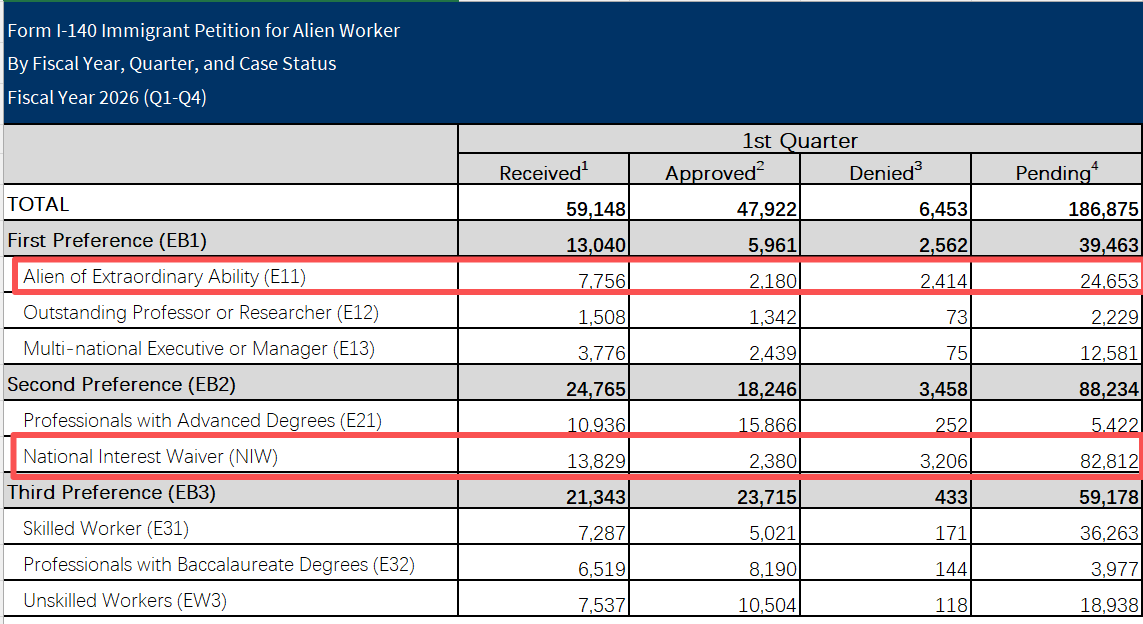
Factual Explanation: This is another widespread confusing misconception among applicants. Most people firmly believe that the NIW program features lower admission barriers and a higher approval rate compared with EB-1A. However, according to the official 2026 fiscal year review data released by USCIS, this viewpoint no longer conforms to the current review situation. At present, the average approval rate of EB-1A remains stable at 53% to 66%, while the NIW approval rate has dropped sharply to approximately 36%. In terms of qualification requirements, NIW does not require applicants to reach the industry-top standard, with slightly lower entry barriers than EB-1A. Nevertheless, the soaring global application volume and continuously tightened review standards have intensified internal competition within the NIW track. Instead of merely describing the basic value of their work, applicants must follow the three core Dhanasar test criteria to fully demonstrate the rationality of PERM exemption from the dimensions of industrial value, national strategic significance and personal irreplaceability. Considering the overall application difficulty and denial risk in 2026, EB-1A and NIW are positioned at the same level, and NIW cannot deliver a higher approval probability.
Misconception 3: Applicants Can Change Employers Freely After I-140 Approval
Factual Explanation: The constraints on job replacement vary significantly among different employment-based immigration categories, and applicants should distinguish relevant rules instead of generalizing:
- No Restrictions: EB-1A and NIW are employer-exempt immigration categories. After I-140 approval, applicants can switch jobs within the same industry without affecting the validity of the approved petition;
- High Risk of Invalidation: For standard EB-2 and EB-3 categories bound to PERM labor certification, changing cooperating employers arbitrarily within 180 days after I-140 approval will invalidate the existing petition completely, and applicants need to restart the entire application process from scratch.
5. Closing Remarks
From an industrial perspective, there is no universal one-size-fits-all solution for Form I-140 petitions. Rather than a standardized examination, the I-140 application is essentially a compound project that relies on applicants’ comprehensive professional qualifications and high-quality legal argumentation. The underlying review logic of Form I-140 never changes: applicants need to fully prove to USCIS that recruiting the candidate can create positive value for America’s economy, scientific research and industrial development, and rejecting qualified elite talents will cause losses to the U.S. immigration system. Applicants who cannot determine the optimal immigration category or evaluate personal application qualifications independently can consult professional immigration attorneys for targeted assessments.
For further details and inquiries, please visit the firm’s official website: https://www.usaym.com.cn/
메타데이터
- post_id
- 2dc70e1aa280
- slug
- complete-guide-to-form-i-140-the-core-stage-of-u-s-employment-based-green-card-2026-updated-2dc70e1aa280
- url
- https://medium.com/@USA_EB1/complete-guide-to-form-i-140-the-core-stage-of-u-s-employment-based-green-card-2026-updated-2dc70e1aa280
- canonical_url
- https://medium.com/@USA_EB1/complete-guide-to-form-i-140-the-core-stage-of-u-s-employment-based-green-card-2026-updated-2dc70e1aa280
- author_url
- https://medium.com/@USA_EB1
- status
- ok
- fetched_at
- 2026-07-20 19:09:02