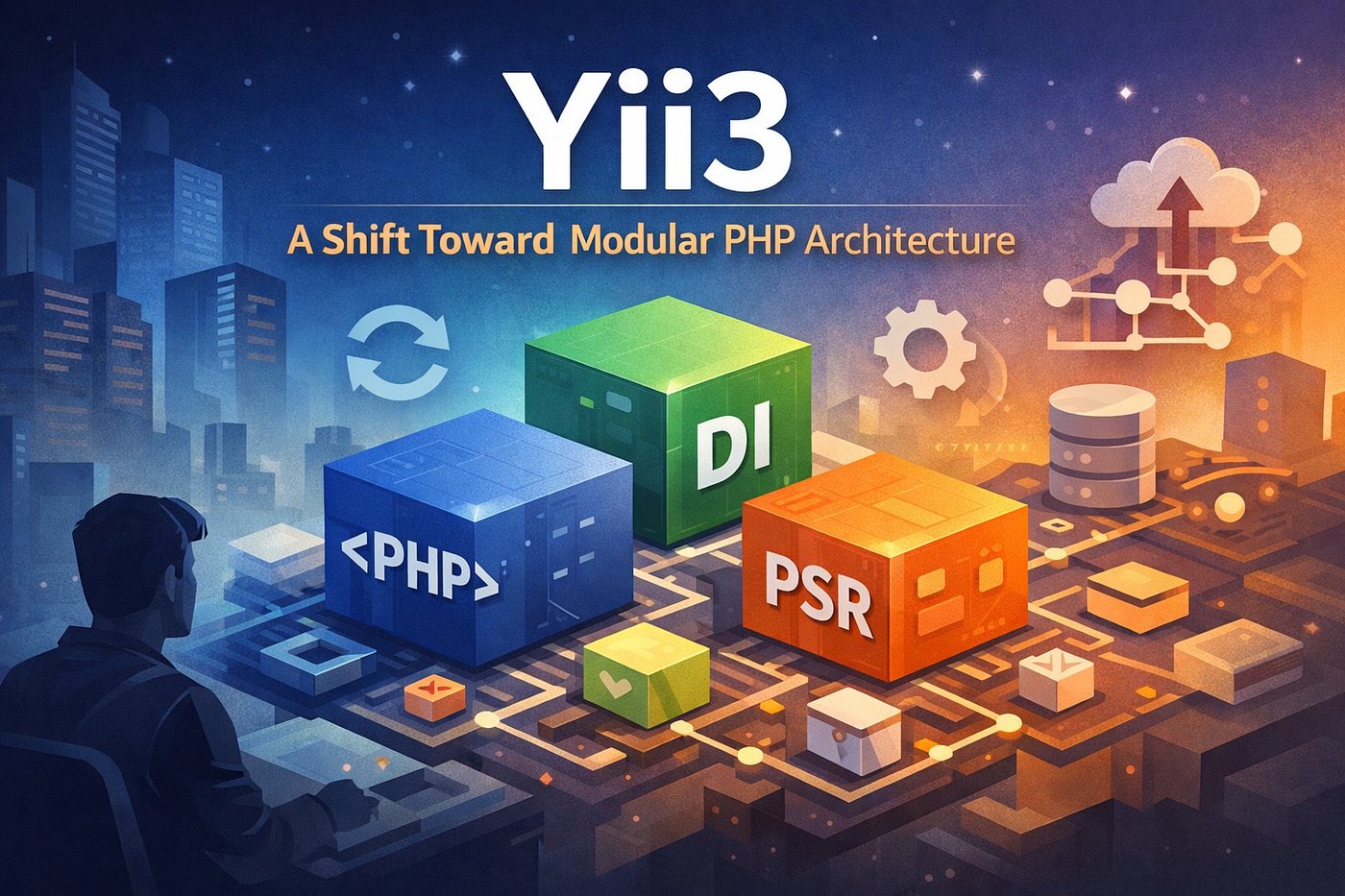
Yii3: A Gradual Shift Toward Modular PHP Architecture (And What It Means for Modern Systems)
The PHP ecosystem is no longer just about rendering server-side HTML. Modern PHP applications now power:
Yii3: A Gradual Shift Toward Modular PHP Architecture (And What It Means for Modern Systems)
The PHP ecosystem is no longer just about rendering server-side HTML. Modern PHP applications now power:
- API gateways
- Event-driven systems
- Queue workers
- Microservices
This shift has exposed a fundamental tension in framework design: convenience vs flexibility.
For years, developers have chosen between:
- Full-stack frameworks that accelerate development
- Minimal frameworks that maximize control
Yii3 does not attempt to “win” this debate. Instead, it reframes it.
Get 10x More Interviews — Without Applying Manually. Automatically send your resume to 300,000+ companies in minutes.

The Real Problem Isn’t Monoliths — It’s Coupling
It’s easy to criticize monolithic frameworks, but the issue is often misunderstood.
A monolith is not inherently bad. In fact, many successful systems are monolithic by design.
The real problem is tight coupling:
- Your ORM is tightly bound to your framework
- Your request lifecycle is fixed
- Your service layer depends on framework-specific helpers
This creates friction when:
- Scaling parts of the system independently
- Replacing infrastructure (e.g., switching databases)
- Writing isolated tests
Yii3’s Core Idea: Make Everything Replaceable
Yii3’s architecture is based on a simple but powerful premise:
Every component should be replaceable without rewriting the system.
To achieve this, Yii3 is built as a set of independent packages, maintained under YiiSoft.
Examples include:
- yiisoft/di (Dependency Injection)
- yiisoft/router
- yiisoft/validator
- yiisoft/log
Each package:
- Has minimal dependencies
- Implements PSR interfaces where applicable
- Can be used outside Yii entirely
This is not just modularity — it is true decoupling at the package level.
Composition Over Convention
Traditional frameworks often rely heavily on:
- Convention over configuration
- Hidden wiring (auto-magic resolution, facades, helpers)
Yii3 deliberately moves away from this.
Instead, it favors:
- Explicit configuration
- Constructor-based dependency injection
- Interface-driven design
This results in code that is:
- More verbose
- But significantly more predictable
Deep Dive: Dependency Injection as a First-Class Citizen
In Yii3, the DI container is not just a helper — it is central to the architecture.
A typical service:
final class RegistrationService
{
    public function __construct(
        private ValidatorInterface $validator,
        private UserRepositoryInterface $repository,
        private MailerInterface $mailer
    ) {

    }

    public function register(array $data): void
    {
        $this->validator->validate($data);
        $this->repository->save($data);
        $this->mailer->send($data['email']);
    }
}
Why this matters:
- Testability
- You can mock every dependency
- No need for framework bootstrapping
2. Replaceability
- Swap MySQL → PostgreSQL → NoSQL
- Replace mail provider without touching business logic
3. Clarity
- No hidden dependencies
- No static calls or facades
This aligns with practices commonly seen in ecosystems like:
- Spring Framework
- .NET
PSR as the Foundation of Interoperability
Yii3 is deeply aligned with standards defined by PHP-FIG.
Key standards include:
- PSR-7 → HTTP message interfaces
- PSR-15 → Middleware handling
- PSR-11 → Container interface
Practical implication:
You can:
- Use Yii3 router with a Slim-based API
- Combine Yii3 validator with Laravel services
- Replace the HTTP stack entirely without breaking core logic
This transforms Yii3 from a “framework” into a set of interoperable building blocks.
Performance Perspective: Realistic Expectations
A common misconception is that modular = faster.
That’s not always true.
Reality:
- Yii3 can be lighter in minimal setups
- But performance depends heavily on:
- Container configuration
- Autoloading overhead
- Middleware stack depth
Example (conceptual comparison):

Yii3 gives you control over performance, not automatic optimization.
Comparing Architectural Philosophies
Let’s position Yii3 more objectively:

Key takeaway: Yii3 trades developer convenience for architectural control.
Where Yii3 Excels
Yii3 is particularly strong in scenarios like:
1. Microservices
- Minimal footprint per service
- Independent component selection
2. Domain-Driven Design (DDD)
- Clear separation of concerns
- Interface-driven architecture
3. Long-Lived Systems
- Easier to refactor over time
- Reduced framework lock-in
Where Yii3 Is Not Ideal
To keep this realistic:
Yii3 is not the best choice when:
- You need rapid prototyping
- Your team relies heavily on scaffolding tools
- You want batteries-included defaults
In these cases, frameworks like Laravel still provide faster delivery.
The Current State of Yii3 (2026)
As of today:
- Yii3 is not a single packaged framework release
- It is a collection of stable and semi-stable components
- Official app templates are still evolving
Adoption is:
- Selective (advanced users, architecture-focused teams)
- Not yet mainstream
Strategic Insight: Why Yii3 Matters
Yii3 reflects a broader industry trend:
Frameworks are becoming ecosystems, not monoliths.
We see this pattern across:
- Java (Spring modularization)
- JavaScript (Node + composable libraries)
- .NET (lightweight services + DI-first design)
Yii3 is PHP’s answer to this shift.
Final Verdict: Engineering Over Convenience
Yii3 is not trying to be:
- The fastest to start
- The easiest to learn
It is trying to be:
- Predictable
- Replaceable
- Maintainable
In other words:
Yii3 is less about building apps quickly — and more about building systems correctly.
References
- PHP-FIG — https://www.php-fig.org
- YiiSoft — https://github.com/yiisoft
- Yii Framework — https://www.yiiframework.com/yii3
Thank you for being a part of the community
Before you go:

👉 Be sure to clap and follow the writer ️👏️️
👉 Follow us: **Linkedin| [Medium](https://medium.com/codetodeploy)**
👉 CodeToDeploy Tech Community is live on Discord — **Join now!**
Disclosure: This post includes affiliate and partnership links.
메타데이터
- post_id
- 2dca36d219a0
- slug
- yii3-a-gradual-shift-toward-modular-php-architecture-and-what-it-means-for-modern-systems-2dca36d219a0
- url
- https://medium.com/codetodeploy/yii3-a-gradual-shift-toward-modular-php-architecture-and-what-it-means-for-modern-systems-2dca36d219a0
- canonical_url
- https://medium.com/codetodeploy/yii3-a-gradual-shift-toward-modular-php-architecture-and-what-it-means-for-modern-systems-2dca36d219a0
- author_url
- https://medium.com/@rizqimulkisrc
- status
- ok
- fetched_at
- 2026-06-23 21:39:52