Why Plant-Derived Proteases Are Finding New Roles Beyond Traditional Food Processing
Most discussions about enzymes focus on microbial production systems or industrial fermentation technologies.
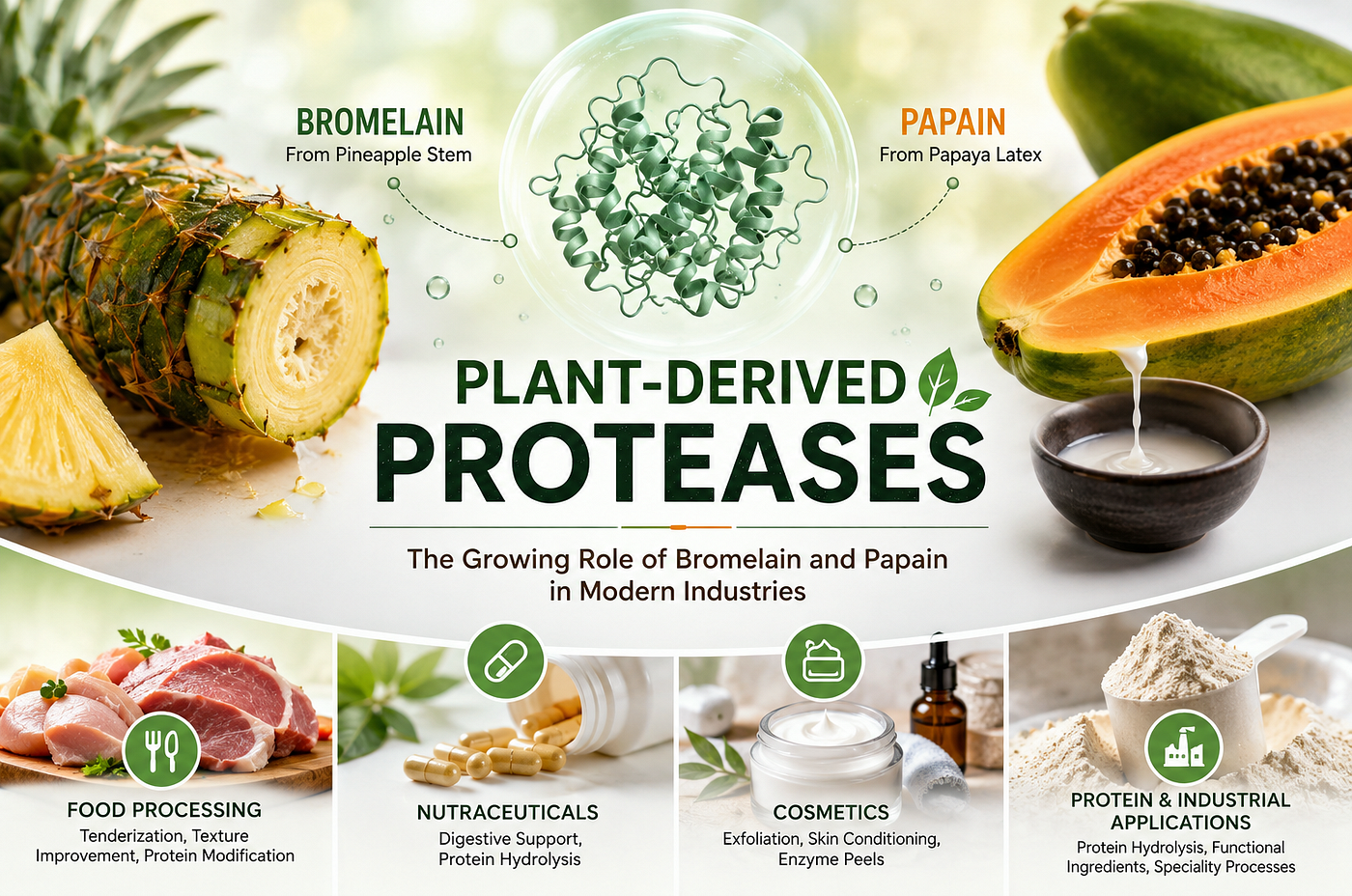
Plant-derived proteases such as bromelain and papain are increasingly being used across food processing, nutraceutical, cosmetic and specialty industrial applications due to their functional versatility and natural origin.
Why Plant-Derived Proteases Are Finding New Roles Beyond Traditional Food Processing
Most discussions about enzymes focus on microbial production systems or industrial fermentation technologies.
Yet some of the most commercially important proteolytic enzymes still originate directly from plants.
For decades, enzymes such as bromelain and papain have been used in food processing, meat tenderization and digestive formulations. But their role in modern manufacturing is expanding far beyond these traditional applications.
Today, plant-derived proteases are finding increasing relevance across nutraceuticals, cosmetics, functional foods, protein processing and specialty industrial applications.
This shift reflects a broader trend occurring across multiple industries: manufacturers are increasingly looking for biological solutions that combine functionality, consumer acceptance and formulation flexibility.
The growing interest in plant-derived enzymes
Consumer preferences continue to influence ingredient selection across global markets.
Manufacturers increasingly face pressure to develop products that are:
- Naturally sourced
- Clean-label friendly
- Sustainable
- Easily understood by consumers
- Compatible with plant-based positioning
Plant-derived enzymes fit naturally into this trend.
Unlike synthetic processing aids or highly technical ingredients, enzymes obtained from sources such as pineapple and papaya carry a strong perception of natural origin while still delivering highly functional performance.
This combination has helped drive growing interest across multiple industries.
Why proteases remain commercially important
Proteases are enzymes that break down proteins into smaller peptides and amino acids.
Although the underlying reaction is simple, protein modification plays an important role in many manufacturing processes.
Protein hydrolysis can influence:
- Texture
- Digestibility
- Solubility
- Flavor development
- Functional performance
- Product stability
As a result, proteases remain among the most widely used enzyme categories globally.
Among plant-derived proteases, bromelain and papain continue to attract significant commercial interest.
Bromelain: the pineapple-derived protease
Bromelain is primarily obtained from pineapple stems and other pineapple tissues.
One reason bromelain gained popularity is its relatively controlled proteolytic behavior.
Across various applications, bromelain is often valued for:
- Consistent protein modification
- Good process control
- Broad application flexibility
- Mild sensory impact
- Strong acceptance in nutraceutical markets
Beyond traditional food applications, bromelain is increasingly evaluated in:
- Dietary supplements
- Functional foods
- Protein processing
- Cosmetic formulations
- Specialty ingredient development
Its versatility has helped maintain strong commercial relevance even as newer enzyme technologies emerge.
Papain: one of the most established plant proteases
Papain is derived from papaya latex and has been used commercially for decades.
Compared with bromelain, papain is often associated with more aggressive protein hydrolysis, making it useful in applications where rapid protein breakdown is desired.
Industries continue to use papain in:
- Meat processing
- Digestive formulations
- Protein hydrolysis
- Food ingredient manufacturing
- Certain cosmetic applications
Its long commercial history and broad availability have helped make papain one of the most recognized plant-derived enzymes worldwide.
Why manufacturers continue to evaluate bromelain and papain
Interestingly, many commercial users do not view bromelain and papain as direct competitors.
Instead, they often evaluate them based on application requirements.
Questions typically include:
- How much process control is required?
- How sensitive is the finished product to texture changes?
- What level of protein breakdown is desired?
- Are sensory characteristics important?
- What regulatory expectations apply?
The answers often determine which enzyme is more suitable for a given process.
In some cases, manufacturers even use bromelain and papain together to balance reaction speed and processing control.
Beyond food processing
Historically, plant proteases were strongly associated with food applications.
That is changing.
Several factors are driving expansion into new markets:
Nutraceuticals
Growing interest in digestive health and functional ingredients continues to support demand for plant-derived enzymes.
Cosmetics
Enzymatic exfoliation and protein modification technologies are creating opportunities for proteases in skincare formulations.
Functional Proteins
As protein ingredients become increasingly important across food and nutrition sectors, controlled protein modification is receiving greater attention.
Specialty Industrial Applications
Protein processing challenges exist in many industrial systems, creating opportunities for selective enzymatic approaches.
The clean-label advantage
One reason plant-derived proteases continue attracting attention is their alignment with clean-label trends.
Consumers increasingly seek products perceived as:
- Natural
- Plant-based
- Minimally processed
- Easy to understand
Plant-derived enzymes fit naturally within these expectations while still delivering measurable technical functionality.
This combination is difficult to achieve with many traditional processing technologies.
The future of plant-derived proteases
Plant-derived enzymes will not replace microbial enzyme technologies.
However, they are likely to remain highly relevant in applications where:
- Natural sourcing matters
- Consumer perception is important
- Controlled protein modification is required
- Functional performance and clean-label positioning must coexist
As food, nutraceutical and specialty ingredient markets continue evolving, bromelain and papain are likely to find new opportunities beyond their traditional uses.
The future may not be defined by choosing between plant-derived and microbial enzymes, but by selecting the right biological tool for the right application.
Manufacturers interested in plant-derived protease solutions can explore:
Plant-Derived Protease Enzymes: https://catalexbio.com/plant-derived-protease-enzymes/
Bromelain Enzyme: https://catalexbio.com/bromelain-enzyme/
Papain Enzyme: https://catalexbio.com/papain-enzyme/
For a detailed comparison of both enzymes: https://catalexbio.com/bromelain-vs-papain/
Catalex Bio supplies bromelain, papain and other proteolytic enzyme solutions with customizable activity levels for food processors, nutraceutical manufacturers, cosmetic formulators and industrial users.
메타데이터
- post_id
- 2dcfe906e44f
- slug
- why-plant-derived-proteases-are-finding-new-roles-beyond-traditional-food-processing-2dcfe906e44f
- url
- https://medium.com/@catalexbio/why-plant-derived-proteases-are-finding-new-roles-beyond-traditional-food-processing-2dcfe906e44f
- canonical_url
- https://medium.com/@catalexbio/why-plant-derived-proteases-are-finding-new-roles-beyond-traditional-food-processing-2dcfe906e44f
- author_url
- https://medium.com/@catalexbio
- status
- ok
- fetched_at
- 2026-07-10 08:54:07