Negotiation Tips That Work
Negotiations can either strengthen a deal or create long-term challenges for your business. This is the stage where having an experienced…
Negotiation Tips That Work
Negotiations can either strengthen a deal or create long-term challenges for your business. This is the stage where having an experienced broker on your team becomes essential. In most transactions, the property owner is represented by a skilled negotiator — and you should be as well.
Effective negotiations involve far more than price alone. Terms, timing, repairs, contingencies, and financing all play a critical role. You also cannot negotiate successfully from a position of weakness. If you are under time pressure, lack viable alternatives, or are unfamiliar with market values, your leverage is limited. Strong negotiations come from preparation, flexibility, and negotiating from a position of strength.
This is where your broker’s value truly shines. They advocate for your preferred timeline, negotiate repairs or improvements prior to closing, and help structure favorable pricing and payment terms. When an owner or their agent presents initial terms, always request them in writing before submitting a counteroffer. In most cases, these terms are already communicated via email.
Documented terms protect you from misunderstandings and shifting expectations. They also establish that your offer is being made in good faith based on the information provided. Verbal discussions alone can easily lead to confusion or misinterpretation.
Written terms allow you to review details carefully, compare the deal against similar transactions, and consult with professionals such as a real estate attorney. Once the initial terms are clear, work with your team to craft a thoughtful counteroffer. The following strategies will help you navigate negotiations effectively and secure the strongest possible outcome for your company.
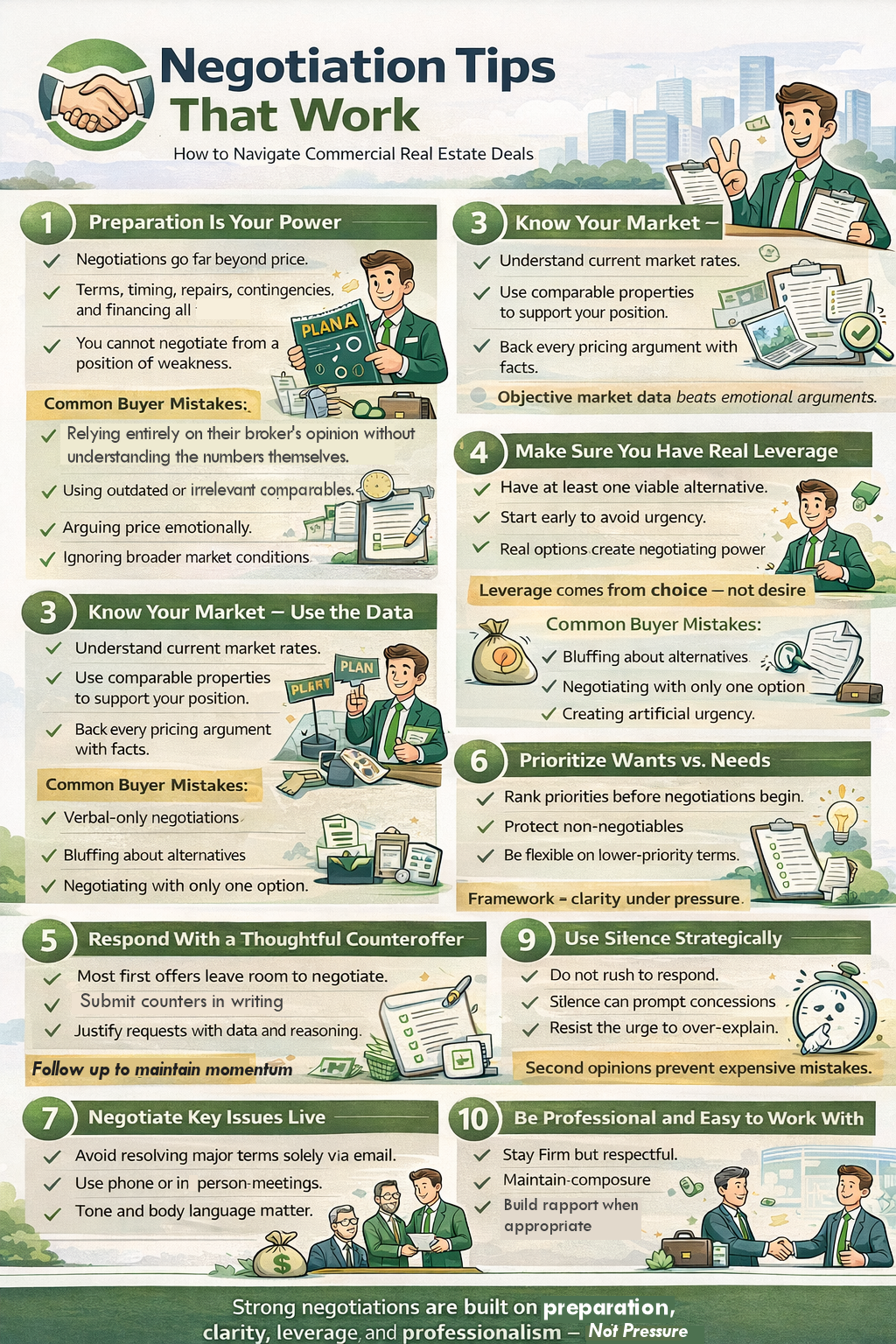
Know Your Market — and Use That Knowledge
Market knowledge should be one of your strongest negotiation tools. By this stage, you should already understand local pricing and have relevant data readily available. Your broker should be well-versed in the area’s market rates, but you should be informed as well.
Knowing the numbers is only half the battle; using them strategically is what matters. If a property is priced above market value, provide the owner with clear, comparable data that supports your position. Objective facts are difficult to dispute.
Market comparisons are one of the most powerful negotiation tools available because they are based on reality — not emotion or urgency. If the property is overpriced, the owner must justify why it should command a premium, unless you are clearly operating in a strong seller’s market.
While your broker brings expertise, the final decision rests with you. You should always form your own informed opinion of the deal.
Common Buyer Mistakes
- Relying entirely on their broker’s opinion without understanding the numbers themselves
- Using outdated or irrelevant comparables
- Arguing price emotionally instead of backing it with hard data
- Ignoring broader market conditions (seller’s market vs. buyer’s market)
Make Sure You Have Real Leverage
Being rushed or chasing the lowest possible price eliminates leverage. True leverage comes from having at least one other realistic option you are willing to pursue. This prevents you from being boxed into a single deal.
This is why starting early is so important. Having backup options gives you credibility. When you tell an owner you have alternatives, it must be true — otherwise, the bluff is often obvious.
When you combine real alternatives with solid market data, you place the owner in a position where compromise becomes more likely. Without leverage, you may be forced to accept unfavorable terms simply to avoid losing the deal or facing a costly interim arrangement.
Common Buyer Mistakes
- Negotiating with only one viable option
- Bluffing about alternative properties that don’t actually exist
- Waiting too long to start the search, creating artificial urgency
- Confusing “wanting a deal” with having negotiating power
Prioritize Your Wants and Needs
The goal is to secure a space that supports and reflects your business. With sufficient time and planning, negotiations can help you achieve that without unnecessary compromise.
Early in the process, there should be no pressure to forfeit key needs. Over time, concessions may be required — but not at the outset. Critical requirements should never be sacrificed.
Before negotiations begin, rank your priorities from least important to most important. This framework will guide your decisions, helping you determine where flexibility is acceptable and where it is not.
Common Buyer Mistakes
- Entering negotiations without clearly defined priorities
- Treating all terms as equally important
- Giving up critical needs too early in the process
- Letting short-term pressure override long-term operational requirements
Respond With a Counteroffer
In most cases, the appropriate response to an initial offer is a counteroffer. While some deals may be non-negotiable, owners typically leave room for discussion.
Sellers often expect a counteroffer and may inflate initial pricing accordingly. An experienced broker will recognize this and help you determine a reasonable adjustment.
Submitting your counteroffer in writing — via letter or email — is usually the best approach. This allows you to explain your position clearly and highlight why your business will be an ideal buyer or tenant.
Be specific. Clearly explain why you are requesting certain terms. Reference market data, comparable properties, or alternative options when relevant. If pricing does not align with the property’s value, state that directly and professionally.
Negotiations often involve several rounds. It is perfectly appropriate to follow up by phone within a day or two to clarify positions and keep momentum moving.
Common Buyer Mistakes
- Accepting the first offer without questioning it
- Making verbal counteroffers that aren’t documented
- Countering without justification or supporting data
- Taking negotiations personally instead of keeping them business-focused
Negotiate Key Issues in Person
Whenever possible, avoid negotiating price or major terms solely through email or text. While convenient, written communication lacks nuance.
In-person discussions — or at minimum, phone or video calls — allow you to read tone, body language, and subtle cues that can provide valuable insight. These elements are often lost in written exchanges.
In many cases, brokers will handle all communication with the seller. Even so, the same principle applies: live conversations are more effective for resolving major points.
Common Buyer Mistakes
- Attempting to resolve major deal points solely through email or text
- Misinterpreting tone or intent in written communication
- Avoiding live conversations due to discomfort
- Letting momentum stall because communication feels inconvenient
Don’t Say Too Much
Silence is a powerful negotiation tool. Experienced negotiators are comfortable with pauses — and they use them intentionally.
When an offer is presented, resist the urge to respond immediately. Allow silence to work in your favor. The discomfort often leads the other party to volunteer concessions or additional information.
If the other party employs this tactic, remain patient and silent as well. Negotiation is as much about restraint as it is about persuasion.
Common Buyer Mistakes
- Over-explaining their position or financial situation
- Filling silence out of discomfort
- Revealing urgency, deadlines, or internal pressures
- Negotiating against themselves unintentionally
Seek a Third-Party Perspective
External validation can reinforce your confidence in a deal. A second opinion — from another professional or industry contact — can confirm whether your position is reasonable.
Your broker’s network can be a valuable resource here. Taking time to consult another expert may prevent costly mistakes and strengthen your negotiating stance.
Common Buyer Mistakes
- Relying only on their own judgment
- Ignoring outside opinions that contradict their assumptions
- Confusing confidence with certainty
- Skipping expert input to “save time”
Be Easy to Work With
While being agreeable won’t necessarily earn you better terms, being difficult can certainly work against you. Professionalism and courtesy help keep negotiations productive.
Maintain a respectful tone, engage in light rapport-building when appropriate, and show empathy throughout the process. These qualities help de-escalate tension if discussions become challenging.
People prefer to work with those who are reasonable and pleasant, and this can influence how flexible the other party is willing to be.
Common Buyer Mistakes
- Becoming confrontational or rigid during negotiations
- Letting frustration show in written or verbal exchanges
- Confusing firmness with hostility
- Damaging rapport over relatively minor deal points
Writing a Counteroffer
Your counteroffer should be presented on behalf of your business — not you personally — even if you are the sole owner. Think of it as a professional proposal that positions your company as a strong and reliable choice.
A well-crafted counteroffer should include:
· Sale Price and Down Payment — Clearly identify the business entity and any affiliated parties.
· Business Structure — Specify whether you operate as an LLC, corporation, nonprofit, or other entity. This helps owners understand liability and stability.
· Contact Information — Include preferred methods and times for communication.
· Terms — Clearly outline each term to avoid ambiguity. List provisions separately so that one unresolved issue does not invalidate the entire offer. Confirm any assumptions or clarifications in writing.
Deliver the counteroffer via email (as an attachment) or by mail using professional letterhead. You should typically expect a response within one to two business days.
Avoid slang or informal language. Precision and clarity are critical — every detail should be unmistakable to prevent delays or misunderstandings.
If you are working with a broker, they will typically provide the appropriate forms. For more complex transactions, engaging a qualified real estate attorney to draft or review the offer may be advisable.
Common Buyer Mistakes
- Writing the offer from a personal rather than business perspective
- Using vague or informal language
- Leaving terms open to interpretation
- Failing to clearly document assumptions or contingencies
to learn more visit https://rogueriverrealestate.com
메타데이터
- post_id
- 2dec76fc982e
- slug
- negotiation-tips-that-work-2dec76fc982e
- url
- https://medium.com/@sky_4243/negotiation-tips-that-work-2dec76fc982e
- canonical_url
- https://medium.com/@sky_4243/negotiation-tips-that-work-2dec76fc982e
- author_url
- https://medium.com/@sky_4243
- status
- ok
- fetched_at
- 2026-06-09 15:37:30