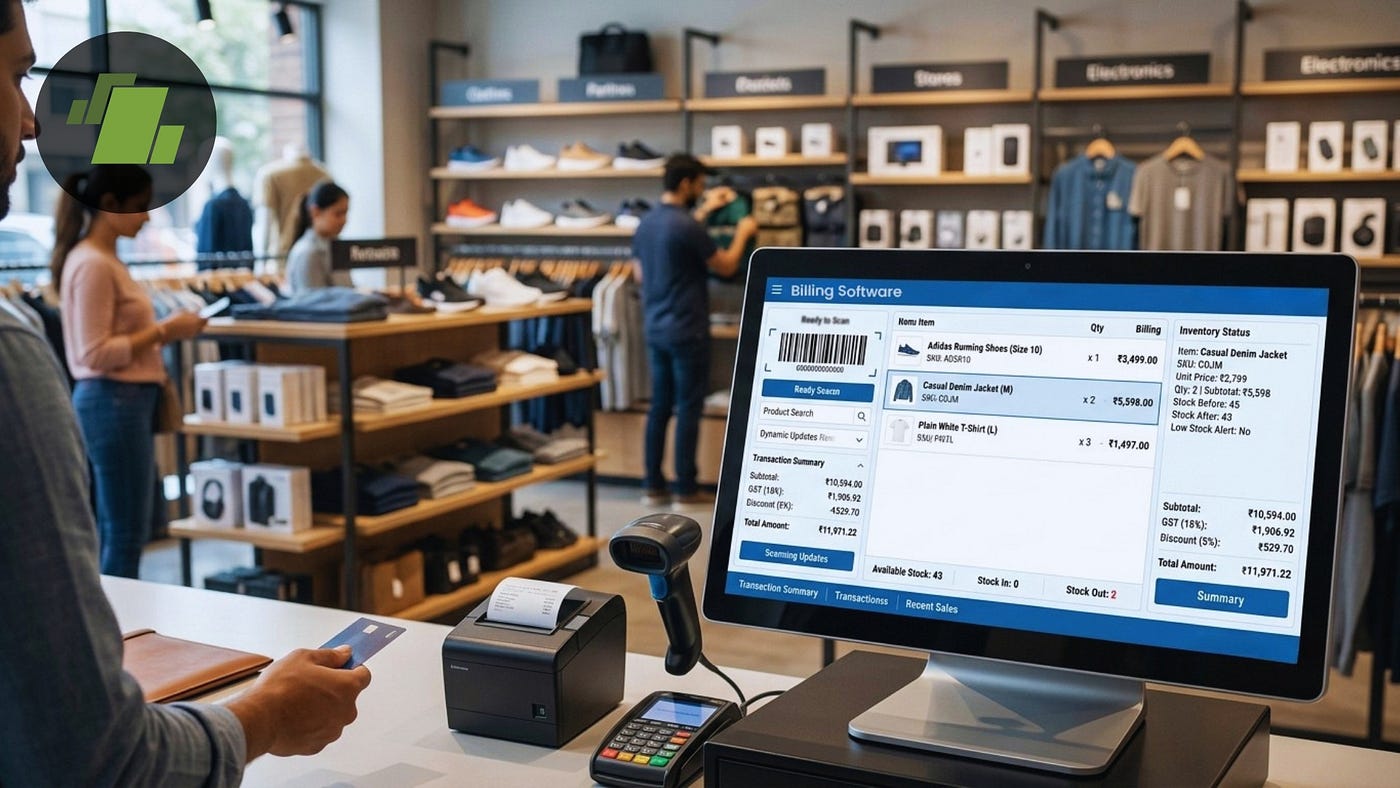
Smarter Billing, Faster Checkout & Grocery POS Software That Works
Smarter billing and faster checkout are achieved with modern grocery POS software that automates billing, tracks inventory in real time…
Smarter Billing, Faster Checkout & Grocery POS Software That Works

Smarter billing and faster checkout are achieved with modern **grocery POS software** that automates billing, tracks inventory in real time, enhances customer experience, and helps grocery retailers improve efficiency, accuracy, and overall profitability.
Key Takeaways
- Faster checkouts and error-free pricing are enabled when grocery POS software automates barcode scanning and real-time billing.
- Centralized inventory, purchasing, and finance become seamless with scalable grocery ERP software supporting business growth.
- Accurate invoicing and GST compliance are simplified by intelligent grocery billing software integrated with daily operations.
- End-to-end visibility across sales, stock, and customers is achieved using unified grocery retail software platforms.
- Improved efficiency, better decision-making, and higher profitability result from adopting modern grocery software solutions.
Introduction
In an increasingly competitive grocery landscape, traditional billing and manual inventory processes are no longer enough. Today’s customers demand speed, accuracy, convenience, and personalization, and grocery retailers must deliver all of this while managing tight margins and complex product catalogs.
That’s where grocery retail software comes into play. These intelligent systems streamline checkout, automate tasks, reduce errors, and bring real-time visibility into every corner of your business. For larger operations seeking even deeper control, **grocery ERP software** extends these benefits with enterprise-grade planning, analytics, and multi-store management.
This comprehensive article covers everything retailers need: from key benefits and features to real-world use cases, selection criteria, implementation best practices, and future trends.
[embed]
1. What Is Grocery POS & Billing Software?
Grocery POS software is a digital system that handles point-of-sale transactions for grocery stores. It replaces cash registers and manual billing books with barcode scanning, automated pricing, and integrated payment handling.
When paired with grocery billing software, it forms the central engine that processes invoices, receipts, tax calculations, inventory updates, and customer transactions, all in real time.
Modern grocery systems integrate:
- Billing & POS Management: This module ensures ultra-fast and error-free billing through barcode and PLU support, multi-counter synchronization, offline billing capability, flexible pricing rules, and real-time data syncing. It allows stores to manage high footfall efficiently without compromising accuracy.
- Inventory Control: Inventory management goes beyond simple stock counts. The system tracks real-time stock movement, manages batch and expiry dates for perishable goods, triggers low-stock alerts, and recommends optimal reorder quantities. This reduces stockouts, overstocking, and product wastage, directly improving profitability.
- Payment Processing: Modern grocery customers expect multiple payment options. Integrated payment processing supports cash, UPI, digital wallets, credit/debit cards, split payments, and even customer credit. Secure and fast payment handling enhances checkout convenience and reduces payment-related disputes.
- Customer Loyalty & CRM: Customer relationship management tools capture purchase history, preferences, and frequency of visits. Loyalty programs, reward points, membership benefits, and personalized offers help grocery retailers increase repeat purchases, boost average basket value, and build long-term customer relationships.
- Reporting & Analytics: Advanced reporting dashboards provide insights into daily sales, profit margins, fast-moving and slow-moving products, peak billing hours, staff productivity, and tax summaries. These insights enable data-driven decisions that improve operational efficiency and strategic planning.
In larger operations, this functionality is extended and centralized through grocery ERP software, which connects procurement, accounting, compliance, and multi-store management in one unified platform.
2. Why Smarter Billing Matters in Grocery Retail
Grocery retail operates on thin margins, high transaction volumes, and time-sensitive inventory. In such an environment, outdated and manual billing processes become a major bottleneck, slowing down operations, increasing errors, and negatively impacting customer experience. Smarter grocery billing software addresses these challenges by automating billing, synchronizing inventory, and ensuring financial accuracy in real time.
Efficient billing systems do more than generate invoices; they directly influence sales velocity, customer satisfaction, inventory health, and regulatory compliance. Here’s how:
2.1 Faster Checkout = Happier Shoppers
Speed at checkout is one of the most critical factors in grocery retail success. Long queues frustrate customers, especially during peak hours, leading to abandoned purchases and lost loyalty. Smarter billing transforms the checkout experience by:
- Reducing wait times: Barcode scanning and touch-based billing eliminate manual item entry, cutting billing time per customer significantly.
- Increasing throughput during peak hours: Faster transactions allow more customers to be served without adding extra billing counters or staff.
- Improving customer satisfaction and loyalty: A smooth checkout experience encourages repeat visits and positive word-of-mouth.
Modern grocery POS software instantly scans items, applies predefined pricing, calculates discounts, and processes payments in seconds — dramatically outperforming manual billing methods.
2.2 More Accurate Pricing
Pricing accuracy is essential in grocery retail, where prices change frequently due to supplier updates, seasonal fluctuations, promotions, and perishable goods. Manual price entry increases the risk of errors, customer disputes, and revenue leakage.
With grocery billing software, pricing is centrally managed and automatically applied at the point of sale. This ensures:
- Consistent pricing across all billing counters
- Accurate application of offers, discounts, and promotions
- Reduced billing disputes and refunds
- Greater customer trust and transparency
By eliminating manual price overrides, grocery retailers maintain pricing integrity while protecting margins.
2.3 Real-Time Inventory Synchronization
Inventory mismanagement is one of the biggest profit killers in grocery retail. Without real-time updates, retailers face stock mismatches, negative inventory, overstocking, and missed sales opportunities.
Smarter billing systems ensure that every sale immediately updates inventory, resulting in:
- Smarter reordering: Automated alerts and data-driven reorder suggestions prevent last-minute purchases and supply disruptions.
- Reduced stockouts and overstocking: Accurate stock visibility ensures the right products are available at the right time.
- Lower shrinkage and wastage: Expiry tracking and real-time movement reduce losses from spoilage and miscounts.
This seamless synchronization between billing and inventory allows grocery retailers to operate leaner, more efficient stores.
2.4 Integrated Tax & Regulatory Compliance
Compliance is non-negotiable in grocery retail, especially in regions with complex tax structures such as GST, VAT, e-invoicing, and local regulatory requirements. Manual tax calculations increase the risk of errors, penalties, and audit complications.
Modern grocery billing and POS systems simplify compliance by:
- Automatically calculating applicable taxes on each transaction
- Generating GST-compliant invoices and e-invoices
- Maintaining audit-ready records and tax reports
- Reducing dependency on manual accounting adjustments
By automating compliance, retailers save time, reduce financial risk, and gain confidence during audits and inspections.
3. Core Features of Effective Grocery POS & Billing Software
To achieve smarter billing, faster checkout, and operational consistency, modern grocery retailers require more than a basic POS system. The best grocery POS software and grocery billing software combine speed, accuracy, flexibility, and real-time synchronization across all retail functions. Below are the core features that define an effective grocery billing system.
3.1 Barcode & PLU Support
Barcode and PLU-based billing form the foundation of fast grocery checkout. Barcode scanning instantly identifies products, applies correct pricing, updates inventory, and records the transaction without manual intervention. This significantly reduces billing time and eliminates human errors common with manual price entry.
PLU (Price Look-Up) codes are equally critical for loose or unpackaged items such as fruits, vegetables, grains, and bakery products. These items are billed by weight or quantity using weighing scale integration, ensuring accurate pricing and seamless checkout. Together, barcode and PLU support ensure consistency, speed, and precision across all product categories.
3.2 Multi-Counter Synchronization
Grocery stores often operate multiple billing counters to manage high customer footfall, especially during peak hours. Effective grocery POS software synchronizes all counters in real time, ensuring every transaction reflects instantly across the system.
This synchronization prevents common issues such as ghost stock, duplicate billing, inconsistent pricing, and inventory mismatches. Whether a sale happens at Counter 1 or Counter 5, inventory, pricing, offers, and customer data remain unified. For supermarket chains, this feature extends across multiple outlets, enabling centralized control and a consistent customer experience.
3.3 Offline Billing Support
Internet downtime should never halt grocery operations. Offline billing capability allows stores to continue billing seamlessly even during connectivity issues. All transactions are stored locally and automatically synced to the central server once the internet connection is restored.
This ensures zero revenue loss, uninterrupted customer service, and complete data integrity. Offline billing is especially critical for high-footfall grocery stores and outlets located in areas with unstable internet connectivity.
3.4 Payment Flexibility
Today’s grocery customers expect multiple payment options for convenience and speed. Modern grocery billing software supports a wide range of payment methods, including:
- Cash
- Credit and debit cards
- UPI and QR-based payments
- Digital wallets and contactless payments
- Split payments and customer credit
Flexible payment handling reduces checkout friction, shortens queues, and improves customer satisfaction. It also helps retailers cater to diverse customer preferences while ensuring secure and accurate payment processing.
3.5 Promotions & Discounts Management
Promotions play a vital role in grocery retail, but manual discount handling often leads to errors and margin leakage. Advanced grocery software includes built-in promotion engines that automate pricing rules, such as:
- Coupons and voucher-based discounts
- Bulk and quantity-based pricing
- Combo offers and bundled products
- Time-bound and festive promotions
These rules are applied automatically at checkout, ensuring consistent pricing and eliminating manual overrides. Retailers can run targeted campaigns to increase footfall and basket size while maintaining profitability and pricing control.
4. How Grocery Retail Software Improves Daily Operations
While faster billing is often the most visible benefit, the real value of grocery retail software lies in how it transforms day-to-day store operations behind the scenes. By integrating sales, inventory, procurement, and customer data into a single system, grocery software creates operational clarity, reduces inefficiencies, and enables smarter decision-making at every level.
4.1 Complete Visibility Across Products and Inventory
Real-time inventory visibility is essential in grocery retail, where thousands of SKUs move rapidly, and demand fluctuates daily. Grocery retail software continuously tracks every product — from incoming stock to final sale — ensuring accurate inventory records at all times.
Store managers can instantly see:
- Current stock levels by SKU and category
- Fast-moving and slow-moving items
- Products nearing expiry
- Stock availability across multiple outlets
This transparency allows proactive replenishment, prevents lost sales due to stockouts, and supports better shelf planning. With automated reorder alerts and demand-based suggestions, retailers can maintain optimal stock levels without over-investing in inventory.
4.2 Shrinkage Reduction and Waste Control
Shrinkage from expiry, theft, spoilage, and manual errors can significantly impact grocery margins. Grocery software reduces these losses through precise tracking and automation.
Key capabilities include:
- Batch and expiry date tracking for perishable goods
- Alerts for near-expiry and slow-moving products
- Accurate stock reconciliation between sales and inventory
- Reduced manual handling and counting errors
By identifying problem areas early and enforcing tighter controls, grocery retailers can drastically reduce wastage, improve inventory turnover, and protect profitability.
4.3 Smarter Vendor and Purchase Management
Procurement decisions directly affect product availability and cash flow. Integrated purchasing modules within grocery ERP software replace guesswork with data-driven insights.
The system helps retailers:
- Automatically calculate reorder quantities based on sales trends
- Track supplier delivery timelines and fulfillment accuracy
- Compare vendor pricing and performance
- Maintain consistent purchase histories and contracts
This structured approach reduces emergency purchases, avoids overstocking, strengthens supplier relationships, and enables better negotiation — resulting in cost savings and improved supply reliability.
4.4 Enhanced Customer Engagement and Retention
Modern grocery retail is not just about transactions — it’s about relationships. Built-in CRM tools within grocery retail software enable personalized and consistent customer engagement.
Retailers can:
- Track individual customer purchase behavior and preferences
- Offer loyalty points, memberships, and cashback programs
- Send targeted SMS and email campaigns for promotions and reminders
- Create personalized offers based on shopping frequency and basket value
These features increase repeat visits, boost average order value, and strengthen brand loyalty by making customers feel recognized and rewarded.
5. Key Benefits of Grocery Billing & POS Software
Adopting modern grocery billing software and grocery POS software delivers measurable advantages across operations, finance, and customer experience. These systems are designed to handle the speed, scale, and complexity of grocery retail while improving efficiency and profitability.
5.1 Faster Billing and Checkout
Speed at the billing counter is critical in grocery retail, where customer volume is high, and margins depend on throughput. Automated barcode scanning and PLU-based pricing eliminate manual item entry, drastically reducing billing time per transaction.
Touch-based interfaces, quick product lookup, and integrated weighing scales further accelerate checkout. As a result, stores can handle peak-hour rush smoothly, reduce queues, and serve more customers without increasing staffing costs. Faster checkout directly translates into higher customer satisfaction and increased daily sales capacity.
5.2 Improved Inventory Accuracy
Accurate inventory is the foundation of profitable grocery operations. Every transaction processed through grocery billing software updates stock levels in real time, ensuring that inventory records always reflect actual availability.
This real-time accuracy minimizes stock mismatches, prevents negative inventory, and reduces shrinkage caused by miscounts or manual errors. Automated alerts for low stock and near-expiry items help store managers act proactively, preventing both lost sales and unnecessary wastage.
5.3 Centralized Business Control
Grocery billing and POS systems provide centralized dashboards that give owners and managers complete visibility into business performance. From a single interface, retailers can monitor:
- Sales by counter, product, or outlet
- Inventory levels and stock movement
- Pricing updates and promotional effectiveness
- Staff performance and billing activity
For multi-counter and multi-store setups, centralized control ensures consistent pricing, standardized processes, and data-driven decision-making across the entire business.
5.4 GST Compliance and Financial Accuracy
Tax compliance is a critical and complex aspect of grocery retail. Modern grocery billing software automates GST calculations, applies correct tax slabs, and generates compliant invoices for every transaction.
Integrated reporting tools produce audit-ready financial statements, tax summaries, and reconciliation reports, significantly reducing manual accounting effort. This automation minimizes compliance risks, prevents penalties, and ensures financial accuracy while saving valuable administrative time.
5.5 Enhanced Customer Experience and Loyalty
Customer experience extends beyond fast checkout. Accurate pricing, flexible payment options, and personalized engagement all contribute to customer satisfaction. Grocery POS systems support loyalty programs, reward points, memberships, and targeted promotions that encourage repeat visits.
By analyzing purchase history and customer behavior, retailers can deliver relevant offers and consistent service, strengthening trust and long-term relationships. Over time, this leads to higher retention, increased basket size, and sustainable revenue growth.
6. Real-World Impact: Case Studies
Real-world implementations show how grocery billing software, grocery POS software, and grocery ERP software deliver measurable improvements across store sizes. These case studies highlight tangible operational, financial, and customer-experience gains.
6.1 Small Grocery Store
- A neighborhood grocery store operating with manual billing and basic inventory tracking adopted modern **grocery billing software** to streamline daily operations and improve customer service.
- Operational Improvements Barcode-based billing and PLU integration reduced checkout time significantly. Faster billing eliminated long queues during peak hours, improving checkout speed and allowing the store to handle higher customer volume without adding staff.
- Inventory & Stock Control Gains Real-time inventory updates ensured accurate stock visibility. Automated low-stock alerts helped the store restock fast-moving items on time, reducing stockouts and preventing lost sales due to unavailable products.
- Revenue Growth Through Smarter Selling Integrated product recommendations and combo offers prompted staff to suggest complementary items at checkout. This led to higher average bill values, as customers spent more through accurate upsell and cross-sell suggestions.
- Customer Experience Impact Quick billing, correct pricing, and consistent availability improved trust and encouraged repeat visits, strengthening long-term customer loyalty.
6.2 Multi-Store Retail Chain
- A regional grocery retail chain managing multiple outlets implemented grocery ERP software to centralize operations, standardize processes, and gain enterprise-level visibility.
- Centralized Pricing and Promotions The ERP system enabled the head office to control pricing, discounts, and promotional campaigns across all outlets in real time. This eliminated pricing inconsistencies and ensured a uniform customer experience across locations.
- Optimized Inventory Across Stores Real-time inventory synchronization allowed stock transfers between outlets and improved demand forecasting. As a result, excess stock was reduced, freeing up working capital and lowering storage costs.
- Unified Financial and Compliance Reporting Instead of managing separate reports for each store, management accessed a single dashboard covering sales, taxes, profitability, and compliance. This reduced accounting workload, improved decision-making speed, and ensured audit-ready financials at all times.
- Scalability and Control The grocery ERP software provided the foundation to add new outlets without operational disruption, supporting controlled and sustainable business growth.
7. Trends Shaping Grocery POS & Billing Systems
The grocery retail landscape is evolving rapidly. Customer expectations for speed, convenience, and personalization, combined with operational demands for efficiency and accuracy, are driving innovation in grocery POS software, grocery billing software, and grocery ERP software. Retailers adopting the latest technologies gain a competitive edge while improving profitability and customer loyalty. Key trends shaping the industry include:
7.1 Cloud-Based Grocery Software
Cloud technology is transforming grocery retail operations by moving software and data storage off local servers. Cloud-based grocery POS and billing software delivers several advantages:
- Scalability: Easily add new stores, counters, or SKUs without upgrading hardware.
- Remote Management: Store owners and managers can monitor sales, inventory, and promotions from anywhere using laptops or mobile devices.
- Cost Efficiency: Reduces IT infrastructure expenses, software updates, and maintenance hassles.
- Data Security: Centralized cloud storage ensures backups, encryption, and disaster recovery.
Example: A supermarket chain can manage 20+ outlets on a single cloud platform, automatically synchronizing pricing, stock levels, and promotions in real time.
7.2 Mobile POS & Scan-Anywhere Billing
Mobile POS systems are redefining the checkout experience. Employees can process transactions anywhere in the store, reducing queues and enhancing customer convenience.
- Reduced Lines: Customers can check out items while shopping, especially during peak hours.
- Impulse Buying: On-the-spot checkout encourages additional purchases as customers no longer have to wait in line.
- Flexibility: Supports handheld devices, tablets, and mobile card readers, allowing quick setup for temporary counters or pop-up promotions.
Impact: Faster checkout, higher customer satisfaction, and improved operational efficiency.
7.3 AI & Predictive Analytics
Artificial intelligence (AI) and predictive analytics are no longer futuristic — they are actively optimizing grocery operations. Integrated with grocery ERP software, AI can:
- Forecast demand based on historical sales, seasonal trends, and local events.
- Recommend optimal reorder quantities to prevent stockouts or overstocking.
- Identify slow-moving items and suggest promotions or discounts to improve turnover.
- Analyze customer purchase behavior to personalize offers and loyalty rewards.
Impact: Retailers reduce waste, improve stock availability, increase margins, and deliver a more tailored shopping experience.
7.4 Voice & AI Search Optimization (VEO & AEO)
Voice-enabled and AI-assisted search is emerging as a critical feature for modern grocery retail software:
- Voice Ordering: Customers can search for products or place orders using voice commands via mobile apps or smart devices.
- AI Search Optimization: Advanced algorithms understand intent, provide accurate search results, and recommend related products.
- Future-Proofing: VEO and AEO integration ensures that grocery stores are optimized for emerging technologies and smart-home assistants.
Impact: Shoppers enjoy faster, hands-free ordering, and stores capture more online and app-based sales through intelligent search and recommendations.
8. How to Choose the Right Grocery Software
Selecting the right grocery retail software, grocery billing software, or grocery POS software is critical for long-term operational efficiency, customer satisfaction, and business growth. With so many solutions available in the market, choosing one that fits your store’s unique needs requires careful evaluation. Here’s a detailed guide:
8.1 Evaluate Key Features
Not all grocery software is created equal. When evaluating options, look for solutions that include:
- Smart Billing: Automated barcode and PLU scanning, multi-counter synchronization, flexible payment options, and offline billing support.
- Inventory Tracking: Real-time stock updates, batch and expiry tracking, low-stock alerts, and multi-store inventory visibility.
- Promotions Engine: Automated discounts, combo offers, bulk pricing, and loyalty program management to drive sales and customer retention.
- Delivery Integration: Online ordering, route optimization, and delivery tracking capabilities to support omnichannel operations.
- Financial Reporting: Automated GST/VAT calculations, audit-ready reports, ledger management, and actionable analytics for smarter decision-making.
By prioritizing these features, grocery retailers ensure the software enhances both operational efficiency and customer experience.
8.2 Scalability
A grocery store today may expand tomorrow. The right software must grow with your business:
- Support More SKUs: Easily handle increasing product varieties without affecting performance.
- Additional Counters: Seamlessly add new billing counters or mobile POS devices during peak periods or store expansions.
- Multiple Store Locations: Centralized dashboards for multi-store chains ensure consistent pricing, promotions, and inventory management across outlets.
Scalable software protects your investment and ensures smooth business growth without costly replacements.
8.3 Real-Time Performance
Real-time capabilities are non-negotiable for grocery retail software:
- Instant Inventory Updates: Every sale or return automatically adjusts stock levels to prevent stockouts or overselling.
- Sales Synchronization: Transactions reflect immediately across all counters and outlets.
- Accurate Reporting: Financial, inventory, and sales data are always up-to-date, enabling faster and better-informed decisions.
A real-time system ensures operational accuracy, reduces errors, and improves customer satisfaction by always showing true product availability.
8.4 Integration Capabilities
Modern grocery operations rely on multiple software and platforms. Your grocery software should integrate seamlessly with:
- Accounting Tools: For automated bookkeeping, tax filing, and financial reporting.
- Payment Gateways: To process credit/debit cards, UPI, digital wallets, and split payments smoothly.
- CRM Systems: To manage loyalty programs, customer profiles, and personalized promotions.
- Delivery Apps: For online order management, route optimization, and real-time delivery tracking.
Integration reduces manual work, minimizes errors, and allows for a unified, omnichannel experience for both staff and customers.
8.5 Support & Training
Even the most advanced software fails without proper implementation and ongoing support. Ensure your solution provider offers:
- 24/7 Customer Support: Assistance via phone, chat, or email to resolve technical issues quickly.
- Staff Onboarding Assistance: Training modules tailored for billing staff, inventory managers, and store managers.
- Documentation & Tutorials: Easy-to-follow guides, videos, and FAQs for reference.
Comprehensive support ensures faster adoption, reduces downtime, and maximizes return on investment.
9. Implementation Best Practices
Implementing grocery billing software, grocery POS software, or grocery retail software successfully requires careful planning and execution. A structured approach ensures smooth adoption, minimizes disruptions, and maximizes ROI. Below are the key best practices for effective implementation:
9.1 Start with a Process Audit
Before installing any software, thoroughly document your current workflows. Understand how billing, inventory management, procurement, delivery, and customer interactions are handled. Identify:
- Bottlenecks in checkout or inventory updates
- Repetitive manual tasks that can be automated
- Pain points in multi-counter or multi-store operations
A clear process audit ensures that the software configuration matches your operational needs, preventing unnecessary complexity and enabling a smoother transition.
9.2 Define Business KPIs
Set clear metrics to measure the success of your grocery software implementation. Key performance indicators (KPIs) may include:
- Billing Speed: Time taken per transaction and average checkout queue length
- Stock Accuracy: Frequency of stock mismatches or out-of-stock items
- Customer Repeat Rate: Loyalty and repeat purchase frequency
- Delivery Time: Average order fulfillment duration for online or in-store deliveries
Defining KPIs upfront allows you to track progress, evaluate ROI, and identify areas requiring improvement during and after deployment.
9.3 Pilot Rollouts
Rather than deploying across all stores or counters immediately, start with a pilot rollout:
- Test the software in one outlet, department, or with a small set of counters
- Gather feedback from staff and customers regarding usability and speed
- Identify configuration tweaks, training needs, or integration issues
Pilot testing reduces risk, ensures the system aligns with your workflow, and allows for incremental improvements before full-scale implementation.
9.4 Train Employees Thoroughly
Software adoption depends heavily on how well employees understand and use the system. Best practices include:
- Role-Based Training: Tailor sessions for cashiers, inventory managers, delivery staff, and administrators
- Hands-On Practice: Allow staff to simulate transactions, billing, and inventory updates
- Continuous Support: Provide manuals, tutorials, and on-call assistance during the initial weeks
Thorough training minimizes errors, builds confidence, and encourages staff to leverage advanced features of grocery software fully.
9.5 Monitor & Optimize Continuously
Implementation doesn’t end once the software is live. Continuous monitoring and process refinement are crucial:
- Track analytics and reports to evaluate KPIs against goals
- Identify bottlenecks, slow transactions, or recurring errors
- Adjust workflows, promotional settings, and inventory triggers based on data insights
- Regularly update software to leverage new features, security patches, and performance improvements
Ongoing optimization ensures that grocery billing software and POS systems deliver maximum efficiency, cost savings, and customer satisfaction over time.
10. Grocery POS Software vs Grocery ERP Software: Key Differences
Grocery retailers today face a choice between grocery POS software for fast, efficient checkout or grocery ERP software for comprehensive, end-to-end business management. Understanding the distinctions helps store owners select the right solution for their current and future needs.
10.1 Scope of Operations
- Grocery POS Software: Primarily designed for store-level operations such as billing, checkout, and basic inventory tracking. It focuses on transaction speed and accuracy.
- Grocery ERP Software: Offers a broader scope, integrating procurement, finance, accounting, compliance, multi-store management, inventory, CRM, and analytics in a single platform.
Impact: POS is ideal for smaller stores with simpler workflows, while ERP is suited for chains or multi-location retailers needing centralized control.
10.2 Billing & Checkout Capabilities
- POS Systems: Support fast barcode scanning, PLU-based billing, and flexible payments to reduce queues and improve customer experience.
- ERP-Enabled Billing: Integrates billing with real-time inventory, accounting, and reporting modules. This allows managers to track sales trends, monitor product availability, and automate tax calculations seamlessly.
Impact: ERP provides long-term operational control, whereas POS focuses primarily on speed at checkout.
10.3 Inventory & Stock Management
- POS Software: Tracks inventory at the store level, managing stock for a single outlet. Useful for small grocers with limited SKUs.
- ERP Software: Offers centralized, real-time inventory visibility across multiple outlets and warehouses. Features include batch & expiry tracking, low-stock alerts, and automated replenishment suggestions.
Impact: ERP ensures optimal inventory levels, reduces stockouts and wastage, and supports chain-wide operational efficiency.
10.4 Multi-Store & Scalability Support
- POS Systems: Suited for single stores or small setups; limited support for adding multiple counters or locations.
- ERP Software: Designed for scalability. Easily manages multiple outlets, centralized pricing, reporting, promotions, and governance.
Impact: ERP is ideal for grocery chains or businesses planning growth, while POS suffices for smaller, local stores.
10.5 Procurement & Vendor Management
- POS Software: Offers basic stock alerts but generally lacks advanced procurement features.
- ERP Software: Automates purchase planning, vendor comparisons, GRN matching, and supplier performance tracking. Integration with inventory and finance ensures timely procurement and cost control.
Impact: ERP reduces manual procurement effort and improves supplier relationships, while POS focuses on immediate stock management.
10.6 Accounting & Compliance
- POS Software: May integrate with external accounting tools but often lacks native compliance modules.
- ERP Software: Includes built-in GST, e-invoicing, ledgers, and audit-ready reporting. Real-time financial integration ensures accurate bookkeeping and regulatory compliance.
Impact: ERP provides a fully automated compliance and finance ecosystem; POS is suitable for stores with simpler accounting needs.
10.7 Reporting & Business Intelligence
- POS Systems: Provide basic sales and inventory reports to track daily operations.
- ERP Systems: Deliver advanced analytics such as demand forecasting, category performance, outlet-level sales comparisons, and profit analysis. Custom dashboards enable data-driven strategic decisions.
Impact: ERP empowers grocery chains to make informed decisions, optimize inventory, and improve overall profitability.
10.8 Ideal Use Case
- Grocery POS Software: Best for small stores or new outlets that need quick setup, faster checkout, and easy inventory tracking without complex backend requirements.
- Grocery ERP Software: Suited for multi-store chains or growing businesses requiring long-term scalability, centralized control, advanced reporting, and strategic growth planning.
Key Takeaway: POS is optimized for operational efficiency at the store level, whereas ERP provides an end-to-end solution for controlling and scaling grocery retail operations.
Conclusion
In today’s digital age, smarter billing and faster checkout are no longer competitive advantages; they are expectations. With grocery billing software, grocery POS software, grocery retail software, and scalable grocery ERP software, retailers can deliver seamless customer experiences while optimizing operations, improving margins, and future-proofing their business.
Whether you operate a neighborhood grocery store or manage a multi-store chain, investing in the right software stack ensures you stay agile, efficient, and prepared for the demands of modern retail.
Call at +91–73411–41176 or send us an email at **sales@logicerp.com to book a free demo** to know more about Smarter Billing, Faster Checkout & Grocery POS Software That Works!
Frequently Asked Questions
1. What is grocery POS software?
Grocery POS software is a retail billing and inventory management system designed for grocery stores and supermarkets. It automates barcode billing, GST calculation, real-time stock updates, and payment processing to improve checkout speed and operational efficiency.
2. How does grocery billing software improve store efficiency?
Grocery billing software speeds up checkout with barcode scanning, automatic tax calculation, and instant invoice generation. It reduces manual errors, manages discounts and promotions, and ensures accurate daily sales reporting.
3. What is the difference between grocery POS software and grocery ERP software?
Grocery POS software handles billing and counter-level inventory, while grocery ERP software provides complete retail management including procurement, warehouse control, accounting, multi-store operations, CRM, and advanced analytics.
4. Can grocery retail software manage real-time inventory?
Yes, modern grocery retail software offers real-time inventory tracking, batch and expiry management, low-stock alerts, and automated purchase suggestions to prevent stockouts and reduce wastage.
5. Is grocery POS software suitable for supermarket chains?
Advanced supermarket POS solutions support multi-store management with centralized pricing, unified promotions, synchronized inventory, and consolidated reporting across all outlets.
6. Does grocery billing software support GST compliance?
Yes, grocery billing software automatically calculates GST, generates tax-compliant invoices, and maintains detailed financial records for smooth audits and regulatory compliance.
7. How does grocery management software increase profitability?
A retail grocery management system improves profitability by reducing billing errors, controlling shrinkage, optimizing stock levels, automating promotions, and providing data-driven insights through real-time analytics.
8. What features should I look for in grocery POS software?
Choose grocery POS software with barcode billing, cloud access, multi-counter support, loyalty management, supplier tracking, automated reordering, detailed reports, and integration with accounting systems.
메타데이터
- post_id
- 2dfa418ef5a7
- slug
- smarter-billing-faster-checkout-grocery-pos-software-that-works-2dfa418ef5a7
- url
- https://medium.com/@logicerp/smarter-billing-faster-checkout-grocery-pos-software-that-works-2dfa418ef5a7
- canonical_url
- https://medium.com/@logicerp/smarter-billing-faster-checkout-grocery-pos-software-that-works-2dfa418ef5a7
- author_url
- https://medium.com/@logicerp
- status
- ok
- fetched_at
- 2026-08-15 15:19:14