F1 Cars Can Drive Upside Down at 170mph
F1 Cars Can Drive Upside Down at 170mph
***https://youtube.com/shorts/b_tBp6u5u4c?si=CVO-vmon96kgU18r***
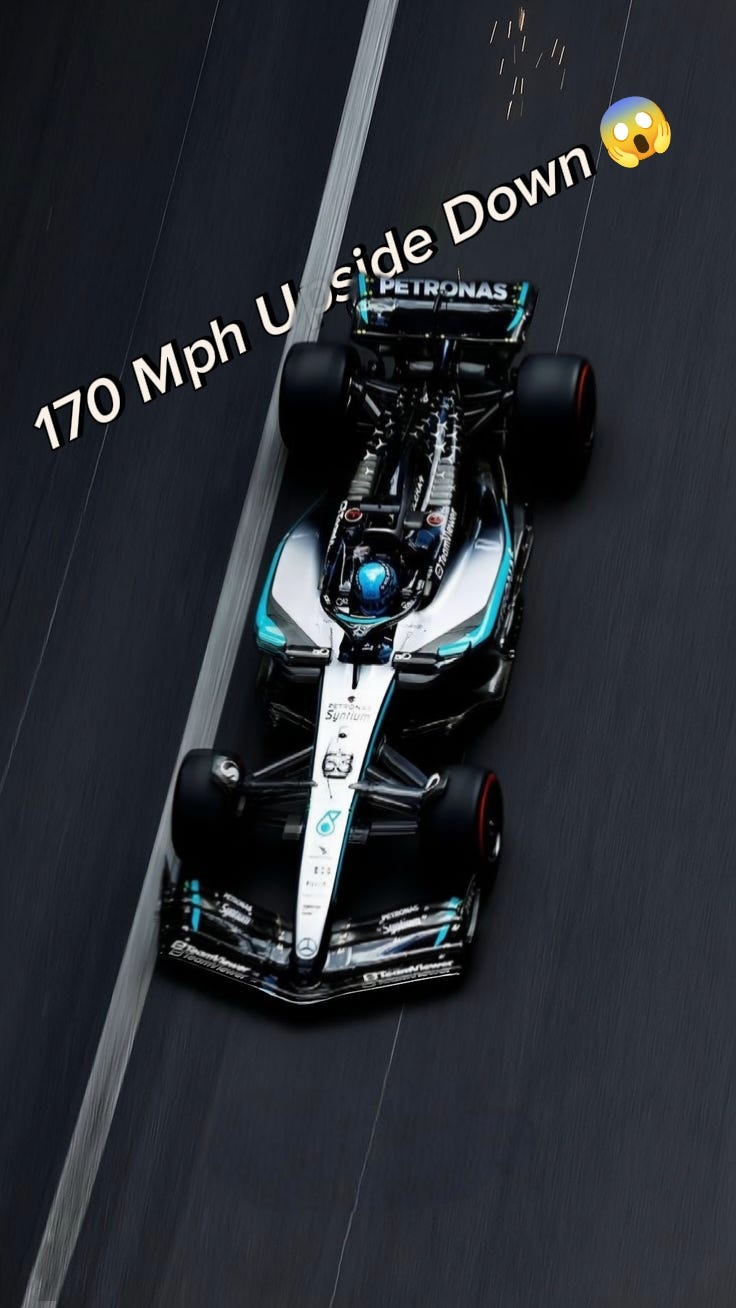
The aerodynamic secret that makes Formula 1 the most engineered sport on Earth. Most people watch Formula 1 for the speed. The overtakes. The crashes. But buried inside every F1 car is a physics fact so extreme it sounds like fiction — these machines generate enough downforce to drive upside down on a ceiling. Here’s exactly how that works, and why it matters. What Is Downforce and Why Does It Sound Impossible? Downforce is the aerodynamic force that pushes a car into the track. In a commercial airplane, wings generate lift — pushing the plane upward. F1 engineers flipped that concept entirely. Every surface on an F1 car is designed to push air in a way that sucks the car downward. The result? At full racing speed, the car is being pressed into the tarmac with a force greater than its own weight. Modern F1 cars generate 1,600kg of downforce at full speed. The car itself weighs around 798kg. That means the aerodynamic grip is literally twice the car’s weight. The Upside Down Claim — Is It Actually True? This is where it gets wild. At 170mph, an F1 car theoretically generates enough downforce to stick to a ceiling and drive upside down. The grip exceeds gravity. Physics allows it. Three key components make this possible: Front and rear wings — act like inverted airplane wings, generating negative lift The diffuser — channels air under the car at high speed, creating a low pressure zone that sucks the car downward The floor — the largest aerodynamic surface on the car, responsible for up to 40% of total downforce Together these systems work as one unified aerodynamic package. Remove any one of them and the entire balance collapses. The Dangerous Side Nobody Talks About Here’s the counterintuitive truth: slow speed corners are more dangerous than fast ones. At 170mph the downforce is enormous — the car is planted, grippy, predictable. But drop below 100mph and that downforce drops dramatically. The car becomes nervous. Twitchy. Harder to control. This is why so many F1 crashes happen at relatively slow chicanes and hairpins. The drivers are fighting a car that was engineered for extreme speed — and at low speed, its greatest strength becomes a weakness. Why This Makes F1 Engineering Extraordinary "The road just isn’t built for what an F1 car can actually do." No public road, no highway, no race track outside of F1 can fully unlock what these machines are capable of. The upside-down fact isn’t just a party trick — it’s proof that F1 operates in a completely different physical reality to every other form of motorsport. Key takeaways: 1,600kg of downforce at full speed — heavier than the car itself 170mph is the theoretical threshold for ceiling driving Wings, diffuser and floor work together as one system Low speed = less grip — counterintuitive but deadly real F1 aerodynamics are closer to aerospace engineering than automotive The Bottom Line F1 isn’t just fast. It’s a rolling physics experiment where engineers have essentially defeated gravity at speed. Every race you watch, those cars are generating forces that defy common sense and the drivers are managing all of it in real time, at 200mph, inches from a wall. That’s not just sport. That’s engineering at its absolute limit. Follow for more facts about machines, automobiles and nature that will completely change how you see the world.
메타데이터
- post_id
- 2e1557779b9f
- slug
- f1-cars-can-drive-upside-down-at-170mph-2e1557779b9f
- url
- https://medium.com/@noonetoldyou.in/f1-cars-can-drive-upside-down-at-170mph-2e1557779b9f
- canonical_url
- https://medium.com/@noonetoldyou.in/f1-cars-can-drive-upside-down-at-170mph-2e1557779b9f
- author_url
- https://medium.com/@noonetoldyou.in
- status
- ok
- fetched_at
- 2026-06-23 17:05:31