When to Use Lasso, Ridge, or Elastic Net Regression: A Complete Guide
In the world of machine learning, linear regression is a foundational technique for predicting numerical values based on input features…
When to Use Lasso, Ridge, or Elastic Net Regression: A Complete Guide
In the world of machine learning, linear regression is a foundational technique for predicting numerical values based on input features. But what happens when we have a large number of features or predictors? How do we deal with multicollinearity, overfitting, or too many irrelevant features? This is where regularization techniques like Lasso and Ridge Regression come into play. Both are forms of linear regression, but they apply different approaches to regularization, making them suitable for different types of problems.
In this post, I will break down the differences between Lasso and Ridge regression, explain the mechanics behind them, and discuss when each method is most appropriate.
What is Regularization?
Before diving into the specifics of Lasso and Ridge, let’s first understand regularization. Regularization is a technique used to prevent overfitting by adding a penalty term to the loss function in a model. This penalty discourages overly complex models and encourages simpler, more generalizable solutions. It’s especially useful when you have a lot of features and want to avoid a model that fits too closely to the training data.
Regularization methods include:
- Lasso Regression (Least Absolute Shrinkage and Selection Operator, also known as ‘L1 Regularization’)
- Ridge Regression (also known as ‘L2 Regularization’)
Both methods modify the linear regression formula to include a penalty term, but the nature of that penalty is different in each.
Bias-Variance Tradeoff: In machine learning, we seek a balance between a model that is too simple (high bias, underfitting) and one that is too complex (high variance, overfitting). Regularization helps shift the model toward a “sweet spot” where the generalization error is minimized.
Lasso Regression (L1): Shrinkage with Feature Selection
Lasso regression, modifies the OLS loss function by adding a penalty on the sum of the absolute values of the coefficients.
Formula:

Sourced from DataCamp training
Where:
- RSS is the residual sum of squares (the sum of squared differences between observed and predicted values).
- λ is the regularization parameter that controls the strength of the penalty.
- β represents the coefficients of the model.
- The penalty term is the sum of the absolute values of the coefficients.
Key Properties of Lasso Regression:
- Lasso performs feature selection: The nature of the L1 penalty means that Lasso can drive some of the coefficients to exactly zero. This makes Lasso a useful tool when you want to perform feature selection and remove irrelevant features.
- Can create sparse models: Since Lasso tends to set some coefficients to zero, the resulting model is simpler and easier to interpret. It’s particularly useful when you suspect that only a subset of your features are important.
- Less stable with highly correlated features: If the features are highly correlated, Lasso tends to randomly pick one and discard the others, which might not be ideal in some cases.
Bias-Variance Impact:
- Introduces more bias than Ridge for a similar λ, because it may discard some features.
- Reduces variance even more by eliminating unimportant variables.
When to Use Lasso Regression:
- When you believe that many features are irrelevant or redundant: If you think that only a few features contribute to the output, Lasso can help you select the most important ones by shrinking the less relevant ones to zero.
- When you want a simpler model: Lasso leads to sparse models, meaning many coefficients are zero. This can be particularly useful when you need to improve interpretability or work with a large number of features.
- When you want to perform feature selection as part of your model-building process: If eliminating unnecessary variables is a priority, Lasso is an excellent choice.
Ridge Regression (L2): Shrinkage for All Features
Ridge regression modifies the ordinary least squares (OLS) loss function by adding a penalty on the sum of the squares of the model’s coefficients.
Formula:

Sourced from DataCamp training
Where:
- RSS is the residual sum of squares (the sum of squared differences between observed and predicted values).
- λ is the regularization parameter that controls the strength of the penalty.
- β represents the coefficients of the model.
- The penalty term is the sum of squares of the model’s coefficients.
Key Properties of Ridge Regression:
- Penalizes large coefficients: The penalty term encourages smaller coefficients, but it does not necessarily drive them to zero.
- Works well when all features are important: Ridge is better suited for situations where you believe all predictors contribute to the outcome, but you want to avoid extreme values that could lead to overfitting.
- Does not perform feature selection: Since Ridge only shrinks coefficients but doesn’t force them to zero, it doesn’t eliminate features from the model.
Bias-Variance Impact:
- Increases bias slightly by pulling coefficients toward zero.
- Reduces variance by preventing large swings in model parameters.
When to Use Ridge Regression:
- When you have a large number of features and you don’t expect any particular feature to be irrelevant.
- When the features are highly correlated: Ridge is great for situations where multicollinearity might be a problem, as it helps stabilize the estimation by shrinking correlated coefficients.
- When you don’t want to eliminate any features from the model.
Elastic Net: A Middle Ground
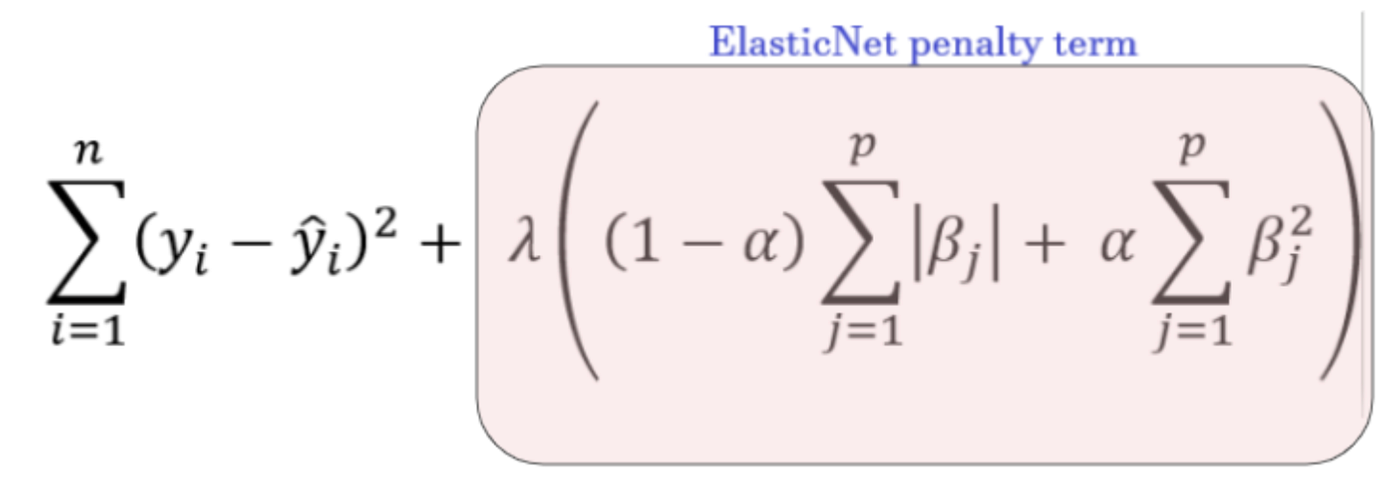
In some cases, you might want the benefits of both Lasso and Ridge regression. Elastic Net combines both L1 and L2 penalties. Elastic Net is useful when you have a large number of features and want to take advantage of both feature selection (Lasso) and handling multicollinearity (Ridge).
Formula:
Sourced from DataCamp training
Where
- α is the mixing parameter controlling the balance between Lasso and Ridge penalties.
Bias-Variance Impact:
- Allows you to fine-tune the bias-variance tradeoff using α and λ.
- Balances feature selection with coefficient stability.
Which One to Choose?
The decision of whether to use Lasso or Ridge depends largely on the nature of your data and your goals. Here’s a simple guide to help you decide:
Use Ridge Regression when:
- You believe all features contribute to the model and you want to shrink their influence rather than eliminate any.
- Your features are highly correlated (multicollinearity is an issue).
Use Lasso Regression when:
- You expect only a subset of features to be important, and you want the model to automatically select the most relevant ones.
- You want a simpler, more interpretable model with fewer variables.
Use Elastic Net when:
- “The elastic net is particularly useful when the number of predictors (p) is much bigger than the number of observations (n)” (Zou and Hastie, 2005, p. 301).
Both Lasso and Ridge regression are powerful tools to reduce overfitting, manage multicollinearity, and improve generalization in linear models. They achieve this by addressing the bias-variance tradeoff in different ways:
- Ridge keeps all features but reduces their magnitude — ideal for highly correlated or small datasets.
- Lasso removes irrelevant features and creates simpler models — great when interpretability or sparsity is key.
- Elastic Net lets you balance both strategies.
Understanding these techniques and knowing when to use them can significantly improve the accuracy, interpretability, and generalization of your machine learning models.
References:
Zou, Hui, and Trevor Hastie. 2005. “Regularization and Variable Selection Via the Elastic Net.” Journal of the Royal Statistical Society Series B: Statistical Methodology, Volume 67, Issue 2: 301–320.
James, Gareth, Daniela Witten, Trevor Hastie, and Robert Tibshirani. 2023. An Introduction to Statistical Learning with Applications in R. 2nd Edition.
LinkedIn: https://www.linkedin.com/in/selinkarabulut/
Portfolio: https://selinekarabulut.github.io/portfolio/
메타데이터
- post_id
- 2e16a67fc255
- slug
- when-to-use-lasso-ridge-or-elastic-net-regression-a-complete-guide-2e16a67fc255
- url
- https://medium.com/@SelinKarabulut/when-to-use-lasso-ridge-or-elastic-net-regression-a-complete-guide-2e16a67fc255
- canonical_url
- https://medium.com/@SelinKarabulut/when-to-use-lasso-ridge-or-elastic-net-regression-a-complete-guide-2e16a67fc255
- author_url
- https://medium.com/@SelinKarabulut
- status
- ok
- fetched_at
- 2026-08-03 03:34:50




