Is Your Data Actually Ready for AI? The Invisible Wall Behind Failed Enterprise Pilots
Every enterprise leader is chasing the same vision: deploying intelligent AI agents that automate customer workflows, utilizing…
Is Your Data Actually Ready for AI? The Invisible Wall Behind Failed Enterprise Pilots
Every enterprise leader is chasing the same vision: deploying intelligent AI agents that automate customer workflows, utilizing personalized Copilots to amplify team productivity, and leveraging predictive engines to outpace the competition. The market enthusiasm is undeniable.
Yet, behind the headlines lies an uncomfortable reality: most AI initiatives stall on the foundation, not the ambition.
According to industry reports, an overwhelming majority of generative AI pilots fail to make it to production. The roadblock isn’t a lack of engineering talent or access to sophisticated large language models (LLMs). The problem is almost always the data.
When you connect advanced AI systems to fragmented, un-cataloged, or ungoverned data estates, the results are predictable: hallucinations, security vulnerabilities, siloed experiments that fail to scale, and inconsistent analytics.
Before you invest another dollar into complex model fine-tuning or custom workflows, a critical question must be answered: Is your data actually ready for AI?
The Hidden Gaps Costing Enterprises Millions
When organizations rush to build AI capabilities without evaluating their current technical foundation, they often run into an invisible wall. These roadblocks typically stem from five core gaps:
- The Fragmented Data Estate: Vital corporate knowledge remains locked away inside isolated silos, legacy formats, and disparate cloud architectures. Without a unified source of truth, AI cannot gain a holistic understanding of your business operations.
- Inconsistent Platform Foundations: If your underlying engineering pipelines duplicate efforts or lack standard semantic models, your analytics remain inconsistent, making it virtually impossible to establish reliable AI grounding.
- Weak Knowledge Grounding: GenAI needs context to add value. If your knowledge bases (internal wikis, documentation, ticket histories) are poorly structured, AI outputs will lean toward generic responses or outright hallucinations rather than domain-specific intelligence.
- Governance and Operational Vulnerabilities: Scaling AI safely requires strict regulatory compliance, clear data lineage, and granular access controls. Without these, deploying AI introduces severe corporate risk.
- Strategy Without Execution: Many leaders possess a high-level vision for AI but lack a practical, sequenced plan that outlines exactly which datasets and workflows are technically viable today.
When these gaps are ignored, Generative AI remains trapped in the “demo phase” — impressive in a proof-of-concept, but too unreliable to be trusted with actual production workloads.
The 6 Pillars of True AI Readiness
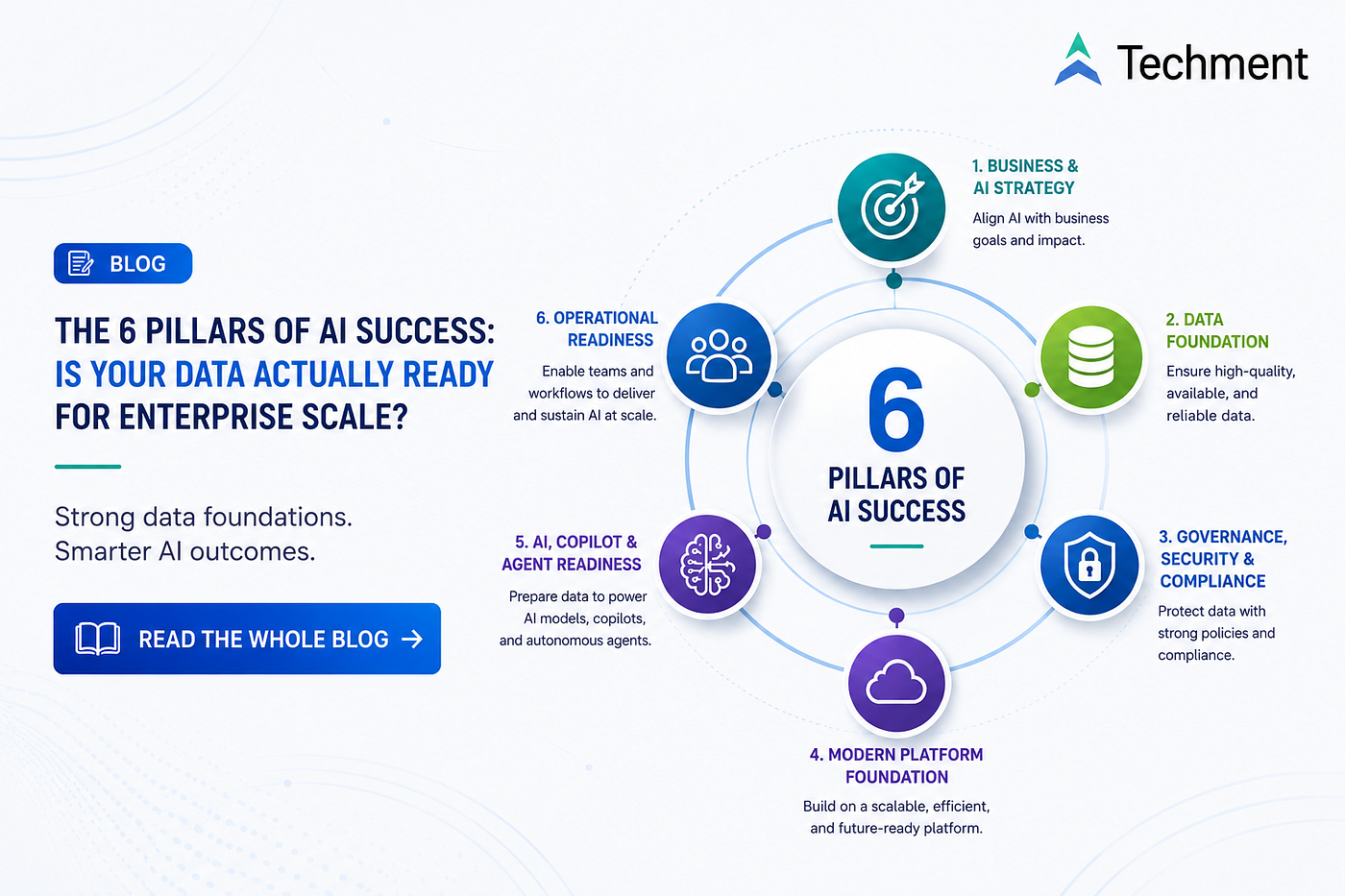
To move confidently from abstract strategic alignment to rapid, secure deployment, enterprises need a structured framework to evaluate where they stand. Techment’s approach categorizes this preparation across 6 Essential Pillars of AI Readiness:

- Business and AI Strategy: Identifying, evaluating, and ranking use cases by their exact operational and financial return, ensuring AI aligns directly with business metrics.
- Data Foundation: Assessing data quality, availability, ingestion throughput, and pipeline efficiency to establish a robust infrastructure.
- Governance, Security, and Compliance: Standardizing data lineage, automated policy controls, and regulatory guardrails so data scaling happens safely.
- Modern Platform Foundation (such as Microsoft Fabric): Evaluating your architecture to eliminate duplicate pipelines and optimize long-term cloud expenditure.
- AI, Copilot, and Agent Readiness: Analyzing how well internal data can ground modern conversational models and power autonomous agentic workflows.
- Operational Readiness: Diagnosing whether internal delivery structures, change-management strategies, and engineering workflows are prepared to absorb and maintain AI systems.
From Analysis to Action: Designing Your Strategy
An assessment shouldn’t just result in a report that sits on a shelf; it must yield a clear blueprint for immediate delivery.
Whether an organization needs a rapid baseline or a comprehensive strategic overhaul, a tactical assessment generally moves through several core engineering phases to turn uncertainty into a board-ready execution plan:

- Discovery & Analysis: Deep stakeholder interviews combined with data infrastructure discovery to inventory data sources and knowledge stores.
- Gap Identification: Deep-dive analysis of data quality logbooks and AI risks to generate empirical readiness scores across the organization.
- Target Architecture Design: Structuring a future-proof, unified technical blueprint — leveraging modern architectures like Microsoft Fabric — to remove architectural silos.
- Prioritization Matrix: Developing an evaluation matrix that maps out high-volume use cases against engineering feasibility.
- The 30–60–90 Day Roadmap: Constructing an actionable, ownership-mapped execution timeline that empowers engineering teams to kick off development sprints instantly.
Choosing Your Entry Point
Every enterprise is at a different stage of technological maturity. Depending on where your team currently stands, there are three logical entry points to uncover your readiness score:
- The 2-Week Readiness Sprint: Ideal for organizations at the early planning phase that need a fast, objective readiness baseline.
- The 4-Week Enterprise Assessment: A comprehensive evaluation that analyzes data estates, logs quality, models architecture, and provides a full transformation roadmap.
- The 6-Week Assessment + Prototype: The optimal path for leaders who want to validate their strategy with real code. This includes the entire enterprise assessment alongside a functioning, limited-scope GenAI prototype to prove business value to stakeholders.
Stop Guessing. Start Engineering.
AI transformation doesn’t fail because enterprises lack the vision to innovate — it fails because they overlook the foundation. By systematically auditing your architecture, data engineering pipelines, and governance frameworks, you can confidently secure project funding and accelerate your time-to-market.
Don’t let your generative AI initiatives stall out as isolated experiments. Ensure your infrastructure is built to scale safely, securely, and predictably.
Ready to uncover your enterprise readiness score and build an actionable, cost-optimized deployment blueprint? Explore Techment’s comprehensive AI & Data Readiness Assessment Services and take the guesswork out of your AI strategy.
메타데이터
- post_id
- 2e16ddc8527a
- slug
- is-your-data-actually-ready-for-ai-the-invisible-wall-behind-failed-enterprise-pilots-2e16ddc8527a
- url
- https://medium.com/@techment/is-your-data-actually-ready-for-ai-the-invisible-wall-behind-failed-enterprise-pilots-2e16ddc8527a
- canonical_url
- https://medium.com/@techment/is-your-data-actually-ready-for-ai-the-invisible-wall-behind-failed-enterprise-pilots-2e16ddc8527a
- author_url
- https://medium.com/@techment
- status
- ok
- fetched_at
- 2026-07-09 23:31:43