Implications of Fabric Sourcing Locations: What Global Buyers Should Consider
In last week’s article, we explored Taiwan as a sourcing destination, highlighting how decades of innovation and functional fabric…
Implications of Fabric Sourcing Locations: What Global Buyers Should Consider
Implications of Fabric Sourcing Locations: What Global Buyers Should Consider
In last week’s article, we explored Taiwan as a sourcing destination, highlighting how decades of innovation and functional fabric development have made it a unique hub. This week, let’s zoom out and look at sourcing locations more broadly — because where you source your fabrics can change everything about your business.
Why Sourcing Location Matters
Choosing where your fabrics come from is not just a logistical decision. It affects:
- Cost structure — Labor costs, material availability, and tariffs all vary by region.
- Lead times and logistics — Distance from your production site or end market impacts speed and flexibility.
- Quality standards — Different sourcing hubs build reputations around specific textile strengths.
- Sustainability impact — Energy sources, environmental regulations, and transport routes all shape the carbon footprint.
- Risk exposure — Political stability, supply chain reliability, and trade agreements matter more than ever.
Each of these dimensions can influence your profitability, competitiveness, and brand positioning.
Key Sourcing Hubs and Their Strengths
- China — Still the largest textile producer globally. Known for high-quality cotton fabrics (Xinjiang cotton being world-class), strong polyester production, and massive capacity for both basics and fashion. Cost competitiveness is narrowing due to rising wages.
- Vietnam — A fast-growing sourcing hub with strengths in synthetic blends and activewear fabrics, supported by foreign investment. Lower labor costs and improving infrastructure attract many international buyers.
- Bangladesh — Specializes in denim and basic knit fabrics used in large-scale garment manufacturing. Extremely cost-competitive, though less focused on high-tech or functional materials.
- Turkey — Well-regarded for denim, jacquards, and fashion-forward fabrics, plus its geographic advantage for quick delivery to Europe. Strong cluster of mills near Istanbul.
- Italy & Portugal — Premium hubs for luxury wool, fine knits, and artisanal finishing. Known for craftsmanship, heritage textiles, and sustainable production practices.
- Japan — Innovator in technical textiles, specialty denim, and cutting-edge synthetics, often combining tradition with advanced R&D.
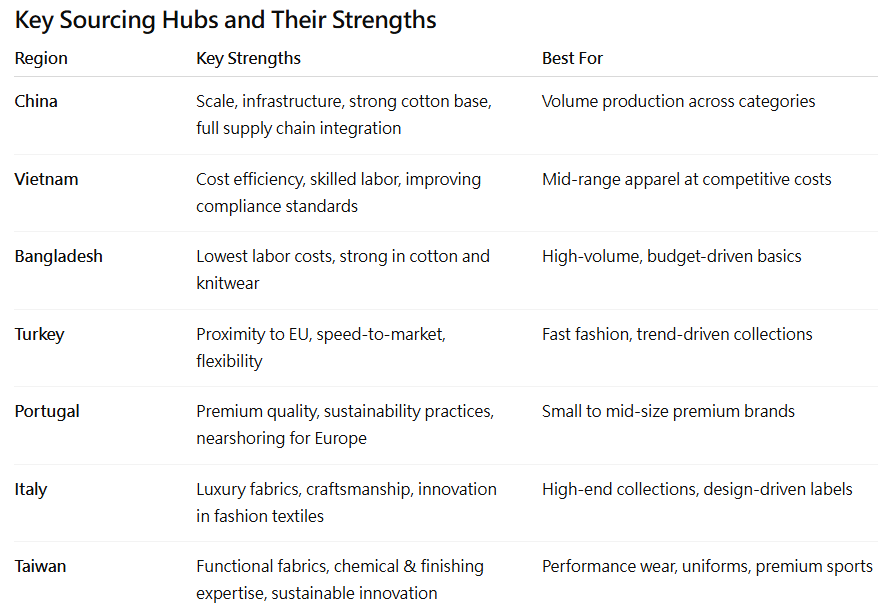
Key Fabric Sourcing Hubs and Their Strengths

Spotlight on Taiwan
Taiwan’s textile industry has always stood apart. Instead of competing purely on cost, it leveraged its strong base in chemical engineering and finishing techniques to become a global leader in functional fabrics.
From moisture-wicking sportswear to flame-retardant uniforms, UV-blocking apparel, and sustainable coatings, Taiwan has established itself as a go-to destination for performance textiles. Many of the world’s best-known brands — including Nike and Lululemon — rely on Taiwanese suppliers, though consumers rarely know it.
Balancing Sourcing Strategy
There’s no one-size-fits-all solution. A small brand with tight budgets may prefer Bangladesh or Vietnam. A premium label seeking innovation may find a better fit in Taiwan or Italy. Larger, established buyers often spread their sourcing across multiple hubs to balance cost efficiency, speed, and innovation.
No single sourcing location offers everything. Many successful brands adopt a portfolio approach, combining:
- High-volume basics from China, Bangladesh, or Vietnam.
- Functional or premium fabrics from Taiwan, Japan, or Europe.
- Nearshoring options for speed and flexibility.
This way, brands can manage costs while still differentiating with innovation and sustainability.
Final Thoughts
Fabric sourcing is never just about placing orders. It’s about aligning your business model and brand vision with the strengths of different regions. Whether your goal is affordability, speed, or differentiation, choosing the right sourcing hub is one of the most important strategic decisions you’ll make.
Let’s Discuss Where do you currently source your fabrics, and what has influenced your choice of location? Have you found that different regions complement each other in your sourcing strategy? Share your thoughts — I’d love to hear your perspective.
메타데이터
- post_id
- 2e2a8bce89df
- slug
- implications-of-fabric-sourcing-locations-what-global-buyers-should-consider-2e2a8bce89df
- url
- https://medium.com/@fanterco.melinda/implications-of-fabric-sourcing-locations-what-global-buyers-should-consider-2e2a8bce89df
- canonical_url
- https://medium.com/@fanterco.melinda/implications-of-fabric-sourcing-locations-what-global-buyers-should-consider-2e2a8bce89df
- author_url
- https://medium.com/@fanterco.melinda
- status
- ok
- fetched_at
- 2026-07-19 00:05:24