AI AND THINKING — Why AI Needs a Thinking Framework #13
AI and Thinking | Post 13 of 15
From Noise to Clarity | Track 4
AI AND THINKING — Why AI Needs a Thinking Framework #13
AI and Thinking | Post 13 of 15

Before you read: think of the last time an AI interaction produced something genuinely strategic rather than merely useful. What did you bring to that interaction before you typed the first word?
The Missing Variable
There is a common assumption about AI capability that leads people toward disappointing interactions. The assumption is that intelligence, their own and the tool’s, is enough. That if you are smart and the AI is powerful, useful output will follow.
It does not always follow. And the reason is not a lack of intelligence on either side. The reason is the absence of a thinking framework.
Without a framework shaping the interaction, AI tends to produce disconnected answers, shallow recommendations, and generic analysis. Not because the tool is incapable of more. Because the thinking surrounding the interaction lacks the structure that would direct it toward something more. Intelligence without structure produces drift. And drift is not the same as insight.
Visual Prompt 1: “What Happens Without a Framework” A hand-drawn sketchnote on a white background. A central AI icon with a vague prompt box on the left: “what should we do?” An arrow from the prompt to the AI icon, then an arrow right to an output area containing four scattered idea fragments pointing in different directions, none connected to the others. A handwritten label beneath the output area: “disconnected. generic. directionless.” A handwritten note beneath the full visual: “intelligence without structure produces drift.” Blue accent on the handwritten note only. Black ink throughout. White background. Rough sketch aesthetic.

What a Framework Actually Does
A thinking framework does several things that intelligence alone cannot. It defines the problem clearly before any answer is attempted. It separates the variables that matter from those that are merely present. It organises priorities so the interaction is directed toward what is most important rather than what is most immediately available. It surfaces the assumptions that might be shaping the question without being stated. It provides a structure for evaluating the output against something specific rather than accepting it because it sounds complete.
In short, frameworks create thinking discipline. And AI performs significantly better when thinking discipline is already present in the person using it.
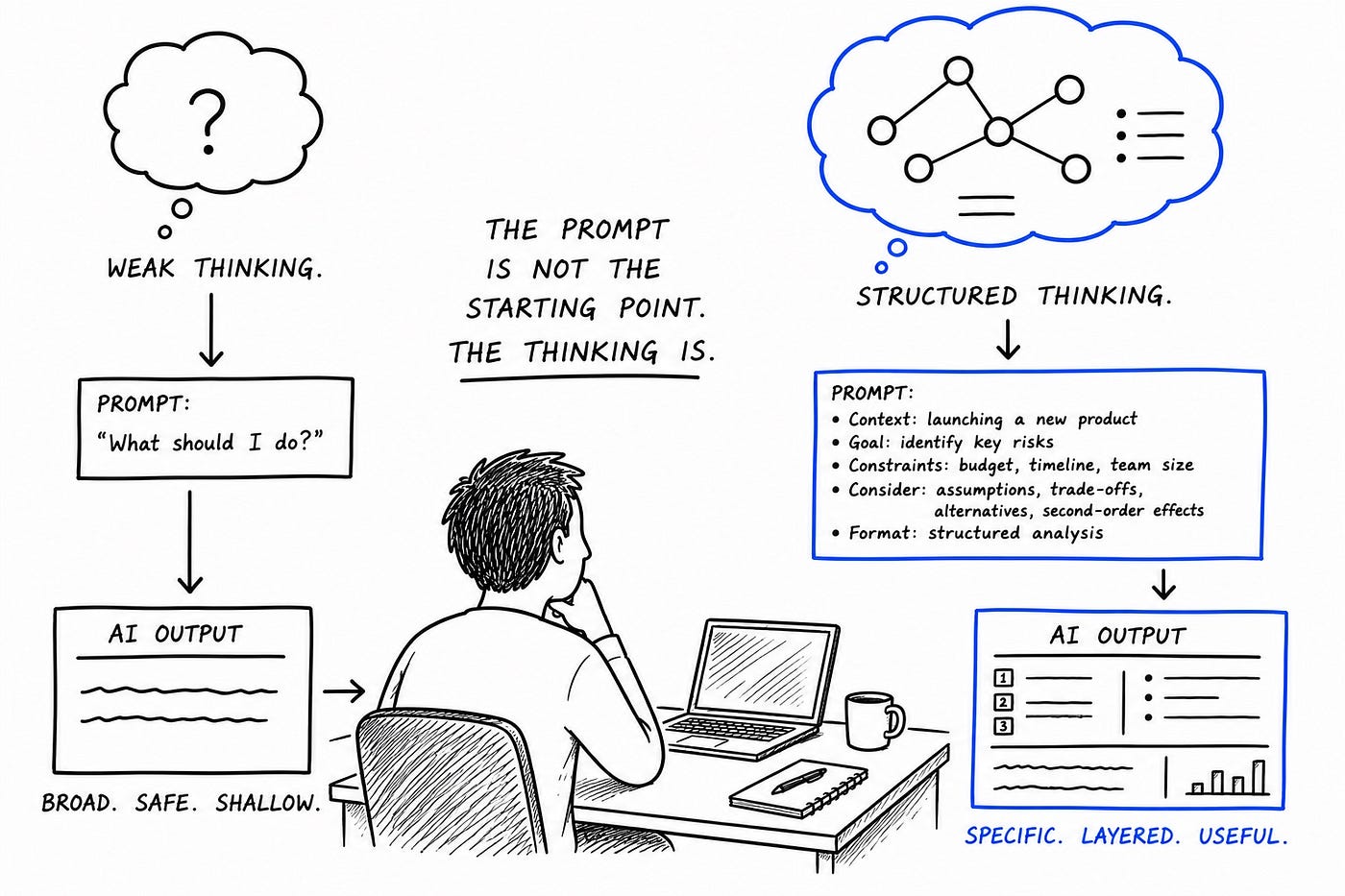
The difference becomes visible in practice. Consider two people facing the same business challenge. The first asks: “What should we do?” The second asks a structured sequence of questions. What assumptions are driving this situation? Which variables matter most and which are secondary? What trade offs are being ignored by the most obvious solution? How would this decision affect different stakeholders whose perspectives are not currently represented? What changes if the core assumption underlying the current strategy turns out to be wrong?
The second person is not merely prompting better. They are thinking better. The framework they are applying before they type a single word is organising the interaction toward insight rather than output. And AI responds accordingly.
Visual Prompt 2: “The Same Challenge. Very Different Interactions.” A two-column hand-drawn sketchnote on a white background. Both columns begin with the same handwritten label at the top: “same business challenge.” Left column header: “no framework” with a handwritten underline. A single prompt box: “what should we do?” An arrow to an AI output box labelled: “generic recommendations.” A handwritten label beneath: “output without direction.” Right column header: “with framework” with a handwritten underline in blue. Five structured question boxes stacked: “what assumptions are driving this?” “which variables matter most?” “what trade offs are ignored?” “how does this affect different stakeholders?” “what if the core assumption fails?” An arrow to an AI output box labelled: “strategic, contextual, evaluative.” A handwritten label beneath: “output with direction.” A handwritten note between the columns at the bottom: “the framework is the difference.” Blue accent on the right column header, question boxes, and output box only. Black ink throughout. White background. Rough sketch aesthetic.

Why Visual Thinking Frameworks Have a Specific Advantage
For sixteen years I have worked with professionals on how to organise their thinking before they try to act on it. The consistent pattern I have observed is that people who work with visual frameworks tend to arrive at AI interactions with significantly more structure than those who do not.
Visual thinking frameworks do something specific. They make complexity visible before you try to resolve it. They force you to organise relationships between ideas rather than hold them loosely in mind. They help you identify the gaps in your current understanding before you ask AI to fill them. They allow you to compare scenarios side by side rather than sequentially. And they help you hold competing ideas simultaneously rather than resolving the tension between them too quickly.
Each of these capabilities directly improves the quality of an AI interaction. When you can see the structure of a problem before you prompt, you prompt with more precision. When you can see the gaps, you ask AI to address specific ones rather than the problem in general. When you can hold competing ideas, you ask AI to help you examine the tension rather than resolve it on your behalf.
This is why visual thinking is not just a communication skill in the AI era. It is a thinking discipline that produces the cognitive architecture AI needs to be genuinely useful. The framework is not the output. It is what makes the output worth having.
Visual Prompt 3: “What a Visual Thinking Framework Brings to AI” A hand-drawn sketchnote on a white background. A structured visual framework diagram on the left, hand-drawn with connected nodes and clear sections, labelled with four handwritten annotations: “makes complexity visible,” “organises relationships,” “identifies gaps,” “holds competing ideas.” A blue arrow pointing right from the framework to a prompt box labelled “structured prompt.” A second blue arrow pointing right from the prompt box to an AI icon. A third blue arrow pointing right from the AI icon to a layered output box labelled: “strategic. contextual. evaluative.” A handwritten note beneath the full sequence: “the framework is not the output. it is what makes the output worth having.” Blue accent on all three arrows and the framework annotations. Black ink throughout. White background. Rough sketch aesthetic.

A Reflection Worth Sitting With
AI generates output. Frameworks guide thinking. And without guided thinking, even a powerful system produces results that drift rather than direct.
The future advantage will not belong to the people with the most advanced tools. It will belong to the people who bring strong thinking frameworks to those tools. Because the framework is what turns AI capability into genuine strategic value.
Think of a complex challenge you are currently facing. Before your next AI interaction on that challenge, try building a simple framework first. Define the problem, separate the key variables, name the assumptions, and identify the trade offs. Then prompt. Notice what changes.
The next post looks at how to develop the thinking habits that make you a stronger AI user over time, and why those habits are more valuable than any single prompting technique.

I am Ai Yat Goh, a visual thinking strategist and co-author of The S.T.A.R. System. I write about thinking clearly in a world full of noise. Follow me here on Medium for the rest of this series, or connect with me on LinkedIn www.linkedin.com/in/aiyatgoh
VisualThinking #ArtificialIntelligence #Leadership #CriticalThinking #StrategicThinking
메타데이터
- post_id
- 2e3069b1c656
- slug
- ai-and-thinking-why-ai-needs-a-thinking-framework-13-2e3069b1c656
- url
- https://medium.com/@aiyat.goh/ai-and-thinking-why-ai-needs-a-thinking-framework-13-2e3069b1c656
- canonical_url
- https://medium.com/@aiyat.goh/ai-and-thinking-why-ai-needs-a-thinking-framework-13-2e3069b1c656
- author_url
- https://medium.com/@aiyat.goh
- status
- ok
- fetched_at
- 2026-06-09 15:37:30