How to Reduce Cart Abandonment and Recover Lost Sales
Your store. The prospect lands and looks through all the pages. They fill up a shopping cart and POOF. They’re gone. Not buying, with no…
How to Reduce Cart Abandonment and Recover Lost Sales
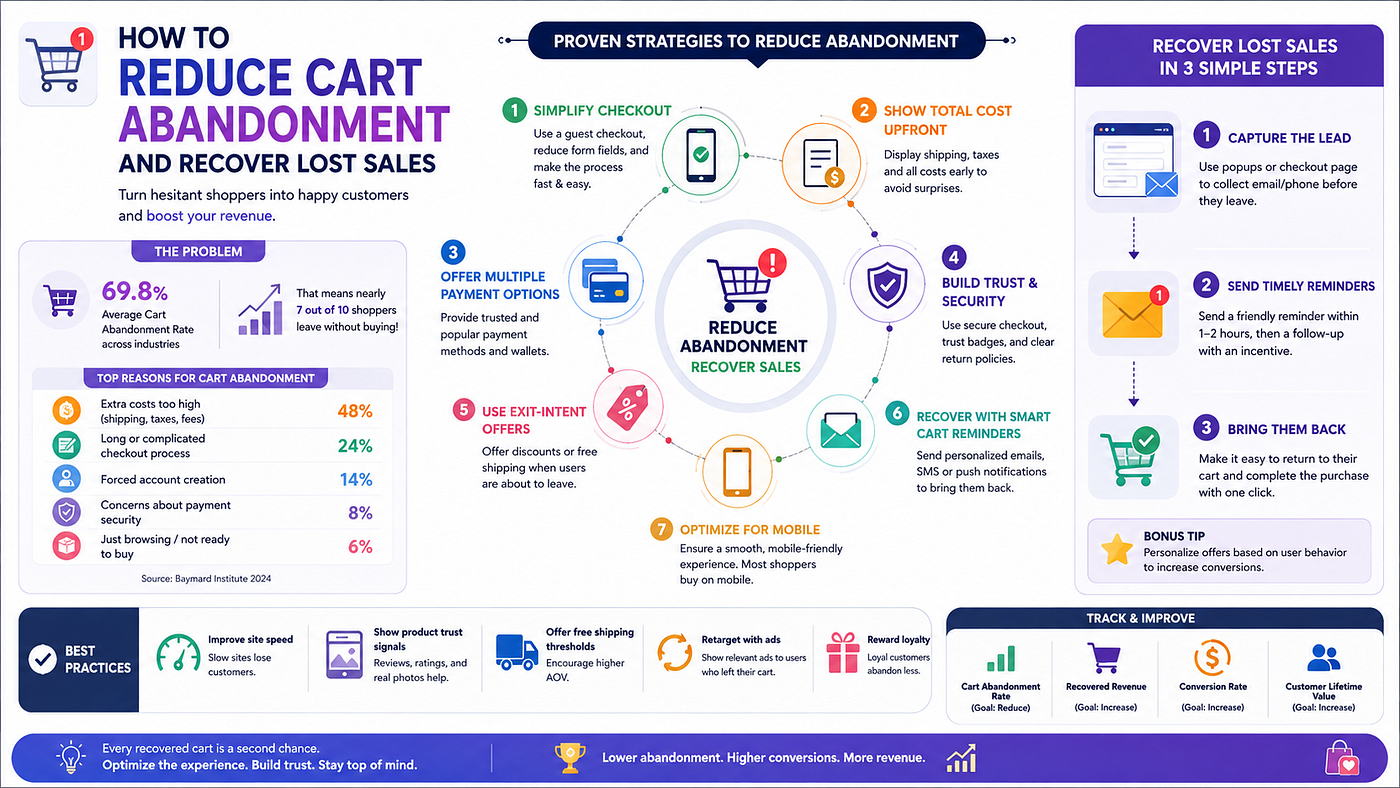
Your store. The prospect lands and looks through all the pages. They fill up a shopping cart and POOF. They’re gone. Not buying, with no explanation. Only an abandoned cart and a lost sale. This happens every day of the week; at least it does for online businesses anyway. It’s called cart abandonment, and the numbers have been sitting well over 70% for the past year or so.
So if an online shopping cart can be abandoned, why not mine? That seems like you’d be missing potential income, right? Yes, it does. But that does not mean that that problem couldn’t be solved and measured without too much change of what you’re doing now. Here are a few small e-commerce operational changes you can make that could affect your cart abandonments and put more cash into your pocket: Here is how.
Why Shoppers Abandon Their Carts
Before fixing the problem, it helps to understand why it happens in the first place. The most common reasons shoppers abandon carts include:
- Unexpected costs at checkout, like shipping fees or taxes that weren’t visible earlier
- Forced account creation before completing a purchase
- A checkout process that feels too long or asks for unnecessary information
- Limited payment options, especially missing popular methods like digital wallets
- Slow page load times, particularly on mobile devices
- A simple distraction: the shopper genuinely intended to buy later but forgot
Understanding which of these applies most to your store is the first step in e-commerce checkout optimization.
Strategies to Reduce Cart Abandonment
Share Costs up front
Surprise fees at the payment stage are a death knell. Include any estimated shipping and taxes as far up the process as you can, ideally in your product descriptions or on your shopping cart page, before even initiating checkout.
Let People Check Out As Guest
Demanding that prospects create accounts forces them to jump an extra hurdle just when you want to lower the bar to conversion. Instead, let them skip an account (they can sign up afterwards), removing some friction in the purchase process.
Tighten Up Your Checkout Process
Every added click and every required field increases friction when your user wants a smooth and rapid experience. Streamline checkout and keep things simple; your users will thank you for it. If it’s possible, aim for a one-page checkout, rather than a lengthy series of multiple pages.
Broaden Payment Options
Consumers’ preferences shift, and offering various payment options, from digital wallets to buy-now-pay-later (BNPL) services (not only credit cards!), is an ever more important convenience tool in a merchant’s belt to keep their customers from abandoning their carts. The easier your customer can pay, the lower the rate of abandoned carts.
Optimize for Mobile Devices
Most online browsing and shopping occur on phones nowadays, so a streamlined and effortless experience for mobile customers is essential. If your checkout isn’t quick and straightforward on smartphones, a significant part of your traffic will walk away before reaching the payment step of the process.
Strategize on Exit-Intent Popup Uses
Sometimes a helpful nudge in the form of pop-up messages triggered while a user is leaving your website, offering a last-minute deal or just reminding them about a cart’s content, could lead a potential buyer to finalize their purchase, rather than walk empty-handed, the second a user moves their cursor or presses a button to leave.
Recovering Abandoned Carts After the Fact
Some people will always leave, no matter how smooth and intuitive the checkout process. And when that happens, the sale isn’t always necessarily lost—at least not forever. Abandoned cart emails still provide one of the most powerful recovery tools available: a timely sequence of emails sent usually within an hour of a shopper abandoning their cart to gently nudge them back and remind them about the goods they left behind.
Retargeting ads placed on social media and display networks work well to bring shoppers back days after their original purchase, even if they never saw a recovery email. For timely offers, SMS reminders are another powerful technique to re-engage shoppers, since SMS message open rates typically outperform email open rates. With all these methods, timing and tone are key; recovery messages should be helpful and reminding, not aggressive sales pitches.
Measuring Your Progress
To tell if your changes are working, monitor your cart abandonment rate consistently over time instead of only as a one-off check. Segment the data wherever you can, such as by device type, traffic source, and checkout step, to pinpoint which areas cause customers to leave the process. Incremental testing usually beats large changes. Adjusting one element in your checkout flow at a time makes it much easier to determine whether it caused customers to buy or abandon the purchase.
Conclusion
Cart abandonment can never reach zero; some of your customers will always browse without intending to buy. However, if you fix major issues that irritate most users, such as unexpected charges, overwhelming order forms, or an insufficient range of payment methods, you should reduce cart abandonment considerably. With abandoned shopping cart emails or another recovery plan, you may take up more of the amount of cash left on the board. Handle every optimization of your checkout as part of the actual continuous improvement process, not a one-off fixed solution. Modest and gradual upgrades quickly accumulate into substantial returns over the duration of months and years and convert lost sales to your regular source of revenue.
Frequently Asked Questions:
What can we consider a favorable cart abandonment rate for the internet store?
The abandonment percentage varies widely across industries; however, many retailers get an approximately 60–80% abandonment rate. Our targets should not be to try to eradicate this altogether but rather to make a slight, stable decrease in these percentage points and consequently recoup further abandoned earnings using recovery emails and also various other methods.
How quickly should you send an abandoned shopping cart email?
Typically, sending an abandoned shopping cart reminder not just as soon as, but rather within one hour after the abandonment happens, performs best, followed up typically by not more than a couple of additional abandoned cart emails across a few days.
Will discounts definitely always motivate recuperating abandoned cart items?
Certainly not necessarily. You might offer a cost cut to several customers; however, a few individuals may be driven by getting rid of inconveniences and aggravation related to the checkout experience instead.
Do guest purchasing carts help enhance store abandonment?
Yes. They will not just assist in reducing abandonment rates, but the number of customers will indeed opt to shop at online merchants where there are no demands to register an account.
Exactly how can I establish where in my online shopping cart people exit my website?
To determine precisely where they are departing, employ an e-commerce store data and analytics tool to figure out cart abandonment costs. You’ll have the ability to review cart abandonment rates and abandonment points to see where the actual abandonment rate peaks.
메타데이터
- post_id
- 2e32a1572fd9
- slug
- how-to-reduce-cart-abandonment-and-recover-lost-sales-2e32a1572fd9
- url
- https://medium.com/@sajidmaria198/how-to-reduce-cart-abandonment-and-recover-lost-sales-2e32a1572fd9
- canonical_url
- https://medium.com/@sajidmaria198/how-to-reduce-cart-abandonment-and-recover-lost-sales-2e32a1572fd9
- author_url
- https://medium.com/@sajidmaria198
- status
- ok
- fetched_at
- 2026-08-12 00:09:20