Java Interview Questions from a Top Company: EY (Based on My Personal Experience)
Preparing for Java interviews at leading consulting and technology-driven organizations like EY (Ernst & Young) requires much more than…
Java Interview Questions from a Top Company: EY (Based on My Personal Experience)
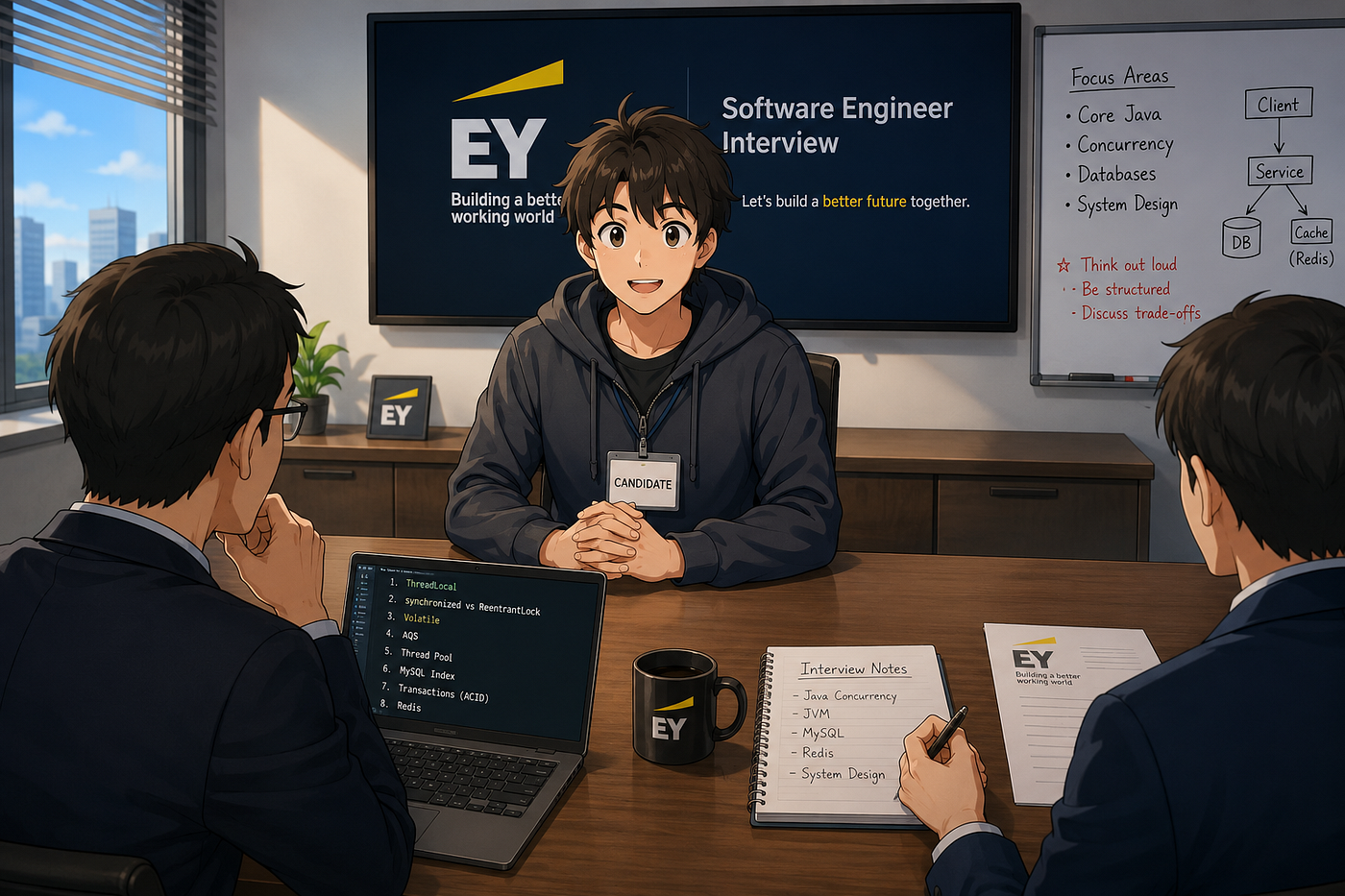
AI image
Preparing for Java interviews at leading consulting and technology-driven organizations like EY (Ernst & Young) requires much more than memorizing syntax. Modern interviews focus heavily on concurrency, JVM internals, database optimization, distributed systems, and practical problem-solving skills.
In this article, I’ll share some of the important interview topics and questions that I encountered during my interview preparation and discussions with engineers. These questions are highly relevant for senior Java developers, backend engineers, and architects.
1. ThreadLocal
1.1 What is ThreadLocal?
ThreadLocal is a utility class in Java that provides thread-local variables. Each thread has its own independent copy of a variable, which means data stored in one thread is completely isolated from other threads.
Its primary purpose is:
- Thread-level data isolation
- Avoiding synchronization overhead
- Maintaining user context, transaction context, or request information
Examples:
- User session information
- Database connections
- Request tracing IDs
- Security contexts
Unlike global variables, ThreadLocal creates a global variable only for the current thread.
1.2 How Does ThreadLocal Work Internally?
Internally, ThreadLocal relies on an inner data structure called ThreadLocalMap.
Each Thread object contains:
Thread.threadLocalsThis field references a ThreadLocalMap, which stores:
Entry {
    WeakReference<ThreadLocal<?>> key;
    Object value;
}
Important Points
- Key → Weak Reference (
ThreadLocal) - Value → Strong Reference (actual data)
Because the key is a weak reference, it can be garbage collected. However, the value remains strongly referenced inside the map, which can potentially cause memory leaks, especially in thread pools.
Example
public void set(T value) {
    Thread t = Thread.currentThread();
    ThreadLocalMap map = getMap(t);

if (map != null)
        map.set(this, value);
    else
        createMap(t, value);
}
Best Practice
Always call:
threadLocal.remove();especially when using:
- Thread pools
- ExecutorService
- Web servers
- Asynchronous processing
Failing to remove ThreadLocal values may result in:
- Memory leaks
- Data corruption
- User context leakage across requests
2. Synchronization and Locking
2.1 Difference Between synchronized and ReentrantLock

Lock Escalation in synchronized
Java performs lock optimization automatically:
Biased Lock
     ↓
Lightweight Lock
     ↓
Heavyweight Lock
Biased Lock
Optimized for single-thread access.
Lightweight Lock
Uses CAS and spinning.
Heavyweight Lock
Involves OS-level mutexes and thread blocking.
2.2 How Does volatile Guarantee Visibility and Ordering?
Visibility
When a variable is declared as volatile:
volatile int count;Any modification is immediately flushed to main memory.
Other threads read directly from main memory instead of CPU cache.
Ordering
The JVM inserts memory barriers:
- Load Barrier
- Store Barrier
This prevents:
- Instruction reordering
- CPU optimizations that violate happens-before relationships
Does volatile Guarantee Atomicity?
No.
This operation is not atomic:
count++;It consists of:
- Read
- Increment
- Write
Multiple threads can still interfere with one another.
For atomic operations, use:
- AtomicInteger
- LongAdder
- synchronized
- ReentrantLock
2.3 How Can Java Avoid Deadlocks?
1. Lock Ordering
Always acquire locks in the same order.
Lock A → Lock BNever:
Thread1 : A → B
Thread2 : B → A
2. Lock Timeout
lock.tryLock(5, TimeUnit.SECONDS)Avoid waiting indefinitely.
3. Deadlock Detection
Use:
jstack
jconsole
visualvm
to detect blocked threads.
3. Multithreading and Thread Pools
3.1 Thread Lifecycle
Java threads generally move through these states:
- New
- Runnable
- Running
- Blocked / Waiting / Timed Waiting
- Terminated
A typical lifecycle looks like:
New
 ↓
Runnable
 ↓
Running
 ↓
Blocked/Waiting
 ↓
Terminated
3.2 How Do You Get a Return Value from a Thread?
The preferred approach is:
Callable + FutureTask
Callable<String> task = () -> "Hello EY";

FutureTask<String> future =
        new FutureTask<>(task);
new Thread(future).start();
String result = future.get();
The Callable interface allows:
- Returning values
- Throwing checked exceptions
3.3 Why Use Thread Pools?
Creating threads is expensive.
Thread pools help:
Reduce Resource Consumption
Avoid repeated creation and destruction of threads.
Improve Response Time
Threads are pre-created and immediately available.
Improve System Stability
Control the number of concurrent threads.
Important ThreadPoolExecutor Parameters
ThreadPoolExecutor(
corePoolSize,
maximumPoolSize,
keepAliveTime,
TimeUnit,
BlockingQueue,
ThreadFactory,
RejectedExecutionHandler)
Core Parameters
- Core Thread Count
- Maximum Thread Count
- Keep Alive Time
- Task Queue
- Thread Factory
- Rejection Policy
4. Concurrency Fundamentals
Parallel vs Serial vs Concurrent
Serial
Tasks execute one after another.
A → B → CConcurrent
Tasks appear to run simultaneously but share CPU time.
A ↔ B ↔ CParallel
Tasks truly execute at the same time on multiple cores.
A || B || C5. Understanding AQS (AbstractQueuedSynchronizer)
AQS is the core synchronization framework in Java.
Classes built on AQS:
- ReentrantLock
- Semaphore
- CountDownLatch
- ReentrantReadWriteLock
- FutureTask
Internal Structure
AQS maintains:
state
A volatile integer.
CLH Queue
A doubly linked waiting queue of blocked threads.
How ReentrantLock Works
state = 0
No thread owns the lock.
Thread acquires lock:
state = 1Re-enters:
state = 2Releases:
state--When:
state = 0the lock becomes available.
6. MySQL Interview Questions
6.1 Should String Be Used as an Index?
Technically yes.
Practically, it is usually not recommended.
Why?
String indexes:
- Consume more space
- Increase maintenance cost
- Cause page splits
- Increase B+Tree height
Most systems prefer:
BIGINT AUTO_INCREMENTinstead of:
UUIDbecause sequential IDs maintain index locality.
6.2 What is an Index?
An index is a data structure designed for:
Fast Data Retrieval
When Should We Create Indexes?
- Frequently queried columns
- WHERE conditions
- JOIN columns
- ORDER BY columns
- GROUP BY columns
When Should We Avoid Indexes?
- Frequently updated columns
- Small tables
- Low-selectivity columns
- Computed expressions
6.3 Why Does an Index Become Invalid?
Common reasons:
Small Tables
Full table scan may be cheaper.
Function Usage
WHERE YEAR(create_time)=2026Index becomes ineffective.
Range Queries
>
<
BETWEEN
LIKE '%abc'
Low Selectivity
Too many duplicate values reduce index usefulness.
6.4 How to Check Index Usage?
Explain Execution Plan
EXPLAIN
SELECT * FROM users;
View Indexes
SHOW INDEXES FROM users;6.5 Composite Index and Leftmost Prefix Principle
Example:
INDEX(a,b,c,d)Queries:
WHERE a=1Uses index.
WHERE a=1 AND b=2Uses index.
WHERE a=1 AND b=2 AND c>5Stops after c.
d becomes unusable because range queries break index ordering.
6.6 Why Does MySQL Use B+ Trees?
B Tree
- Data stored in all nodes.
- More disk I/O.
B+ Tree
- Data stored only in leaf nodes.
- Internal nodes contain only keys.
- Leaf nodes are linked.
Advantages:
- Lower tree height
- Fewer disk reads
- Better range query performance
- Predictable query cost
This is why InnoDB chooses B+ Trees.
6.7 Covering Index
If all required columns exist inside the index:
SELECT name, age
FROM users
WHERE id=1;
No table lookup is required.
Benefits:
- Reduced I/O
- Faster execution
- Better cache utilization
6.8 MySQL Lock Types
Row Lock
- Shared Lock (S)
- Exclusive Lock (X)
Supported by InnoDB.
Table Lock
Locks the entire table.
Lower overhead but lower concurrency.
Global Lock
Entire database becomes read-only.
Typically used for:
- Full backups
- Data migration
7. Database Sharding
Generally considered when:
- Table size exceeds tens of millions of rows
- Query latency increases significantly
Vertical Sharding
Split tables by business domain.
Example:
User Table
Order Table
Payment Table
Horizontal Sharding
Split rows.
Example:
User_0
User_1
User_2
based on:
userId % 38. Transaction Fundamentals (ACID)
Atomicity
All succeed or all fail.
Consistency
Data remains valid before and after transactions.
Isolation
Concurrent transactions do not interfere.
Durability
Committed data is permanently stored.
9. MySQL Isolation Levels
Read Uncommitted
Allows dirty reads.
Read Committed
Prevents dirty reads.
Allows non-repeatable reads.
Repeatable Read (MySQL Default)
Prevents:
- Dirty reads
- Non-repeatable reads
May still experience phantom reads under certain scenarios.
Serializable
Highest isolation.
Transactions execute serially.
Highest consistency, lowest concurrency.
10. Redis Interview Questions
Cache Avalanche
Large numbers of keys expire simultaneously.
Solution
- Randomized TTL
- Cache preheating
Cache Penetration
Data does not exist in:
- Redis
- Database
Solution
- Bloom Filter
- Parameter validation
- Cache empty values
Cache Breakdown
Hot key expires.
Massive traffic directly hits the database.
Solution
- Never expire hot keys
- Mutex locks
- Logical expiration
11. Database and Redis Consistency
A commonly used approach:
Delayed Double Delete
Delete Cache
     ↓
Update Database
     ↓
Delete Cache Again
This minimizes stale data issues.
Large-scale systems may additionally use:
- MQ-based serialization
- Ordered queues
- Binlog synchronization
- CDC pipelines
12. Redis Data Structures and Their Use Cases

Final Thoughts
Interviews at companies like EY increasingly focus on practical engineering knowledge rather than theoretical definitions. Topics such as:
- Java Concurrency
- Thread Pools
- AQS Internals
- JVM
- MySQL Indexing
- Transactions
- Redis Architecture
- Database Sharding
- Distributed System Design
are fundamental for senior backend roles.
If you’re preparing for Java interviews in 2026, mastering these concepts with real-world scenarios and implementation details will significantly improve your chances of success.
Thank you for reading!
If you found this article useful, feel free to give it a clap 👏, share it with your friends, and follow for more deep dives into distributed systems, Spring Boot architecture, Kafka, Redis, and high-scale backend engineering.
😊 Your support is the biggest motivation to continue sharing technical insights.
메타데이터
- post_id
- 2e3e64e84c98
- slug
- java-interview-questions-from-a-top-company-ey-based-on-my-personal-experience-2e3e64e84c98
- url
- https://medium.com/codetutorials/java-interview-questions-from-a-top-company-ey-based-on-my-personal-experience-2e3e64e84c98
- canonical_url
- https://medium.com/codetutorials/java-interview-questions-from-a-top-company-ey-based-on-my-personal-experience-2e3e64e84c98
- author_url
- https://medium.com/@umeshcapg
- status
- ok
- fetched_at
- 2026-07-09 08:27:28