I Became One of the Rarest Technology Executives in the Country. Then I Started Counting.
In April 2026, I was appointed Chief AI Officer and CTO of Medical Knowledge Group, a Novo Holdings-backed pharma services company based in…
I Became One of the Rarest Technology Executives in the Country. Then I Started Counting.
In April 2026, I was appointed Chief AI Officer and CTO of Medical Knowledge Group, a Novo Holdings-backed pharma services company based in New York City. It was a role I had been building toward for over a decade, and when it became official, my first instinct was to celebrate. My second was to get curious.
Specifically, I wanted to know: how many people actually hold this title? And of those people, how many are women?
With the help of my assistant (for my llc), I did some research. The CAIO role is new enough that the data is thin, scattered, and often contradictory, but we found some interesting material. Every data point in this piece is sourced from research published between January 2025 and May 2026, or from original census research my team compiled in April 2026. We did not use older data. If a number is here, we checked it. What we found was more specific, and more stark, than I expected.
This is what we found.
The CAIO Role Is Exploding. The Diversity Is Not.
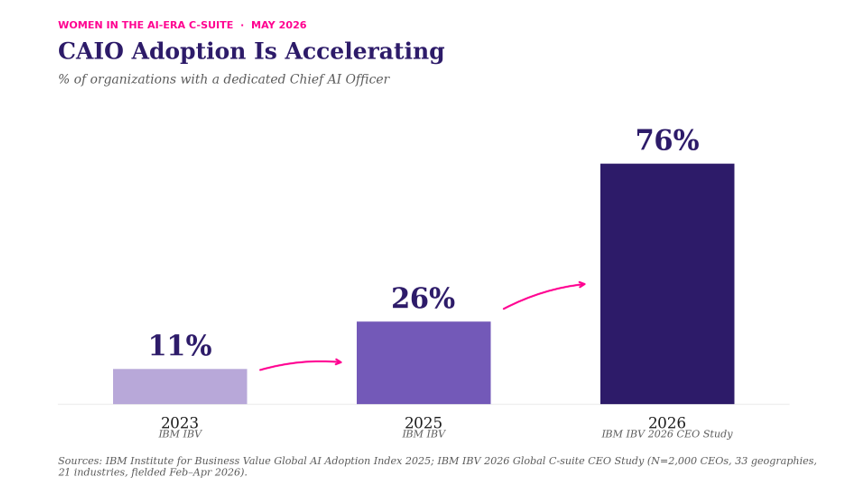
The Chief AI Officer title barely existed three years ago. IBM’s 2026 Global C-suite CEO Study, surveying 2,000 CEOs across 33 geographies and 21 industries between February and April 2026, reports that 76% of organizations now have a Chief AI Officer. A year earlier, IBM’s Institute for Business Value put that figure at 26%. Two years before that, it was 11%.
That is the steepest growth curve for any C-suite title in modern memory.
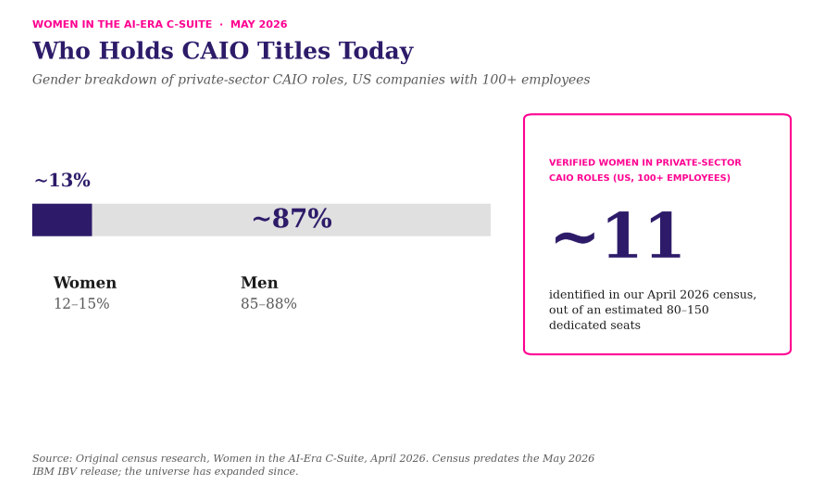
And yet the gender composition of the role is not keeping pace. Our original census research, compiled in April 2026, identified approximately 11 women in private-sector CAIO roles at US companies with 100 or more employees. Across all sectors including government, fewer than 25 women currently hold the title in the United States. That is out of an estimated 80 to 150 dedicated seats in the private sector alone, and several hundred more executives holding functionally equivalent titles.
Somewhere between 12 and 15 percent of private-sector CAIO roles are held by women. And that estimate is generous.
The census was completed just before IBM’s May 2026 data published. The absolute number of women in the role has almost certainly grown since, but the universe has grown faster. Whether the proportion has held, improved, or deteriorated is the central open question.
The CAIO role is being filled primarily from the existing data science and technology leadership pipeline, and that pipeline skews heavily male. This was never going to produce gender diversity automatically. It requires deliberate effort, and right now, the data does not show that effort happening at scale.
What this means: The CAIO title is being defined right now, by the people appointed to it right now. The role does not have 30 years of incumbents and patterns to draw from. That is an opportunity. But if the current trajectory holds, the gender composition of this new title will look a lot like the old ones.
The Numbers Behind the Numbers
Understanding how rare this profile actually is requires layering the filters.
Start with gender. Women hold approximately 12 to 15% of CAIO seats at US companies with 100 or more employees, according to our original census research for this report. Russell Reynolds Associates’ Architects of Change report, published May 2025 and covering 498 Fortune 500 technology officers, found 18% of technology officer roles combined are held by women, aggregating across CTO, CIO, CDO and hybrid titles. The CAIO is tracking closer to the CTO end of that range, replicating the most male-dominated technology executive patterns rather than the more balanced CIO pipeline, which made meaningful progress over two decades.
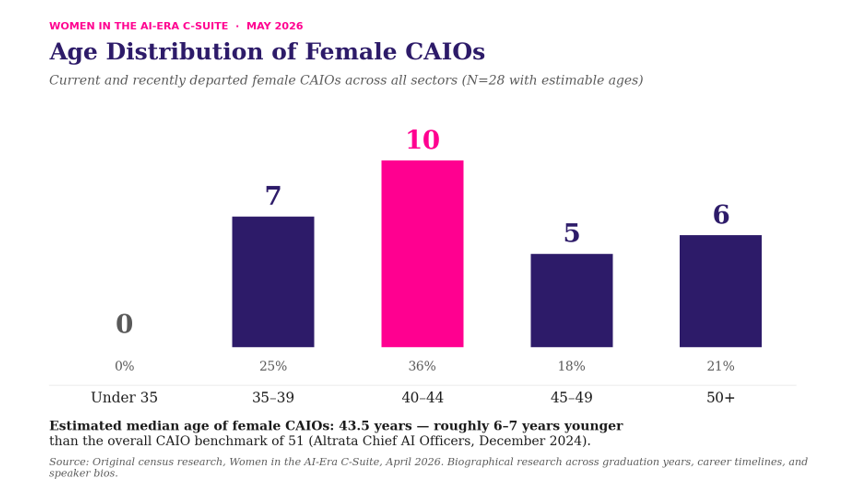
Add age. Our census of current and recently departed female CAIOs across all sectors identified 28 individuals with estimable ages. Of those 28, none are under 35. Seven are between 35 and 39. Ten are between 40 and 44. The estimated median age for female CAIOs is approximately 43.5 years, roughly six to seven years younger than the overall CAIO average of 51. Women are reaching the role through more compressed, technically-driven pathways rather than the traditional long-tenure general management track.
Add sector. Restrict to healthcare, specifically PE-backed healthcare, and the universe shrinks again. Compound probability analysis of a profile combining female, age 35 or younger, dual CTO and CAIO title, at a PE-backed healthcare company places that profile in the top 0.001% of technology C-suite executives in the United States. Our research found approximately zero to two individuals matching that description currently. I am one of them.
This is not to brag. I genuinely did not know that when I took the role. And I think more women should know what they are walking into, and what it means, before they get there.
What this means: When you filter for gender, age, sector, and title simultaneously, the number of people in this profile drops to essentially zero. That rarity is not a reason to feel isolated. It is a reason to understand the landscape clearly and move through it with that knowledge.
Healthcare Is the Exception. Mostly.
One sector stands out in this data, and it is the one I work in.
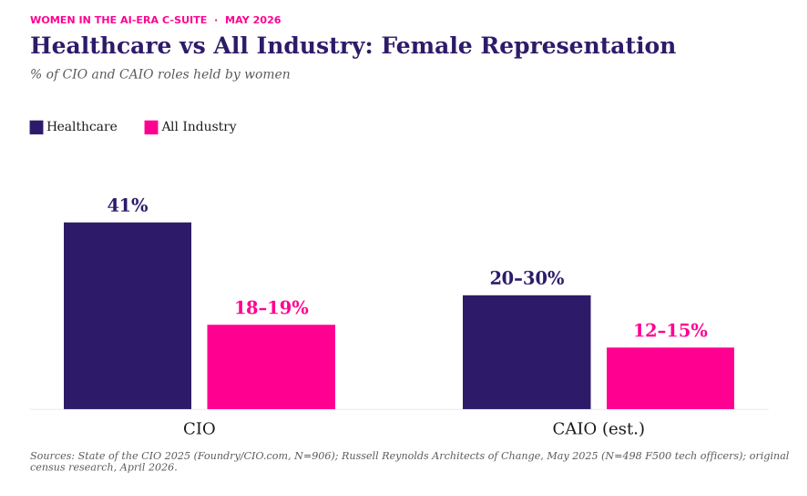
Healthcare dramatically outperforms every other industry for female CIO representation. The Foundry and CIO.com’s State of the CIO 2025 survey, which covered 906 IT leaders, found that 41% of healthcare CIOs are women, compared to 24% across all sectors. That is nearly double the all-industry average. The CHIME Salary Survey from 2018 separately reported approximately 27% for hospital and health system CIO members specifically, a figure that has not been refreshed in seven years.
The structural reason is not complicated. Women comprise a substantial majority of the healthcare workforce broadly, and the leadership pipeline reflects that reality, at least up to a point. The cliff happens at the VP-to-C-suite transition. And when you look specifically at the CAIO, healthcare’s strength in CIO representation does not carry over cleanly.
Among major health systems and pharma companies appointing dedicated CAIOs, male appointees still dominate the most prominent organizations. The female healthcare CAIOs I identified in our research include Berta Rodriguez-Hervas at Pfizer, Divya Pathak at Regeneron, Ashley Beecy at Sutter Health, Alda Mizaku at Children’s National Hospital, Sara Murray at UCSF Health, and Maggie Helms at HealthPartners. That is a real and meaningful list. It is also a short one.
Healthcare gave women a foothold in technology leadership. The CAIO is a new title being built from a different pipeline, and the foothold does not automatically transfer.
What this means: If you work in healthcare and you have been watching women rise through CIO roles for the past decade, do not assume the same momentum will carry into AI leadership automatically. The CAIO draws from a different talent pool, and the diversity patterns are different. The sector advantage is real but it is not automatic.
How Women Who Have This Role Got Here
One of the most useful things our research surfaced was not a statistic. It was a pattern.
The women currently holding CAIO titles did not get there the same way. There are roughly three career archetypes.
The first is the tech-native data scientist, typically in their mid to late 30s. These women compressed the standard path to 12 to 14 years by moving from technical individual contributor roles directly to executive leadership, skipping general management entirely. They built deep technical expertise early, combined it with product or business fluency, and reached the C-suite well before the traditional timeline. This is the one that is closest to my own path although I started in product not data science; however, I managed a data engineering team for nearly six years.
The second is the cross-functional executive, typically in their early to mid 40s. This is the largest group. These women accumulated 15 to 20 years across multiple domains before reaching the CAIO title. Divya Pathak’s path through IBM Research, Mayo Clinic, NYC Health and Hospitals to Regeneron is a clear example. Technical depth in more than one area, combined with genuine business fluency and operational experience, is what the M-shaped profile looks like in practice. The timeline is longer but the range is wider, and that range is increasingly what organizations are paying for.
The third is the government and institutional career, typically 50 and older. Women like Susan Davenport at the Department of the Air Force, Valerie Szczepanik at the SEC, and Suma Nallapati in Denver followed traditional civil service ladders over 25-plus years. Federal CAIOs as a group are approximately seven years older than their private-sector counterparts.
What connects all three archetypes is that none of them followed the standard playbook. The standard playbook produces a 51-year-old CAIO with decades of sequential career progression. The women in this census got there differently, faster, or both.
What this means: There is no single path to this role. What the women who have it share is not a specific background or pedigree. It is a combination of technical depth, range across multiple domains, and the persistence to keep building when the title did not yet exist. If you are building those things right now, you are building toward something real.
The Window Is Open Right Now. It Will Not Stay Open.
The CAIO role is being defined right now, in real time. The people appointed to it in 2025 and 2026 are not filling a role with a 30-year track record of incumbents and expectations. They are building what the role means. They are writing the job description by doing the job.
That creates a window.
AI talent scarcity is extreme. Nash Squared’s 2025 Digital Leadership Report found that AI jumped from the sixth most scarce tech skill to number one in 18 months. Separately, PwC’s 2025 Global AI Jobs Barometer, based on analysis of nearly a billion job advertisements across six continents, found that professionals combining deep AI technical expertise with business fluency command a wage premium of 56% over peers, up from 25% the prior year.
That scarcity creates real leverage for mid-career professionals with genuine technical depth and business range. It compresses the timeline between recognized AI expert and C-suite consideration in a way that the previous decade simply did not.
But it will not last. The CAIO role will normalize. Its demographic profile will age upward as more people accumulate the years required to reach it through traditional pathways. The window where appointment in your 30s is genuinely rare, genuinely category-defining, genuinely attention-getting, is roughly 2025 to 2028.
Nash Squared’s 2025 report found women in tech leadership declined from 14% to 13% globally last year. At current rates, their modeling puts gender parity in technology leadership at six decades away.
The executives who establish thought leadership, publish research, build communities, and accumulate credibility in this window will define the narrative of what AI-era technology leadership looks like. Regardless of what the aggregate demographics eventually become.
What this means: This is not abstract. If you are a woman with genuine AI expertise, in your 30s or early 40s, the moment you are in right now has a specific value that it will not have in five years. The role is new. The incumbents are few. The people who show up, do the work publicly, and build their credibility now are going to be the reference points when this role becomes common. That window closes as the role normalizes.
What I Actually Think About All of This
I did not take this role because I wanted to be a statistic. I took it because the work is genuinely interesting and the problem space matters. Healthcare AI, done well, changes patient outcomes. That is the work I want to be doing.
But I can’t look at this data and not have a reaction to it.
Progress is not just stalling. In some places it is going backwards. Nash Squared’s 2025 Digital Leadership Report documented a regression in women’s tech leadership representation globally. Russell Reynolds, in their May 2025 Architects of Change report covering 498 Fortune 500 technology officers, found that only 18% of technology officer roles combined are held by women, aggregating across CTO, CIO, CDO and hybrid titles. The CAIO is tracking closer to the bottom of that range than the top.
I do believe there are women out there who should be in this room and are not. Some of them do not know the room exists. Some of them have been told, implicitly or explicitly, that they are not the profile. Some of them are sitting in roles one level below this one, doing work that qualifies them for it, without anyone telling them that.
The reason my team and I did this research was not to produce a number. It was to make the landscape visible. If you are a woman working in AI, in data science, in technical leadership, in healthcare technology, this is the landscape you are operating in. These are the numbers. The window is real. The scarcity is real. The path is compressed for people who built the right skills.
I was appointed to a role that fewer than two people in the United States currently hold in its exact configuration. I had no idea that was true when I took it. Now I do. And I think you should too.
For an in-depth look at Women in the CAIO role (and the role more broadly) check out my original research HERE.
Christie Mealo is Chief AI Officer and CTO at Medical Knowledge Group, a Novo Holdings-backed pharma services company based in New York City. She is the founder of Philly Data and AI, a 2,500-member community, and the author of O’Reilly’s forthcoming The Probabilistic Product: A Strategic Playbook for Building Defensible AI-Native Businesses. Research sources: IBM Institute for Business Value Global AI Adoption Index 2025; IBM IBV 2026 Global C-suite CEO Study; Foundry/CIO.com State of the CIO 2025; CHIME Salary Survey 2018; Nash Squared Digital Leadership Report 2025; PwC 2025 Global AI Jobs Barometer; Russell Reynolds Associates Architects of Change, May 2025; and original census research, April 2026. All figures reflect US companies with 100 or more employees.
Source: Women in the AI-Era C-Suite, May 2026
메타데이터
- post_id
- 2e50aa0a7c4e
- slug
- i-became-one-of-the-rarest-technology-executives-in-the-country-then-i-started-counting-2e50aa0a7c4e
- url
- https://medium.com/@christiemealo/i-became-one-of-the-rarest-technology-executives-in-the-country-then-i-started-counting-2e50aa0a7c4e
- canonical_url
- https://medium.com/@christiemealo/i-became-one-of-the-rarest-technology-executives-in-the-country-then-i-started-counting-2e50aa0a7c4e
- author_url
- https://medium.com/@christiemealo
- status
- ok
- fetched_at
- 2026-06-16 19:09:56




