What if your AI had a manager?
Claude Code now supports multi-agent orchestration, with specialized AI agents working in parallel. Learn how it works and makes AI better.
What if your AI had a manager?
For a long time, that question seemed unnecessary. You opened a chat, typed a prompt and one AI handled everything. But, if you think about it, it is like hiring one employee and expecting them to research, write, fact-check, edit all by themselves. Sure, they may get it done eventually. But the moment tasks get bigger, more complex, more demanding, that one employee will start showing their limits.
In April 2026, Anthropic released the Managed Agents API which allowed developers to go into Claude’s platform and build their own multi-agent systems.
This month, Anthropic brought multi-agent orchestration directly into Claude Code
So what’s changed?
Previously, you had a single LLM handling one conversation thread, one context window, one model, sequential execution. You would prompt it, it would reason through everything in that one pass and return a response. The bottleneck was that complex tasks that needed breadth all had to fit inside that single context, done one step at a time.
Claude Code now automatically figures out how many agents are needed, assigns every agent a role and decides how they should coordinate. You have an orchestrator agent that receives the task and breaks it down into subtasks and hands each one off to a subagent that is running in its own isolated context. These subagents run in parallel, each with their own tools, system prompts and memory. They return compressed outputs back to the orchestrator, which combines everything into a final result.
This is an upgrade to the Claude managed agents platform designed to allow developers to create fleets of agents to solve complex, large scale tasks that are too big for a single instance to handle effectively and represents a paradigm shift from monolithic models to a collaborative framework.
Ways in which multi agent systems (MAS) can work
There are three ways that agents can be structured:
Centralized : One orchestrator (or the coordinator agent) heads the team. It receives the task, decides how to split it, assigns each subagent their job and when they are all done it collects their outputs and gives the final result. Nothing happens without the orchestrator knowing about it. This is the most common type of structure because it’s the most auditable, i.e, if something goes wrong, you know exactly where in the chain it happened.
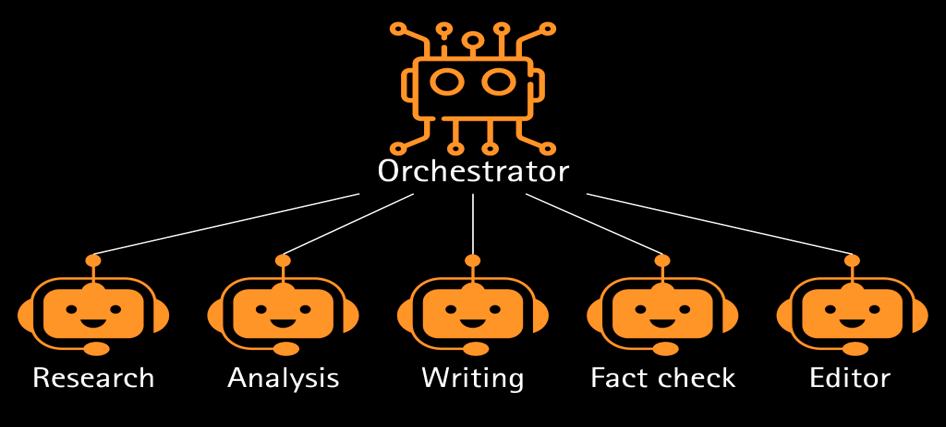
A single orchestrator delegates tasks to five specialized subagents: Research, Analysis, Writing, Fact-check and Editor.
Decentralized : There is no lead. Each agent knows what the other agents are capable of and they pass work between themselves based on what’s needed. Agent A finishes its part and hands directly to Agent B, which hands to Agent C with no one overseeing the whole project.
This is flexible because agents can react dynamically to each other. But dangerous because there’s no single point of oversight. If Agent B produces a bad output and passes it to C, nobody catches it before it flows downstream. This is why the industry has largely moved away from pure decentralized designs.
Hybrid : A lead exists but doesn’t micromanage everything. Some subagents are allowed to talk directly to each other for smaller handoffs, only surfacing back to the orchestrator when a major step is complete.
The agents can further be classified into Cooperative, where they work towards a shared objective like a group of researchers or Competitive, where agents pursue conflicting goals. The type you choose fundamentally changes the system’s design as a cooperative system is built to combine while a competitive one is built to clash!
Behind the scenes
Agentic Runtime : This is the engine underneath that makes multi agents actually run. It’s the infrastructure that keeps each agent's execution loop going, managing when agents act, pause, wait, retry and managing what happens when an agent fails or gets stuck. Managed Agents provide a complete environment featuring tool permissioning, automated context management, checkpointing and retries allowing developers to move beyond simple prompting.
Parallelism : Instead of doing one task after another, all tasks run at the same time. This is one of the biggest practical wins of multi-agent systems, what would take 5 sequential steps now takes as long as the slowest single step.
Handoffs : When one agent’s output becomes another agent’s input. In a sequential pipeline this is explicit, Agent A finishes and hands its result directly to Agent B. In a centralized system, handoffs go back through the orchestrator. In decentralized, agents hand off directly to each other. Handoffs are where most failures happen, if the output of one agent is poorly formatted or incomplete, the next agent gets garbage input.
Context isolation : Each agent has its own conversation thread and memory. They cannot see what the other agents are thinking or doing. This is intentional as you don’t want one agent's analysis affecting another agent’s reasoning before it has had a chance to form its own independent conclusion. Isolation keeps each agent’s output clean and unbiased. It also means if one agent crashes, it doesn't take the others down with it. This is the reason multi agent outputs are more trustworthy than one agent trying to do everything because each specialist reasoned independently before the orchestrator compared their conclusions.
The Pros and Cons
Like any other feature, MAS has its own set of pros and cons. The pros include
Specialization : By designing agents to excel at specific tasks, the system can now produce higher quality results.
Scalability and Resilience : Because the system is now modular, you can add new agents as your needs grow and as mentioned above, if one agent crashes, the entire system doesn’t necessarily crash
Parallelism is another reason to use multiple agents to get the job done quicker.
However, managing handoffs between the agents and ensuring they don’t contradict each other requires proper orchestration.
Overhead : As agent count grows, the network traffic and context management required to keep them in sync can become intense.
Conflicting Objectives : Without clear rules, agents might work against each other’s objectives, hampering the overall process
Infrastructure demands : Running multiple LLM agents simultaneously requires a lot of compute.
Multi-agent systems are still young. The overhead, the coordination failures, the infrastructure demands, these are all real problems today. But if there’s one thing the “exponential” has taught us, it’s that what seems like a hard ceiling today tends to look small a year later. Given the pace at which AI is moving, we will probably not be waiting too long.
Source : Claude with Code 2026, San Francisco
메타데이터
- post_id
- 2e51a2bbdc44
- slug
- what-if-your-ai-had-a-manager-2e51a2bbdc44
- url
- https://medium.com/the-ai-entrepreneurs/what-if-your-ai-had-a-manager-2e51a2bbdc44
- canonical_url
- https://medium.com/the-ai-entrepreneurs/what-if-your-ai-had-a-manager-2e51a2bbdc44
- author_url
- https://medium.com/@sreeja-p
- status
- ok
- fetched_at
- 2026-07-09 17:12:49