Who Gets Replaced by AI First? Cloudflare’s Layoff List Tell The Truth
Layoff
Who Gets Replaced by AI First? Cloudflare’s Layoff List Tell The Truth
Layoff
Disclosure: I use GPT search to collection facts. The entire article is drafted by me.
Here’s the detail that makes this particular story worth reading carefully.
On May 7, 2026, Cloudflare announced it was cutting approximately 1,100 employees — about 20% of its total workforce. The same day, the company reported Q1 2026 revenue of $639.8 million, a 34% year-over-year increase and the highest single quarter in the company’s 16-year history. It was also the company’s first-ever mass layoff.
That juxtaposition is not accidental. It’s the entire signal.
This isn’t a company bleeding out and cutting costs to survive. This is a company growing at speed, deciding to restructure around a different model of how work gets done. CEO Matthew Prince said so explicitly: “Today’s actions are not a cost-cutting exercise or an assessment of individuals’ performance; they are about Cloudflare defining how a world-class, high-growth company operates and creates value in the agentic AI era.”
The company’s internal AI usage had increased more than 600% in just three months. Employees across HR, finance, marketing, and engineering were running thousands of AI agent sessions daily. 100% of code deployed in Cloudflare’s products is now reviewed by autonomous AI agents.
So the question isn’t whether this is an unusual moment. It clearly is. The real question is: what does it actually reveal about which work is most vulnerable, and why?
The Framework: Builder, Seller, Measurer
Prince’s internal communications drew on Peter Drucker’s rough taxonomy of organizational work — builders, sellers, and measurers. The headline interpretation that spread quickly was: AI comes for measurers first. Builders and sellers are safer.
That framing is clean. It’s also a little too clean, and the cleanness is worth interrogating.
“Builder” is not a synonym for “software engineer.” “Seller” is not synonymous with “sales rep.” And “measurer” is emphatically not a synonym for “person who makes spreadsheets.”
These are functional descriptions of three things organizations need to do:
- Builders change the system — create products, write code, design infrastructure, produce things that didn’t exist before
- Sellers connect the system to the outside world — bring in revenue, cultivate customers, translate value into relationships
- Measurers let the organization understand what’s happening inside itself — audit, report, track, verify, check, translate internal reality into legible information
The Cloudflare announcement carved out one explicit exception: salespeople who carry revenue quotas were exempted from the cuts. Everyone else — across all teams and geographies — was in scope. This is a practical implementation of the framework, not just a rhetorical one.
But the mechanism behind why measurers get hit first is more interesting than the category label suggests.
What Actually Gets Compressed

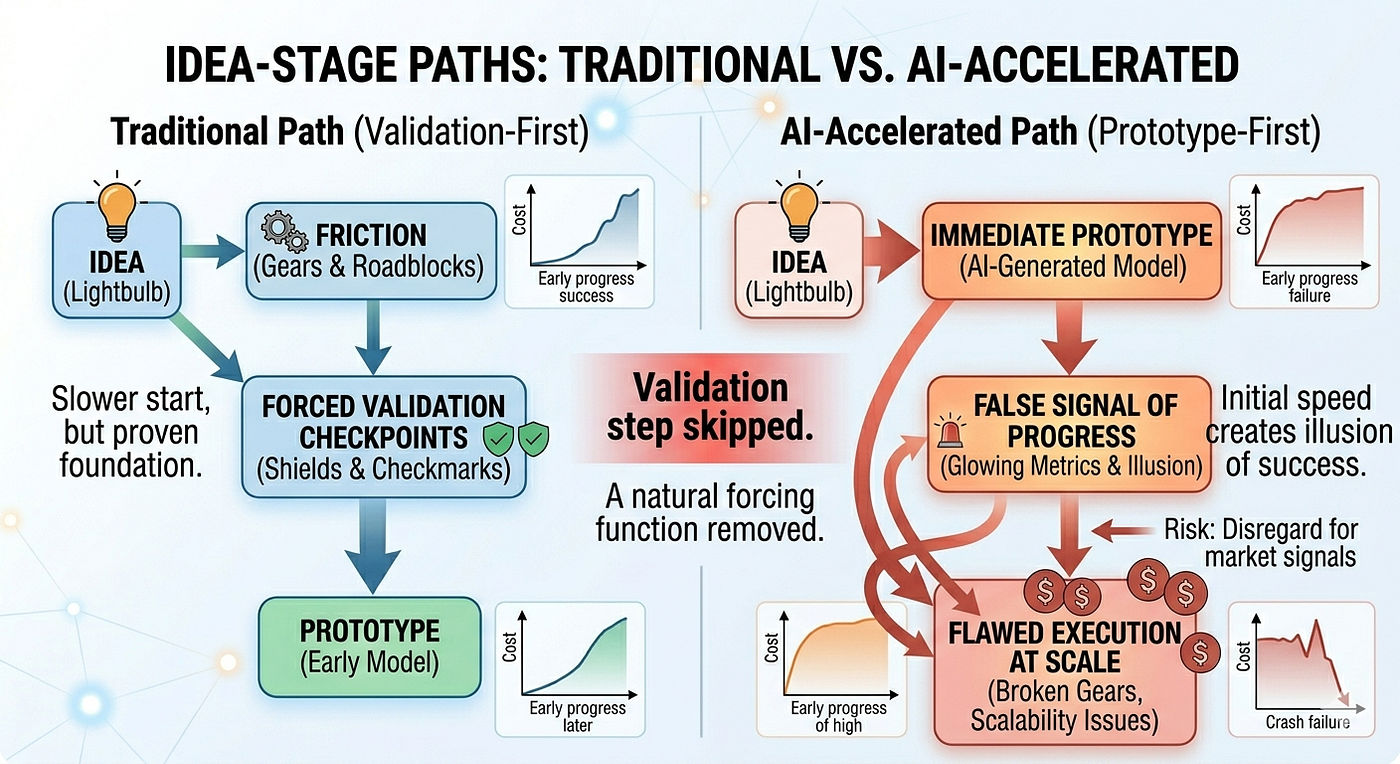
AI Generated Image
Think of a company as a software system. It produces events continuously — sales closed, tickets resolved, invoices sent, bugs deployed. The organization needs to understand what those events mean, in real time, in order to make decisions.
The traditional method of achieving that understanding was expensive, slow, and lossy: monthly close reports, quarterly audits, weekly status meetings, manual progress tracking, layer-by-layer status summaries, carefully formatted decks that by the time they reach a decision-maker are already weeks stale.
This is the “measurement layer” that AI compresses first. Not because auditing or compliance or finance are low-value functions — they’re not. But because a large share of the work inside those functions was manual information translation: gathering data, normalizing it, spotting anomalies by eye, building summaries, getting the right person to review, escalating appropriately. These are exactly the tasks where AI agents are genuinely capable today.
Cloudflare isn’t hypothesizing this. Their HR, marketing, and finance teams have been running thousands of AI agent sessions daily. The organizational sensing layer has already shifted from “humans who process and relay information” to “systems that process and relay information, monitored by humans.”
The distinction is significant. Monitoring a system is not the same as operating one manually. You need fewer people to monitor than to operate, but the people you do need have to understand the system more deeply — because when it breaks, they need to know why and how to fix it.
The Misconception: Measurement Isn’t a Cost Center
Here’s where the headline framing becomes actively misleading.
The “measurers get replaced first” narrative can be read as: measurement is overhead, measurement is waste, measurement is the administrative fat that AI trims away. That reading is wrong and potentially dangerous.
Measurement, properly understood, is the organization’s immune system.
The legal team that asks “can we actually do this?” before a contract closes is measuring. The QA engineer who asks “is this behavior genuinely fixed or just suppressed?” is measuring. The finance analyst who asks “does this revenue number actually hold under scrutiny?” is measuring. The compliance officer who asks “do we have a documented evidence trail for this decision?” is measuring.
None of these are glamorous. None of them are “building” in the product sense. But organizations that remove these functions, or hollow them out, don’t become leaner and faster. They become more brittle. Problems don’t get caught early. Errors compound. The absence of a challenge to a bad decision is not the same as the decision being correct.
What AI actually compresses is low-quality human measurement — the kind that is slow, manual, retrospective, and lossy. Repetitive data entry. Meeting-based status synchronization. Monthly summaries assembled from disparate spreadsheets. Sampling-based quality checks that miss systematic problems. These are measurement mechanisms that work poorly even when performed by humans.
The risk isn’t that measurement disappears. The risk is that organizations confuse “we’ve automated the reporting” with “we’ve improved the quality of our understanding.” AI can produce a complete-looking, confident-sounding answer on top of bad data faster than any human can. If the underlying data quality, permission boundaries, and metric definitions are wrong, AI doesn’t make the problem visible. It makes it more presentable.
The Anthropic Research: What the Evidence Actually Shows

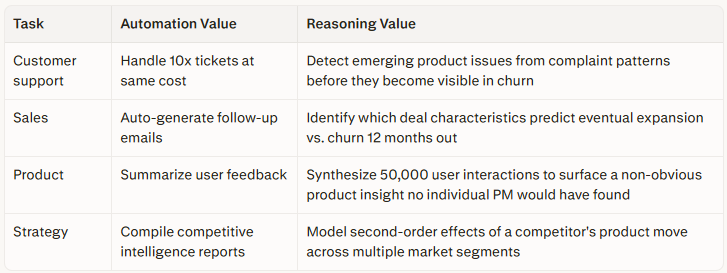
AI Generated Image
The Anthropic economics research published in early 2026 is more careful than the LinkedIn hot takes it spawned.
Its central finding is not “AI is replacing workers.” It’s that AI is currently reshaping work at the task level, with limited but detectable early effects on hiring patterns. Specifically: workers in highly AI-exposed occupations are showing signs of slower hiring growth, particularly for younger workers entering those fields. The effect on overall unemployment is not yet statistically significant.
The five most AI-exposed occupations by their “Observed Exposure” measure: computer programmers, customer service representatives, data entry specialists, medical records specialists, and market research analysts.
Notice that two of those five are technically sophisticated roles. Computer programmers. Market research analysts. These aren’t low-skill roles that “obviously” get automated. They’re knowledge-work roles where AI has already demonstrated substantial task-coverage.
The Anthropic researchers are explicit that their measure captures current real-world AI usage against theoretically automatable tasks — not a prediction of future displacement, but a measurement of present penetration. Claude currently covers about 33% of all tasks in the Computer & Math occupational category. That’s not “AI replaces programmers.” That’s “AI handles a third of what programmers do, and the proportion is growing.”
The implication for the builder/seller/measurer framework: builders aren’t structurally immune. They’re at a different point on the same curve.
The “AI Washing” Problem
There’s a countervailing argument that deserves serious treatment rather than dismissal.
Sam Altman has acknowledged that “AI washing” is real — companies attributing to AI what would have been restructuring decisions regardless. Marc Andreessen’s sharper version: many large tech companies were significantly overstaffed during the 2020–2022 hiring surge, and AI has provided a more palatable narrative frame for the correction that was already inevitable.
Both observations have merit. They point in different directions.
Altman’s point is a warning about precision: don’t read every AI-framed layoff as evidence of AI capability. Some of it is regular business cycle behavior with better PR copy.
Andreessen’s point is a warning about scale: the overstaffing was real, the correction is real, and the AI framing doesn’t change the underlying economic logic.
Neither argument undermines the Cloudflare case specifically. The 600% internal AI usage increase is not a talking point — it’s a disclosed operational metric. The exemption of quota-carrying salespeople isn’t narrative; it’s a documented operational decision. The fact that 100% of deployed code is now AI-reviewed is a concrete change in engineering workflow, not a press release claim.
The Cloudflare restructuring may be an outlier in the specificity of its AI integration. Most other companies making similar announcements have less internal evidence to point to. The appropriate response to “AI washing” is not to disbelieve all AI-driven restructuring claims; it’s to apply more rigorous evidentiary standards to each one.
The Practical Framework: Three Chains, Not Three Job Titles
The “am I a builder, seller, or measurer?” question is the wrong question. It leads to either false comfort or false panic, depending on where you land.
The more useful diagnostic is to examine three chains within your actual work:
The value chain. Does your work change a product, a customer outcome, a revenue number, or a risk profile in a way you can describe specifically? If you cannot name the mechanism by which your work creates value, it doesn’t mean the value doesn’t exist — but it does mean the work is harder to defend when an automated system can produce similar outputs faster. The test is not “is my job title important?” but “can I explain what would break if I stopped doing this?”
The evidence chain. Are your judgments and recommendations grounded in traceable primary data? Can the reasoning be audited, replicated, or challenged? Or does your value rest primarily in your ability to synthesize and relay information in a form others find convenient? Synthesis and relay are exactly what AI agents do well. Primary judgment grounded in traceable data is harder to replicate, because it requires the underlying evidence to be real and verifiable, not just coherent-sounding.
The control chain. Which actions in your workflow can be automated? Which require human recommendation but automated execution? Which require explicit human confirmation? And critically: when something goes wrong, who has the authority and the context to stop it, roll it back, and explain what happened? Organizations that hand control to AI systems without designing this chain don’t eliminate human judgment from the loop. They just make it implicit and undocumented — which is worse.
The Cloudflare case illustrates all three. The company has made the value chain explicit (revenue growth without proportional headcount growth), built evidence chains through AI-monitored deployments, and is explicitly designing the control chain (100% of deployed code reviewed by autonomous agents, with human oversight of the review process). The restructuring is the organizational consequence of having built those chains.
What This Actually Means
The deepest thing Cloudflare’s announcement reveals isn’t about job categories. It’s about organizational architecture.
The question “who gets replaced by AI?” is, at its core, the wrong framing. The right framing is: which processes get replaced by AI? And then: which roles exist primarily to execute those processes, and which roles exist to own and improve them?
Process execution — data gathering, report generation, status synchronization, anomaly spotting, document drafting, code review — increasingly belongs to automated systems. Process ownership — defining what gets measured, why, what the thresholds mean, what action follows, and who’s accountable — still requires humans. Not because AI can’t form opinions on these questions. Because accountability can’t be delegated to a system that doesn’t bear consequences.
Anthropic’s research is useful here not for its specific exposure rankings but for its underlying point: AI is currently reshaping work at the task level, not the job level. The programmers who survive don’t do less programming — they do different programming, at a higher level of abstraction, with AI handling implementation from their specification. The analysts who survive aren’t the ones who produce more reports — they’re the ones who design what gets measured and why, and who can catch the failure modes that automated systems generate confidently but incorrectly.
The organizations that navigate this best won’t be the ones that cut the fastest. They’ll be the ones that most clearly distinguish between measurement-as-execution (automatable) and measurement-as-judgment (not automatable, and more important than it’s ever been).
The Point at Which This Becomes Clear
The answer to “who gets replaced by AI first?” is not a job title.
It’s a work pattern: reactive, retrospective, manual information translation, where the primary value delivered is organizing and relaying information that a system could organize and relay faster with better reliability.
And the follow-on question — the one that matters more — is: once that work pattern is automated, what happens to the humans who were doing it?
Two outcomes are possible. In one, those humans move up the value chain: they design the systems that replaced them, define what gets measured, own the accountability when the system errs. In the other, they become the gap between the automated system’s confidence and its actual reliability — a gap that closes slowly, when it closes at all.
Cloudflare’s bet is that it can build an organization where the first outcome dominates. The 1,100 departing employees are the cost of that bet. Whether the bet pays off depends entirely on whether the company builds the control chains, evidence chains, and accountability structures that make AI-generated outputs trustworthy rather than merely fluent.
That work is neither automated nor optional. It is, increasingly, the only work that can’t be handed to an agent.
If you’d like to show your appreciation, you can support me through:
✨ **Patreon ✨ [Ko-fi](https://ko-fi.com/jinlowmedium) ✨ [BuyMeACoffee](https://buymeacoffee.com/jinlowmedium)**
Every contribution, big or small, fuels my creativity and means the world to me. Thank you for being a part of this journey!
메타데이터
- post_id
- 2e55e2e85170
- slug
- who-gets-replaced-by-ai-first-cloudflares-layoff-list-tell-the-truth-2e55e2e85170
- url
- https://medium.com/jin-system-architect/who-gets-replaced-by-ai-first-cloudflares-layoff-list-tell-the-truth-2e55e2e85170
- canonical_url
- https://medium.com/jin-system-architect/who-gets-replaced-by-ai-first-cloudflares-layoff-list-tell-the-truth-2e55e2e85170
- author_url
- https://medium.com/@jinlow
- status
- ok
- fetched_at
- 2026-06-14 13:58:26