GMP vs cGMP in Pharma: Critical FDA, PIC/S, and EU GMP Standards You Must Know
What Are GMP and cGMP Standards in Pharma?
GMP vs cGMP in Pharma: Critical FDA, PIC/S, and EU GMP Standards You Must Know
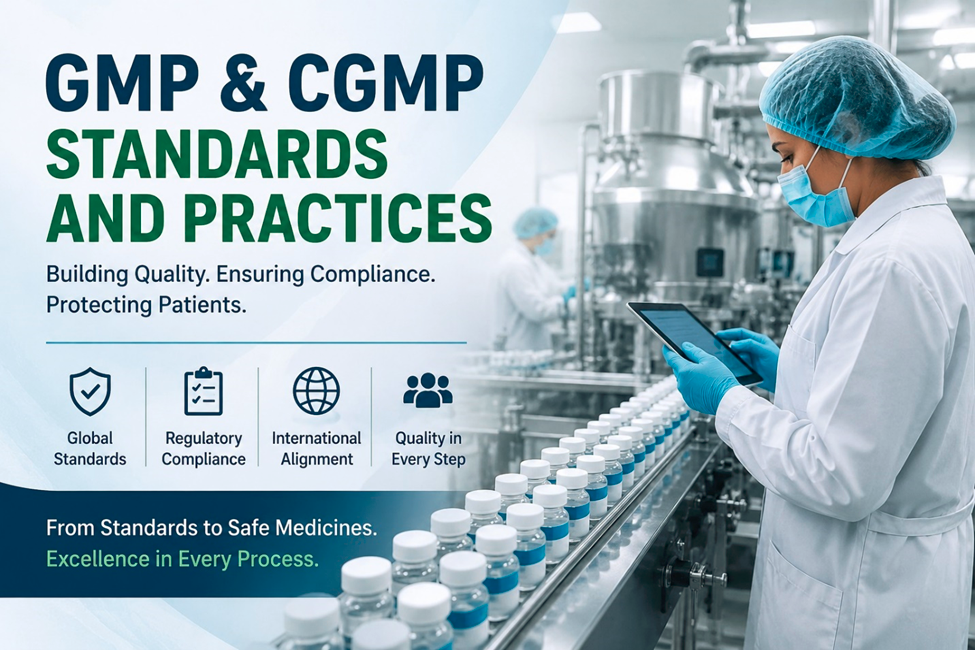
GMP vs. cGMP (Image generated by AI)
What Are GMP and cGMP Standards in Pharma?
GMP and cGMP standards guide how pharma companies make safe, consistent, and reliable medicines. GMP means Good Manufacturing Practice. CGMP means Current Good Manufacturing Practice.
Read more about GMP vs cGMP and discover the key differences that impact pharmaceutical quality and compliance.
Why GMP and cGMP Knowledge Matters
GMP and cGMP knowledge helps pharma professionals work with more confidence. It also supports better documentation, cleaner processes, stronger audits, and safer products. Learners can also study Pharmuni’s Introduction to Good Manufacturing Practices (GMP) course to build practical GMP foundations.
FDA cGMP Regulations in the United States
In the United States, FDA uses cGMP to define enforceable quality expectations for drug manufacturing. These rules help prevent contamination, mix-ups, weak controls, and poor documentation. They also protect patients by requiring quality throughout the product lifecycle. FDA states that cGMP regulations set minimum requirements for methods, facilities, and controls used in drug manufacturing, processing, and packing. (U.S. Food and Drug Administration)
FDA cGMP regulations matter for companies that manufacture, process, pack, or sell medicines for the US market. These standards help confirm that medicines contain the claimed identity, strength, quality, and purity. The “current” part is important. It means companies must use updated science, suitable technology, and modern quality systems. Therefore, a process that worked years ago may not meet today’s cGMP expectations.
21 CFR Part 210 and 21 CFR Part 211: Why They Matter
21 CFR Part 210 and 21 CFR Part 211 form the main cGMP framework for US pharmaceutical manufacturing. Part 210 covers manufacturing, processing, packing, and holding of drugs. Part 211 focuses on finished pharmaceutical products. Together, they guide facilities, equipment, production controls, laboratory controls, records, packaging, holding, and distribution. Part 211 states that it contains minimum cGMP requirements for drug products. (eCFR)
- 21 CFR Part 210 explains cGMP rules for drug manufacturing, processing, packing, and holding.
- 21 CFR Part 211 focuses on cGMP requirements for finished pharmaceutical products.
- Together, both parts define minimum quality expectations for US drug manufacturing.
The 5 Ps of cGMP Standards
The 5 Ps help teams understand cGMP in daily work. People need documented training and job competence. Premises must prevent contamination and support clean material flow. Processes must follow approved SOPs and validation evidence. Products and materials need identity checks, supplier qualification, and quality control. Procedures must guide each activity clearly, because in GMP work, undocumented work creates compliance risk.
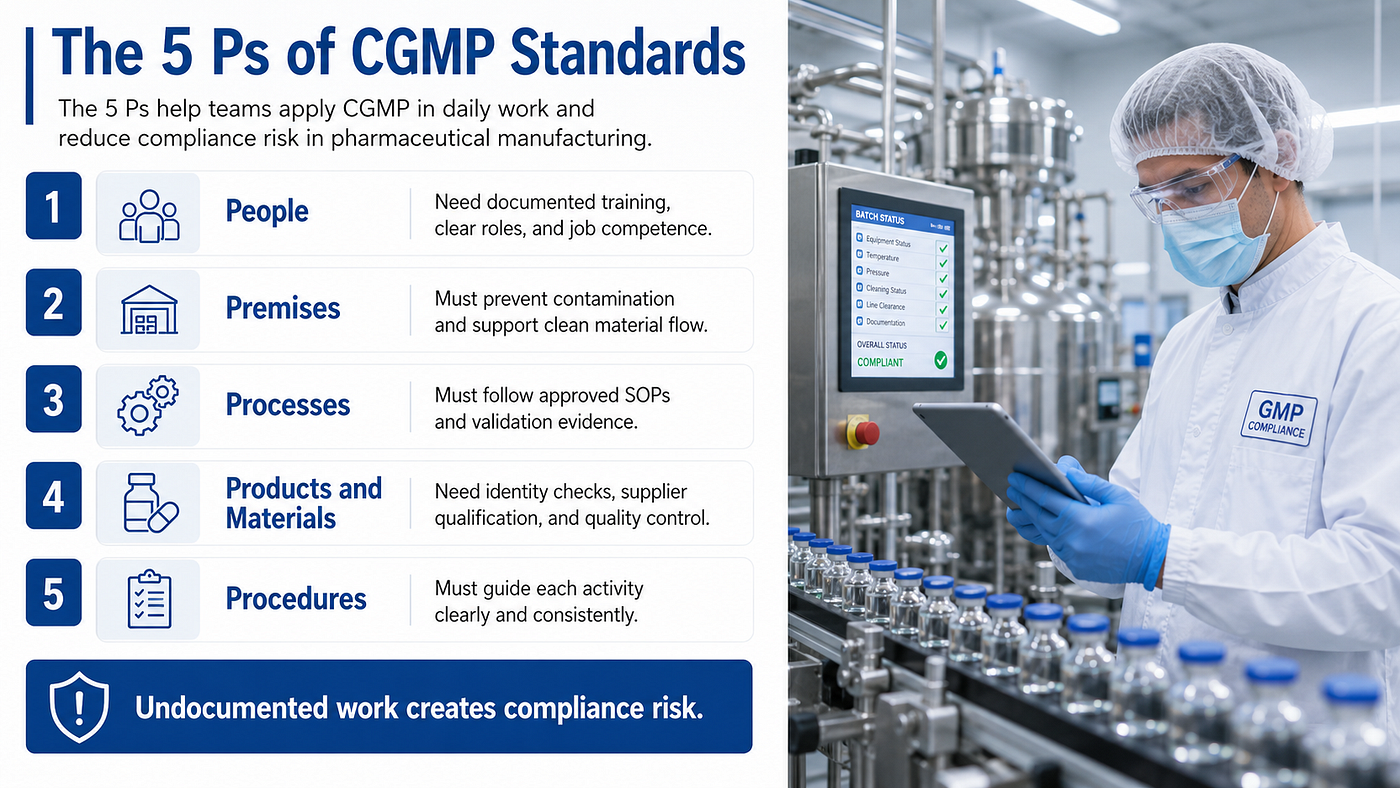
The 5 Ps of cGMP standards (Image generated by AI)
GMP Guidelines, cGMP Regulations, and Global Requirements
Pharma companies rarely follow one GMP system only. Many manufacturers supply medicines across several markets. Therefore, they must compare FDA, EU, WHO, PIC/S, and local country expectations. This matters because one weak quality system can affect inspections, exports, product release, and patient trust. Global GMP awareness helps companies design stronger documentation, validation, training, and supplier systems.
· EU GMP guides manufacturing quality across Europe.
· WHO and PIC/S support global inspection alignment.
· PIC/S GMP Guide and International Inspection Alignment
· UK MHRA GMP Requirements After Brexit
· Health Canada GMP Guide for Drug Products
· Australia TGA GMP and PIC/S-Based Requirements
· Japan PMDA and MHLW GMP Expectations
· India Schedule M GMP Requirements for Pharma Facilities
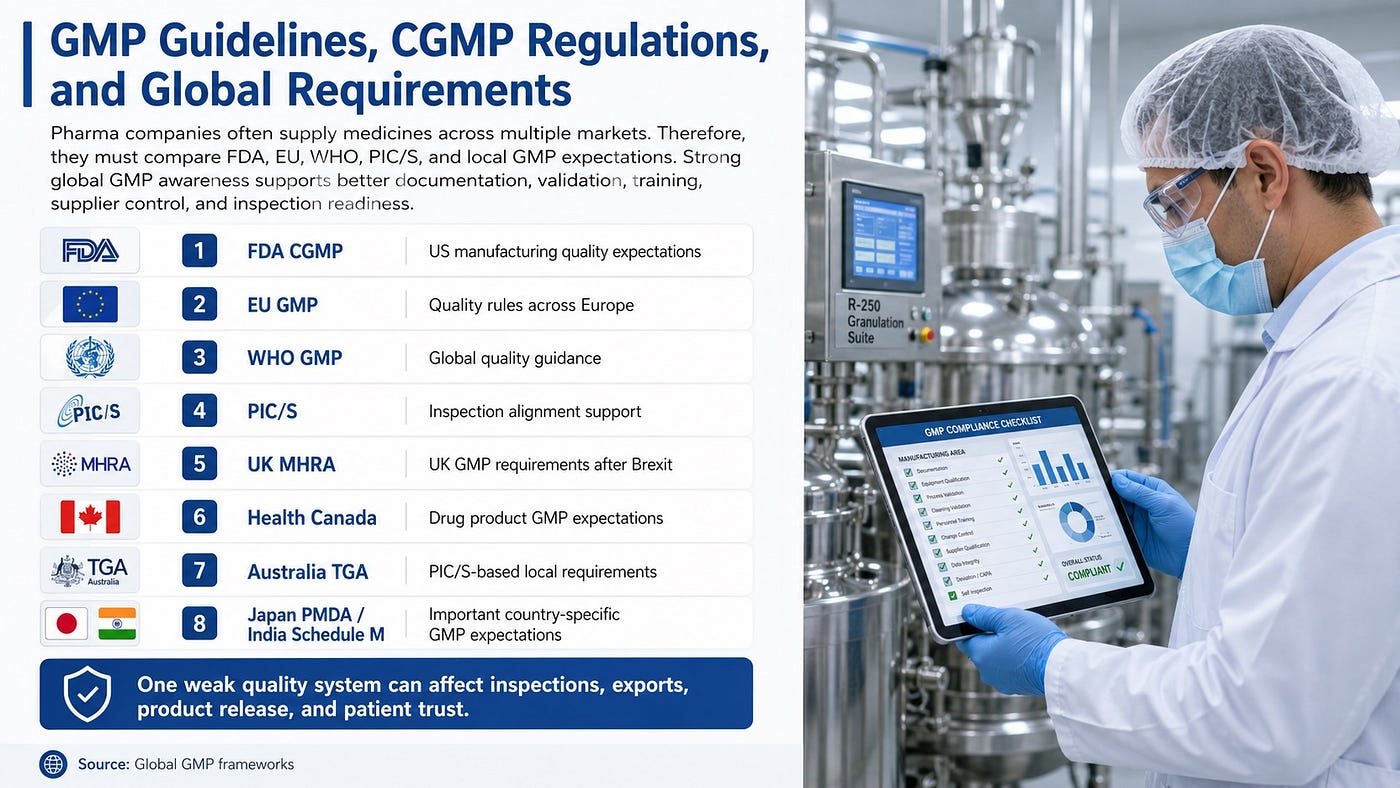
GMP compliance in pharmaceutical manufacturing (Image generated by AI)
EU GMP Guidelines and EudraLex Volume 4
EU GMP guidelines support pharmaceutical quality across European markets. These guidelines are organized under EudraLex Volume 4. They cover key GMP expectations for medicinal products, including quality systems, personnel, premises, equipment, documentation, production, quality control, outsourced activities, complaints, recalls, and self-inspections. Therefore, EU GMP knowledge matters for companies that manufacture, import, or release medicines for Europe. (Public Health)
WHO GMP Guidelines for Global Pharmaceutical Quality
WHO GMP guidelines support global pharmaceutical quality, especially in international and emerging markets. WHO explains that GMP defines quality measures for production and quality control. It also covers personnel, premises, materials, validation, documentation, complaints, product defects, and contract manufacturing. Therefore, WHO GMP helps companies build quality systems that regulators and global partners can understand. (World Health Organization)
PIC/S GMP Guide and International Inspection Alignment
PIC/S supports international GMP inspection alignment. Its GMP Guide helps regulators and manufacturers work with more harmonized expectations. This is useful because pharma companies may face inspections from different authorities. Therefore, PIC/S alignment helps quality teams prepare systems for documentation review, validation evidence, contamination control, supplier oversight, and risk-based inspections across several markets.
UK MHRA GMP Requirements After Brexit
UK MHRA GMP requirements still matter after Brexit because the UK remains a major medicine market. Many GMP principles still align with EU-style expectations. However, companies must monitor UK-specific regulatory updates, licensing rules, import expectations, and inspection priorities. As a result, quality teams should not assume that EU compliance alone always answers every UK market requirement.
Health Canada GMP Guide for Drug Products
Health Canada GMP expectations matter for drug fabricators, packagers, labellers, testers, distributors, importers, and wholesalers. These roles affect quality across the full supply chain. Therefore, companies that target Canada need strong documentation, supplier control, validated processes, deviation management, release systems, and complaint handling. These controls help protect product quality before medicines reach patients.
Australia TGA GMP and PIC/S-Based Requirements
Australia’s TGA applies GMP expectations for medicines, active pharmaceutical ingredients, and related regulated products. Australia also uses PIC/S-based GMP guidance. Therefore, companies supplying Australia should understand both local TGA requirements and wider PIC/S alignment. This helps manufacturers prepare inspection files, validation packages, quality agreements, product release systems, and lifecycle controls in a structured way.
Japan PMDA and MHLW GMP Expectations
Japan’s GMP expectations matter for companies targeting the Japanese pharmaceutical market. PMDA and MHLW expectations focus on reliable quality systems, clear documentation, controlled manufacturing, and inspection readiness. Therefore, companies should prepare precise records, validated processes, and consistent quality oversight. Japan also values strong regulatory communication, so evidence quality and document accuracy can affect review outcomes.
India Schedule M GMP Requirements for Pharma Facilities
India Schedule M GMP requirements matter for domestic manufacturing, exports, and global competitiveness. India plays a major role in the global medicine supply chain. Therefore, facility design, utilities, equipment, documentation, production controls, quality control, hygiene, validation, and stability systems require strong oversight. For Indian manufacturers, Schedule M alignment can support local compliance and international market confidence.
How Do Country-Specific GMP Rules Affect Pharma Companies?
Country-specific GMP rules affect how companies design facilities, write SOPs, validate processes, train staff, qualify suppliers, and prepare for inspections. A company may meet one market’s expectations but still show gaps in another region. Therefore, global manufacturers must compare requirements early. This reduces rework, product delays, import problems, warning letters, and inspection findings.
- Companies must adjust documentation to match each target market.
- Quality teams must prepare for different inspection styles and expectations.
- Manufacturers must align validation, supplier control, and release systems globally.
What Have I Learned from GMP and cGMP Standards and Audits?
From my experience working with GMP systems in multinational pharmaceutical environments, audits rarely fail because teams do not know the rules. Instead, problems often appear when daily practice does not match written procedures. During GMP and cGMP reviews, auditors expect evidence. They look for complete batch records, controlled documents, trained personnel, calibrated equipment, validated methods, reliable laboratory data, and effective CAPA follow-up.
FDA inspection activity also shows why audit readiness matters. In fiscal year 2024, FDA completed 3,128 drug and device establishment inspections across global regions. These included 2,684 routine surveillance inspections and 453 for-cause inspections. A for-cause inspection can occur when regulators suspect quality problems or receive complaints. Therefore, compliance must work every day, not only before an announced audit.
메타데이터
- post_id
- 2e679e69c961
- slug
- gmp-vs-cgmp-in-pharma-critical-fda-pic-s-and-eu-gmp-standards-you-must-know-2e679e69c961
- url
- https://medium.com/@ershadmoradi25/gmp-vs-cgmp-in-pharma-critical-fda-pic-s-and-eu-gmp-standards-you-must-know-2e679e69c961
- canonical_url
- https://medium.com/@ershadmoradi25/gmp-vs-cgmp-in-pharma-critical-fda-pic-s-and-eu-gmp-standards-you-must-know-2e679e69c961
- author_url
- https://medium.com/@ershadmoradi25
- status
- ok
- fetched_at
- 2026-06-11 10:13:20