Use AI-based Simulation to Find Optimal Laser Parameters for TGV Drilling, Before Touching a Wafer
By Mujeeb, AI/Agentic Engineer, Optimizing Chip Manufacturing | South Korea
Use AI-based Simulation to Find Optimal Laser Parameters for TGV Drilling, Before Touching a Wafer
By Mujeeb, AI/Agentic Engineer, Optimizing Chip Manufacturing | South Korea
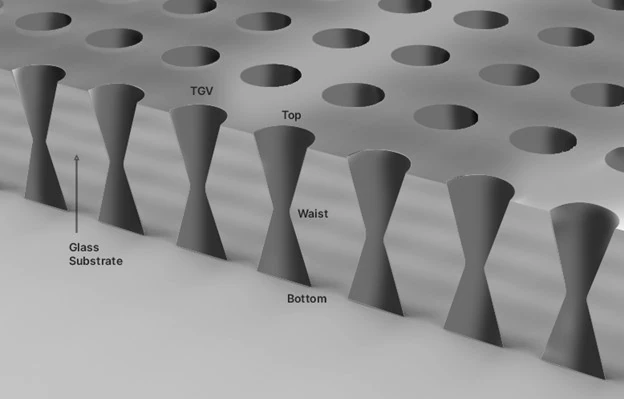
Finding the right laser parameters for Through-Glass Via (TGV) drilling requires days of work, significant material cost, and experiment after experiment — adjusting different parameters each time. Seven or eight iterations, on average, before you converge on a parameter set that meets spec. And the process repeats for every new glass substrate, every new customer specification, every new via geometry.
I found a way to bring that down to one or two physical runs. This is the story of how.
What Is TGV? Why Does Laser Parameter Selection Matter So Much?
A Through-Glass Via (TGV) is a vertical hole drilled through a glass substrate that allows electrical connections to pass through it. TGVs are becoming critical infrastructure in advanced semiconductor packaging — enabling the compact, high-density chip stacking that powers AI accelerators and Systems on Chip.
The drilling is performed by ultrashort-pulse lasers. The challenge is that glass, particularly under 0.5mm thick , is highly sensitive to parameter errors. Set them wrong and you get vias with the incorrect diameter, the wrong taper angle, or worse: micro-cracks that cause failures downstream.
The laser itself has many parameters: pulse energy, pulse frequency, beam diameter, focal point position, and more. Layer on top of that the glass thickness and etching parameters — temperature, time, chemicals— and you are searching a high-dimensional space with a deeply non-linear relationship between inputs and outputs.
Trial and error in this space is expensive. That is the problem I set out to solve.
Build a Model That Understands the Process
In the [1] Yuhang adopt the following approach that first train a model to understand the process. For the training there are less numbers of samples in hundreds, given that a single experiment took several weeks. The data was noisy and contained missing values. I trained a machine learning model to predict via quality from laser and etching parameters.
The challenge here was not choosing the most powerful model, but choosing one that could work well with limited, noisy data. That meant spending more time on data curation, outlier investigation, and feature engineering than on model development itself.
I tested three approaches: Random Forest, XGBoost, and a neural network. XGBoost performed best. It handles noisy, tabular data with complex interactions well and is robust when training data is scarce.
Using the Model as a Simulator, Not a Predictor
In the [1] Yuhang use the trained model as a Simulator not as a predictor. This is the part that changed how we think about ML in manufacturing.
If we rely solely on a model that predicts optimized laser parameters, we know — from its accuracy — that it will be not much accurat. So I reversed the problem.
Instead of asking: “Given these laser parameters, what via shape will we get?”
I started asking: “Given a customer’s specification, what parameters should we use to produce the required shape?”
This inversion is the key insight. I used the trained model as a fast virtual simulator of the physical drilling process, evaluating parameter sets against the customer’s required via shape in seconds rather than weeks. Thousands of virtual experiments become possible in minutes — no etching, no measurements, no scrapped glass.
With a simulation of the full process in hand, the next step was to search the parameter space intelligently for the one optimized combination.
Search the Parameter Space with Bayesian Optimization
To find the combination of laser parameters that produces the required TGV shape, I used Bayesian Optimization. It was well-suited to this problem for two reasons.
First, the search space is large. Pulse energy, frequency, beam diameter, focal point, and etching parameters together create a vast combination space that brute-force methods cannot efficiently explore.
Second, the relationship between parameters and via quality is not smooth — there is no simple gradient to follow. Bayesian Optimization handles this well because it builds a probabilistic model of the objective function and uses it to decide, intelligently, where to sample next.
The Outcome
Experimental iterations to reach a validated parameter set: reduced from 7–8 rounds down to 1–2.
The physical runs that remain are for validation — confirming that the simulator’s recommendation holds in reality, accounting for real-world variation the model cannot fully capture.
What This Approach Cannot Do
This system is not a replacement for process engineering expertise. The model is bounded by its training data, and the simulator is only as trustworthy as the data that built it.
Invest in data quality. It will return more value than any model architecture choice.
I’m an AI/ML Engineer specializing in machine learning and Agentic AI for semiconductor manufacturing, currently based in South Korea. I’m working on process optimization for TGV drilling, lithography, and mask writing. LinkedIn: https://www.linkedin.com/in/mujeeb-merwat/
메타데이터
- post_id
- 2e706bba9964
- slug
- use-ai-based-simulation-to-find-optimal-laser-parameters-for-tgv-drilling-before-touching-a-wafer-2e706bba9964
- url
- https://medium.com/@mujeeb.merwat/use-ai-based-simulation-to-find-optimal-laser-parameters-for-tgv-drilling-before-touching-a-wafer-2e706bba9964
- canonical_url
- https://medium.com/@mujeeb.merwat/use-ai-based-simulation-to-find-optimal-laser-parameters-for-tgv-drilling-before-touching-a-wafer-2e706bba9964
- author_url
- https://medium.com/@mujeeb.merwat
- status
- ok
- fetched_at
- 2026-06-23 17:05:31