Porter’s Five Forces in Product Management: A Strategic Lens for Building Winning Products
In the world of product management, success isn’t just about building a product that solves a problem — it’s also about positioning it…
Porter’s Five Forces in Product Management: A Strategic Lens for Building Winning Products
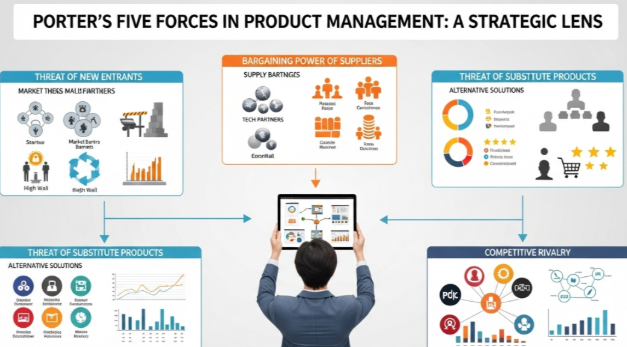
In the world of product management, success isn’t just about building a product that solves a problem — it’s also about positioning it effectively in a competitive market. One of the most powerful tools product managers can leverage for this purpose is Porter’s Five Forces Framework, developed by Michael E. Porter.
This framework helps product managers understand the competitive dynamics of an industry, anticipate potential threats, and make informed decisions on product strategy, pricing, positioning, and growth. Let’s break it down.
🔹 The Five Forces and Their Role in Product Management
1. Competitive Rivalry (Industry Competition)
- What it means: How intense is the competition among existing players?
- Why it matters for PMs: High rivalry forces PMs to differentiate — through unique features, pricing strategies, or superior user experience.
- Example: In the ride-hailing industry (Uber vs. Lyft vs. local players), rivalry is fierce, requiring constant innovation like subscription plans or loyalty programs.
PM takeaway: Invest in competitive analysis. Constantly benchmark features, customer reviews, and pricing against competitors.
2. Threat of New Entrants
- What it means: How easy is it for new players to enter the market?
- Why it matters for PMs: If barriers to entry are low, new startups can disrupt quickly. This impacts long-term product strategy.
- Example: In SaaS products, where cloud infrastructure is relatively cheap, new tools pop up frequently. Slack had to fend off multiple collaboration tool entrants.
PM takeaway: Build moats — network effects, brand loyalty, and ecosystem integration make it harder for new entrants to displace your product.
3. Bargaining Power of Buyers (Customers)
- What it means: How much influence do customers have over pricing and product features?
- Why it matters for PMs: Strong buyer power means customers can easily switch, demanding better pricing or features.
- Example: In B2B software, enterprise clients have significant bargaining power — they negotiate contracts and demand customizations.
PM takeaway: Deeply understand customer needs. Prioritize retention and customer success to reduce churn.
4. Bargaining Power of Suppliers
- What it means: How much influence do suppliers (technology vendors, manufacturers, distributors) hold?
- Why it matters for PMs: Limited suppliers can increase costs, reduce margins, or slow innovation.
- Example: Hardware product managers at smartphone companies depend heavily on chip manufacturers like Qualcomm — supplier power is high.
PM takeaway: Diversify supplier options and build strong vendor relationships to reduce risks.
5. Threat of Substitutes
- What it means: Can customers switch to alternative solutions (not direct competitors) that solve the same problem?
- Why it matters for PMs: Substitutes can blindside products by fulfilling the same customer need differently.
- Example: Netflix competes not just with Hulu or Disney+, but also with YouTube, gaming platforms, and even social media — because all fight for user attention.
PM takeaway: Don’t just track direct competitors — monitor substitutes that compete for customer time, money, or attention.
🔹 How Product Managers Can Use Porter’s Five Forces
- Market Entry Decisions → Before launching a product, analyze if the market has high rivalry or substitute risks.
- Pricing & Positioning → Adjust pricing strategy based on customer bargaining power and competitive pressure.
- Feature Prioritization → Build defensible features that strengthen your competitive moat.
- Growth Strategy → Identify opportunities where forces are weaker — like markets with low rivalry or fewer substitutes.
🔹 Final Thoughts
Porter’s Five Forces isn’t just an academic framework — it’s a practical tool for product managers to evaluate external risks, shape go-to-market strategies, and design long-term product roadmaps.
By consistently revisiting these forces, product managers can ensure their products remain relevant, competitive, and resilient in dynamic markets.
👉 The best PMs don’t just build products — they build strategic defensibility. Porter’s Five Forces is one of the best maps to guide that journey.
메타데이터
- post_id
- 2e796ba9d9b7
- slug
- porters-five-forces-in-product-management-a-strategic-lens-for-building-winning-products-2e796ba9d9b7
- url
- https://medium.com/@dishant.salunke9/porters-five-forces-in-product-management-a-strategic-lens-for-building-winning-products-2e796ba9d9b7
- canonical_url
- https://medium.com/@dishant.salunke9/porters-five-forces-in-product-management-a-strategic-lens-for-building-winning-products-2e796ba9d9b7
- author_url
- https://medium.com/@dishant.salunke9
- status
- ok
- fetched_at
- 2026-07-24 02:42:35



