The Most Expensive Number in Corporate Wellness.
Why 67% program awareness can still mean a wellness program is failing.
The Most Expensive Number in Corporate Wellness.
Why 67% program awareness can still mean a wellness program is failing.
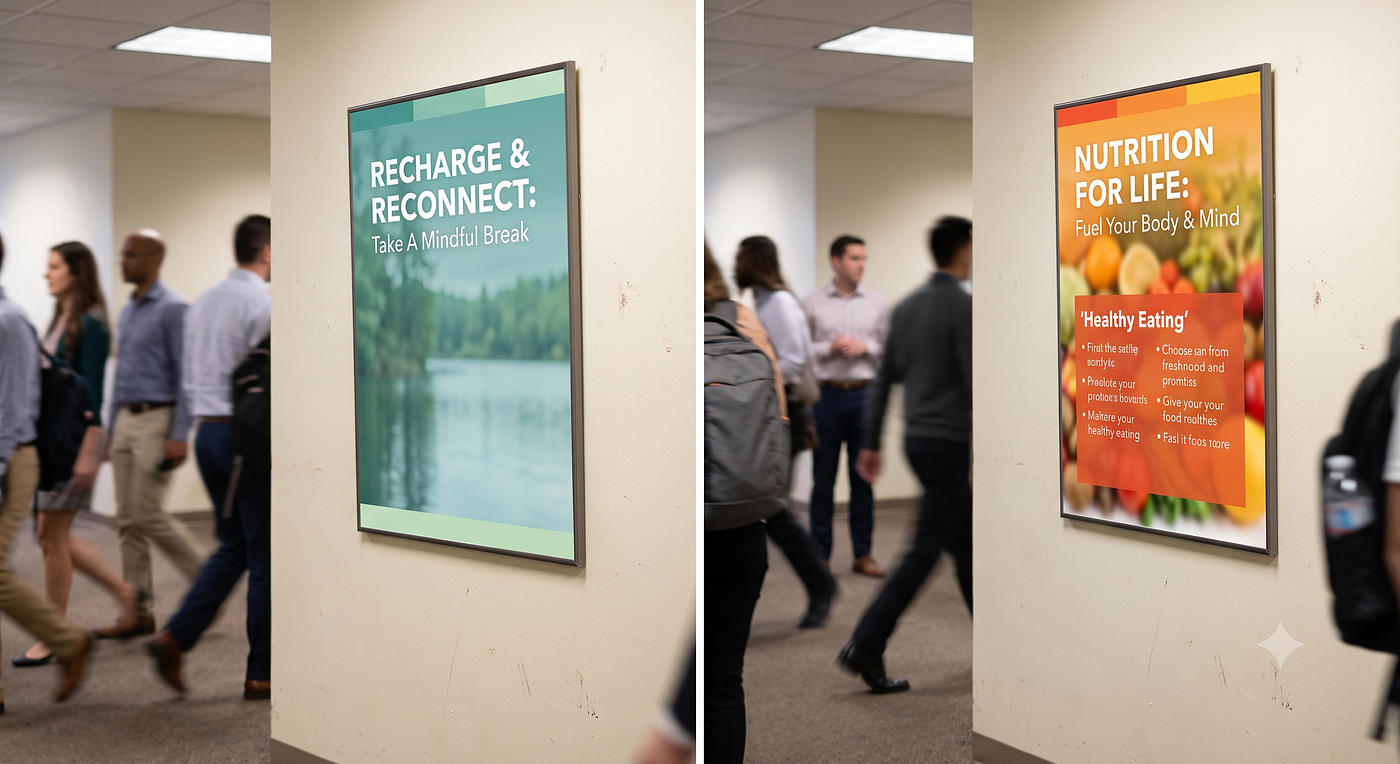
Most employee wellness programs are measured on the wrong number. I have spent the last several months building a strategy for a Chief Wellness Officer role at one of the largest public hospitals in the country. The data kept revealing a version of the same paradox.
Two thirds of staff knew the wellness program existed.
Fewer than one in five had used it in the last ninety days.
Sit with that for a second. Sixty-seven percent awareness. Eighteen percent active engagement. By traditional reporting standards, the first number earns a celebratory slide in the board deck. Marketing worked. The brand is healthy. The mailers, the badge stickers, the all-staff emails, the lunch and learns. They all did their job.
And yet the program did not.
This is the awareness trap. We confuse the moment a staff member learns a program exists with the moment they actually use it to take care of themselves. They are not the same moment. They are not even close. And when leaders optimize for the first one, they often spend an entire year and an entire budget moving a number that does not change behavior, does not change burnout scores, and does not change retention.
Here is how to escape the trap.
Awareness is one of four levers. It is also the cheapest.
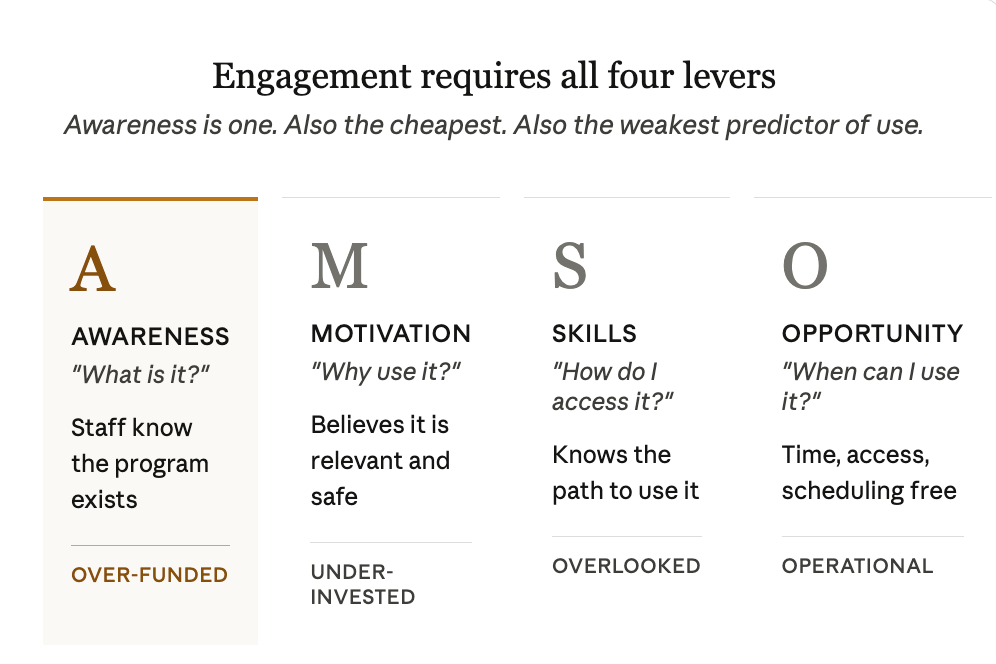
The behavior change literature is fairly settled on this point. For a person to take a new action, four things have to be true at roughly the same time. They have to know the option exists. They have to want to use it. They have to feel capable of using it. And they have to have an actual opportunity to use it inside the rhythms of their day.
Researchers call this AMSO. Awareness, Motivation, Skills, Opportunity.
Most wellness programs invest disproportionately in the first lever because it is the most visible and the easiest to fund. Posters and emails are concrete deliverables. A behavior change strategy is not.
But awareness is also the lever with the weakest causal link to actual use. People know that exercise is good for them. People know about their employer’s 401(k) match. People know that smoking causes cancer. Awareness, in isolation, almost never moves behavior at scale.
If engagement is stuck and awareness is high, the problem is downstream of awareness. More campaigns will not fix it.
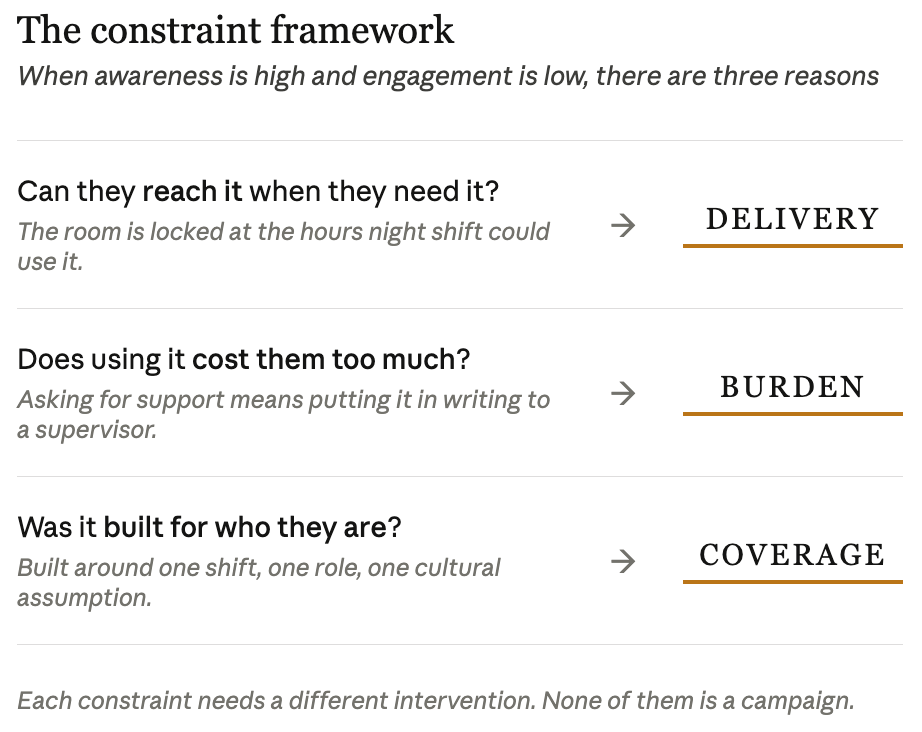
Diagnose before you prescribe. When I see an engagement gap, the first question is not how to promote the program better. The first question is which of three constraints is actually blocking the behavior.
The first constraint is delivery. The program exists on paper but does not actually reach the staff member in a usable form. The room is locked at the hours night shift could use it. The therapist is only available during the hours the unit cannot leave the floor. The signup link takes seven clicks and a manager approval. The program is real, but the delivery is broken.
The second constraint is burden. The staff member knows about the program and is willing to use it, but the cost of using it is too high. Using the wellness room means a colleague has to cover theirassignment. Asking for peer support means putting it in writing to asupervisor. Going to the therapy session means explaining the absence to a unit that is already short staffed. The program is real, the delivery works, but the social, time, or psychological cost is more than the perceived benefit.
The third constraint is coverage. The program serves a real need but only for a slice of the workforce. It is built around one shift, one role, one language, one set of cultural assumptions. Awareness can be high across the entire organization while engagement clusters in the segment the program was actually built for.
These three constraints look identical from the outside. All you see is the engagement number not moving. But they require completely different interventions. A delivery constraint needs operational redesign. A burden constraint needs to reduce the friction of asking. A coverage constraint needs new modalities, not louder marketing.
The most expensive mistake a wellness leader can make is to treat all three the same way and respond with another campaign.
What an awareness number is actually telling you.
If awareness is below fifty percent, you have a marketing problem. Run the campaign.
If awareness is above sixty percent and engagement is below twenty, you have a behavior change problem. The campaign is finished. The work now is to figure out which of the three constraints is binding, in which segments, and to redesign the program at that point of friction. This shift is uncomfortable for organizations because it moves the wellness function out of communications and into operations.
It asks wellness leaders to know how the program is actually delivered, who is actually carrying the cost of using it, and who is actually being left out.
That is a harder job than running a poster campaign. It is also the only job that produces a different number on the next survey.
The reframe.
Awareness is not the goal. Awareness is the prerequisite. When the wellness team can say that two thirds of staff know about us, that is not a finish line. That is permission to begin the real work.
The real work is engagement. The real measurement is whether the staff member who is exhausted on a Tuesday night actually opens the door of the wellness room. Whether they actually text the peer champion. Whether they actually show up to the group.
Every one of those acts is a small bet a staff member is making that the program will be worth the cost of using it. The wellness leader’s job is to make that bet pay off, every single time, until the bet itself becomes invisible. When that happens, you stop needing awareness campaigns. The program becomes the way the institution feels.
메타데이터
- post_id
- 2e7bf4774f08
- slug
- the-most-expensive-number-in-wellness-2e7bf4774f08
- url
- https://medium.com/@mnhowell00-46278/the-most-expensive-number-in-wellness-2e7bf4774f08
- canonical_url
- https://medium.com/@mnhowell00-46278/the-most-expensive-number-in-wellness-2e7bf4774f08
- author_url
- https://medium.com/@mnhowell00-46278
- status
- ok
- fetched_at
- 2026-07-13 17:38:32






