Does what we see really exist?
Daniel Kahneman often faced objections and criticism of his theory. And that is absolutely normal — more than that, from a scientific…
Does what we see really exist?
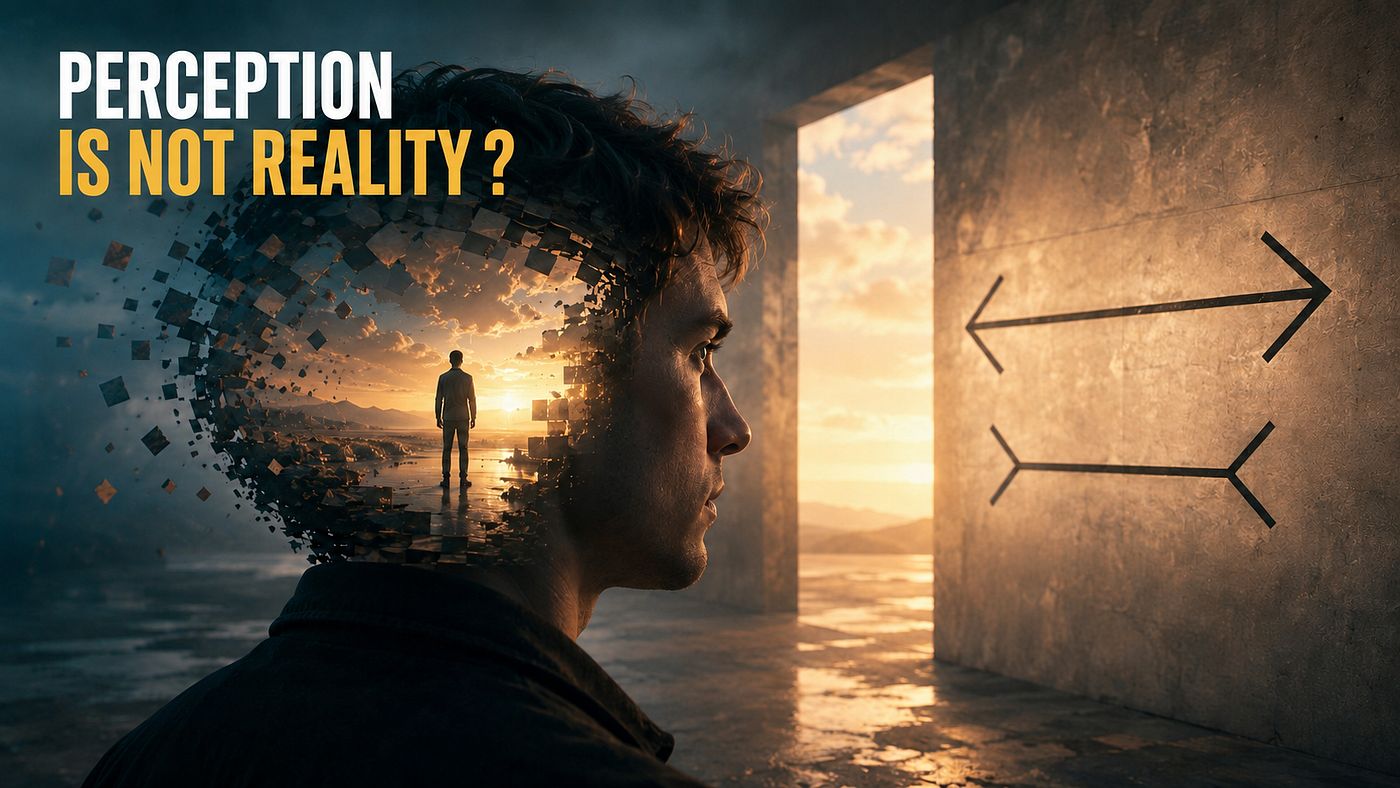
Daniel Kahneman often faced objections and criticism of his theory. And that is absolutely normal — more than that, from a scientific standpoint, it is the right thing. In the end, he did receive the Nobel Prize in Economics.
For me, a convincing proof of his correctness is the Müller–Lyer illusion. Two lines of equal length have different markings at their ends: on one line they point outward, on the other inward. In experiments, almost all participants looked at them and claimed that the line with the outward-pointing markings was longer. They weren’t answering randomly — they genuinely saw it that way.
[embed]
This leads to an important fact: we do not see the world as it actually is. More precisely, our brain has systematic perceptual errors, most likely shaped by evolution.
This is not unique to human perception. For example, I have read that a bee is physically incapable of seeing objects larger than a coin. Another example: we cannot see Wi-Fi waves, yet we use them effortlessly.
Reality exists within the brain and is, in essence, a representational model of the world filtered through our sensory and cognitive systems.
So how do we fight this? We don’t. And probably shouldn’t. What matters is not falling into the traps of these mental “bugs.” For instance, instead of taking claims on faith, we should gather facts, verify them, analyze them, and reach a rational, scientifically grounded conclusion.
That is how science works. If we measure with a ruler and obtain a result, we must accept the fact: the lines are equal in length, even if the brain stubbornly suggests otherwise.
Everything is useful. Everything that exists serves a purpose. The same applies to these brain reactions — they exist for a reason, just perhaps not for making precise decisions.
And sound decisions should be made on the basis of facts, not by living inside our interpretations of those facts.
메타데이터
- post_id
- 2e81e01e2958
- slug
- does-what-we-see-really-exist-2e81e01e2958
- url
- https://medium.com/@QuietResistance/does-what-we-see-really-exist-2e81e01e2958
- canonical_url
- https://medium.com/@QuietResistance/does-what-we-see-really-exist-2e81e01e2958
- author_url
- https://medium.com/@QuietResistance
- status
- ok
- fetched_at
- 2026-08-22 08:53:31