The Closest Tragedy
North Korea is thirty minutes away. Most days, nobody looks.
The Closest Tragedy
North Korea is thirty minutes away. Most days, nobody looks.
Thirty minutes from Seoul.
That’s the distance between you and North Korea.
From Ganghwa, the line moves east. Closer to Seoul. Closer to ordinary life.
Gimpo. A short drive past the international airport. The Han River estuary opens wide, and the sunset over the water stops you mid-breath.
Aegibong Peace Ecopark. Gimpo Marine Park. Bike paths along the river.
Behind every one of those postcards — barbed wire.
Couples watch that sunset. Families ride along the river. Children eat lunch at a school three kilometers from North Korean soil.

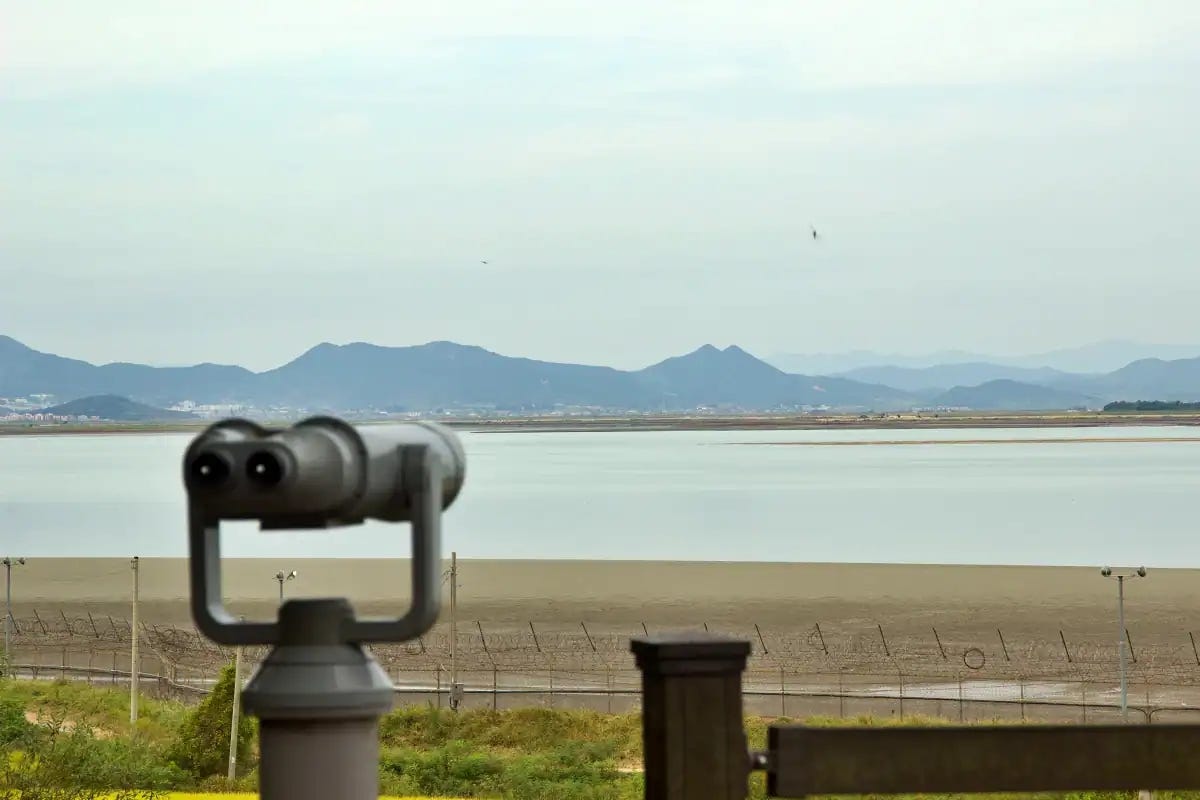
Aegibong Peace Ecopark. The telescopes point toward North Korea. The Starbucks is behind you.
They glance at the other side the way you’d glance at a billboard on your commute.
Division isn’t something far away here. It’s the view from the kitchen window.
I know. I used to be the one behind the wire.
Memories of Paju
Paju has changed since my service days.
Wider roads. A bigger city. Imjingak Pyeonghwanuri Park overflows with tourists now.
The barbed-wire fence hasn’t changed.
During my service, we guarded that fence in 24-hour shifts. Winter nights cold enough to numb your hands through the gloves. Summer monsoon downpours that turned the ground to mud under your boots.
Our mission was to stop anything from crossing that line.
Back then, it was duty. Looking back now — it was a fate none of us chose.
And the boys who guard it now didn’t choose it either.
The Face Behind the Checkpoint
Thirty minutes from Seoul, and you hit the first checkpoint.
A young soldier steps forward. Twenty, maybe twenty-one. Eyes too tired for a face that young.
“ID, please.”
I hand it over. He scans it. Looks at me. Back at the card. At me again.
I see myself in him. Twenty years ago, standing at a checkpoint just like this one. Checking IDs. Watching the fence. Counting down the days.
And I see my young friend, on guard duty right now in Cheorwon. Same uniform. Different year.
The uniform changes. The years change. The fence doesn’t.
Koreans call that feeling ansseureoum (안쓰러움). Watching someone carry a burden that should never have been theirs.
He didn’t choose this fence. Neither did I. Neither will the ones who come after us.
He waves me through. “Have a safe visit, sir.” I drive forward.
How many more generations?
The question drives with me.
The Color of the Air
Once you pass the checkpoint and enter the Civilian Control Line, the answer to “What’s the air like inside the DMZ?” is almost absurd.
Clean. Startlingly clean. A bluish clarity you don’t find in Seoul.

The Han River estuary at Aegibong. On the other side of that water — North Korea.
No factories. No apartment towers. No human noise for seventy years. Just wind through the grass and, somewhere far off, a bird you can’t name.
Seventy years of fear left the land alone. Mines and fences kept everyone out. Life returned on its own terms.
And five million people on the other side of the checkpoint breathe something else entirely.
The Paradox of Five Million
Gimpo, Paju, Goyang, Yeoncheon.
Millions of people live within sight of the fence.
An elementary school in Gimpo sits three kilometers from North Korea. Children see it from classroom windows.
Division isn’t a history lesson. It’s the view from the third-floor hallway.
Couples watch sunsets at Aegibong Peace Ecopark. North Korea, 1.4 kilometers away.
Commuters drive past barbed wire twice a day. Morning. Evening. Every day.
The fence becomes wallpaper. Background. Normal.
I drove past it for years before I served. Never looked.
Now I can’t stop looking.
That’s the difference between Gimpo and Ganghwa.
Ganghwa, you go to cry. Gimpo, you go to live.
And somewhere in that ordinary living, the fence disappears.
Not because it’s gone. Because you’ve stopped seeing it.
Division doesn’t win through tragedy. It wins through ordinariness.
Prev: My Father’s Land Next: Two Pajus — where tourist attractions and military zones share the same address.
The full series lives on KoreAtlas.
메타데이터
- post_id
- 2e82e4d5b6b5
- slug
- the-closest-tragedy-2e82e4d5b6b5
- url
- https://medium.com/@drpj1225/the-closest-tragedy-2e82e4d5b6b5
- canonical_url
- https://medium.com/@drpj1225/the-closest-tragedy-2e82e4d5b6b5
- author_url
- https://medium.com/@drpj1225
- status
- ok
- fetched_at
- 2026-06-24 23:31:39