Sixteen Heaps of Wheat
How a Familiar Ritual Led Me to New Horizons of Motherhood in Bharatiya Tradition
On Gratitude, Reverence, and Invocation
Sixteen Heaps of Wheat
How a Familiar Ritual Led Me to New Horizons of Motherhood in Bharatiya Tradition
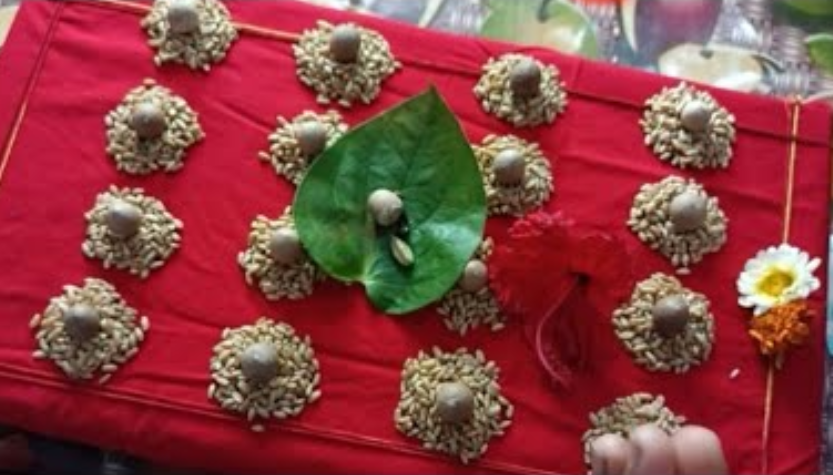
Image: Author
A Personal Note Before I Begin
Parvathi Ji’s thoughtful exploration of the Sapta Matarah opened a window that many of us may have walked past without fully noticing.
Her article introduced me to a dimension of Bharatiya thought that was both unfamiliar and deeply moving, the recognition of seven forms of motherhood woven into the fabric of civilization itself.
Read her thoughtful article here:
What follows is neither a scriptural exposition, nor an academic treatment of the subject.
Rather, it is a personal reflection inspired by Parvathi J’s work and shaped by my own experiences of participating in rituals, observing traditions, and occasionally pausing to wonder about the deeper meanings behind practices that we often inherit long before we understand them.
As a member of the Marwari Maheshwari community, I grew up seeing, even participating in the worship of the Shodasha Matrikas before all auspicious ceremonies, yet I confess that I had never seriously explored how these ritual traditions might connect with the broader ideas of the Sapta Matarah and the Sapta Matrikas.
This article is therefore offered in the spirit of learning rather than teaching, of exploration rather than any conclusion.
If Parvathi Ji’s article illuminated one horizon of motherhood in Bharatiya civilisation, these thoughts merely attempt to gaze toward a few adjoining horizons.
I remain, as always, a student of our traditions and welcome corrections, additions, and insights from those more knowledgeable than myself and even others too.
From Seven to Sixteen
The Expanding Circle of Motherhood in Bharatiya Tradition
Parvathi Ji’s beautiful article on the Sapta Matarah set many thoughts in motion.
Some articles inform.
Some educate.
A few illuminate corners of our own lives that we have walked past for decades without fully seeing.
For me, this was one such article.
As I read about the seven forms of motherhood recognized by Bharatiya civilization, I found myself travelling back through memory. I could almost see the sacred arrangements made before weddings, yajnas, griha-praveshas, and other auspicious ceremonies in our Marwari Maheshwari tradition.
There would be the worship of Shri Ganesh.
There would be the Navagrahas.
And there would be the Shodasha Matrikas.
Sixteen small heaps of wheat carefully placed before the diety.
Nine heaps of rice for the Navagrahas.
The rituals were familiar.
The reverence was unquestioned.
Yet, if I am honest, I had never paused to ask why.
Why sixteen Mothers?
Why before every auspicious beginning?
Why were they invoked before the ceremony itself could commence?
Parvathi Ji’s exploration of the Sapta Matarah helped me see those little heaps of wheat in an entirely new light.
Her article explores what may be called the social horizon of motherhood.
Not merely the mother who gives birth, but every force that nurtures life.
The biological mother.
The Guru’s wife.
The scholar’s wife.
The queen.
The cow.
The caregiver.
Mother Earth.
Together they reveal a profound civilizational insight: Motherhood is not merely a biological relationship.
It is any force that gives life, protects life, nourishes life, teaches life, or helps life flourish.
As I reflected further, it seemed to me that Bharatiya thought expresses this same instinct through three expanding circles.
The First Circle: Gratitude
The Sapta Matarah
These are the mothers we encounter in daily life.
They remind us to recognize and honor the many visible and invisible hands that contribute to our well-being.
The lesson here is gratitude.
To acknowledge that none of us grows through our own efforts alone.
We are all sustained by mothers beyond our mother.
The Second Circle: Reverence
The Sapta Matrikas
Many of us are familiar with the Sapta Matrikas of temple tradition:
Brahmani, Maheshwari, Kaumari, Vaishnavi, Varahi, Indrani, and Chamunda.
In many temples across Bharat, especially in the South, their presence is almost inevitable.
Here motherhood moves beyond society and enters the sacred realm.
The nurturing forces of life are no longer represented merely through human relationships but through divine archetypes.
The Matrikas embody protection.
Power.
Wisdom.
Courage.
Preservation.
The ability to confront chaos and restore order.
The lesson here is reverence.
The recognition that the forces sustaining civilization are ultimately sacred.
The Third Circle: Invocation
The Shodasha Matrikas
This is perhaps where many of us encounter the Mothers most often, even if we know little about them.
Before an auspicious undertaking begins, the Matrikas are invoked.
Marriage.
Housewarming.
Yajna.
Sacred ceremonies of every kind.
Why?
Perhaps because every new beginning requires more than favorable circumstances.
It requires protection.
Blessing.
Nourishment.
Harmony.
The unseen support systems that allow life to flourish.
The Shodasha Matrikas form an expanded circle of maternal energies surrounding the event.
A sacred assurance that the undertaking does not proceed alone.
The lesson here is invocation.
Not merely acknowledging motherhood.
Not merely revering motherhood.
But consciously inviting its presence into our lives.
From Seven to Eight to Sixteen
An interesting pattern appears throughout Bharatiya traditions.
The number seven often signifies foundational completeness.
We encounter it repeatedly:
Seven Rivers.
Seven Sages.
Seven Worlds.
Seven Mothers.
In some traditions, an eighth Matrika is added, expanding the circle of protection.
And then, in ritual practice, the circle expands further into sixteen.
The movement itself feels meaningful.
Seven lays the foundation.
Eight extends protection.
Sixteen signifies fullness.
Completeness.
A flowering into totality.
Whether or not this interpretation is scripturally exact, it beautifully reflects a recurring rhythm found throughout Bharatiya thought.
A Thought That Stayed With Me
Modern societies often ask:
“Who is my mother?”
Bharatiya civilization appears to have asked an additional question:
“To whom do I owe a mother’s debt?”
The answer was never limited to one individual.
It expanded.
From one mother to many.
From the household to society.
From society to the cosmos.
From gratitude to reverence.
From reverence to invocation.
Perhaps that is why the concept of motherhood occupies such a revered place in our civilization.
Not because motherhood was narrowly defined.
But because it was generously expanded.
Expanded until every force that sustains life could be honored through the same sacred word:
Mother. Maa.
And perhaps that is the enduring message of the Sapta Matarah, the Sapta Matrikas, and the Shodasha Matrikas.
That motherhood is not merely something we receive.
It is something we are called to recognize.
To honor.
And, in whatever measure we can, to embody.
A Humble Note
I write this not as a scholar of these traditions, but as a lifelong student who has participated in many rituals and only recently begun to appreciate some of the deeper ideas they preserve.
If I have misunderstood, oversimplified, or overlooked important nuances, I welcome correction from the learned ones.
One of the joys of exploring Bharatiya civilization is discovering that every answer opens the door to a dozen new questions.
And perhaps that, too, is a form of nurturing.
A mother does not merely provide answers.
She awakens curiosity.
The Matrikas, it seems, continue to do exactly that.
I think this piece works best if published not as a rebuttal or extension, but as a grateful reflection inspired by Parvathi J’s article- almost as though her essay prompted you to look at those sixteen heaps of wheat from your childhood and discover that they were carrying a philosophy all along. That personal connection gives the companion post both warmth and authenticity.
메타데이터
- post_id
- 2e993c0a89ad
- slug
- sixteen-heaps-of-wheat-2e993c0a89ad
- url
- https://medium.com/the-pillionaire-diaries/sixteen-heaps-of-wheat-2e993c0a89ad
- canonical_url
- https://medium.com/the-pillionaire-diaries/sixteen-heaps-of-wheat-2e993c0a89ad
- author_url
- https://medium.com/@rkkarnani
- status
- ok
- fetched_at
- 2026-06-11 05:11:55