The Ahupuaʻa Revival: How Can We Learn from Traditional Hawaiian Food Systems?
[This blog is part of a series on local food systems arising from my work at my nonprofit, Think BIG, and my campaign as the resilience…
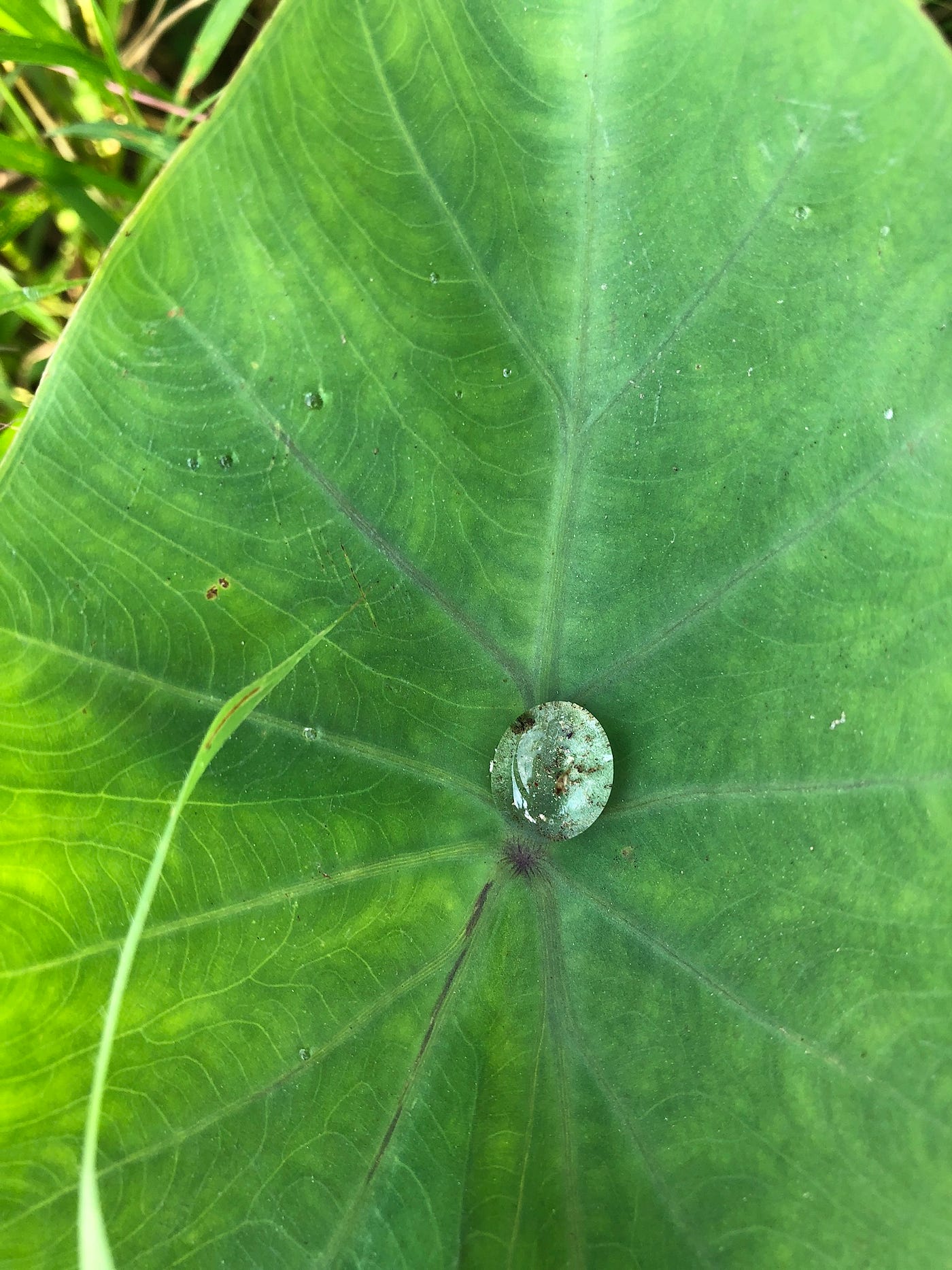
Kalo leaf with dew drop (photo Tam Hunt)
The Ahupuaʻa Revival: How Can We Learn from Traditional Hawaiian Food Systems?
[This blog is part of a series on local food systems arising from my work at my nonprofit, Think BIG, and my campaign as the resilience candidate for state House]
Here’s a question I think about a lot: if the ships stopped coming tomorrow, how long could we feed ourselves here on the Big Island?
The honest answer for the Big Island today is maybe a week. That’s how much food sits on our shelves and most pantries at any given moment. We import about 85 to 90 percent of what we eat, most of it traveling around 2,400 miles to get here, and we send roughly $1.5 billion off-island every year to pay for it. For an island in the middle of the largest ocean on Earth, that’s a remarkable thing to have allowed to happen.
It’s remarkable in part because it wasn’t always this way. Before Western contact, these islands fed a population of several hundred thousand people — most estimates land somewhere between 400,000 and 800,000 — entirely from local farming, agroforestry, fishing, and fish ponds (loki i‘a). No imports. No container ships. The land and the sea right here fed everyone.
So when I talk about food security in my campaign for state House (www.hunt4house.com), I’m not proposing some untested experiment. I’m pointing at something that already worked, for centuries, on this exact land, right here.
The land management system that made it work was the ahupuaʻa, and I think it has a lot to teach us today.
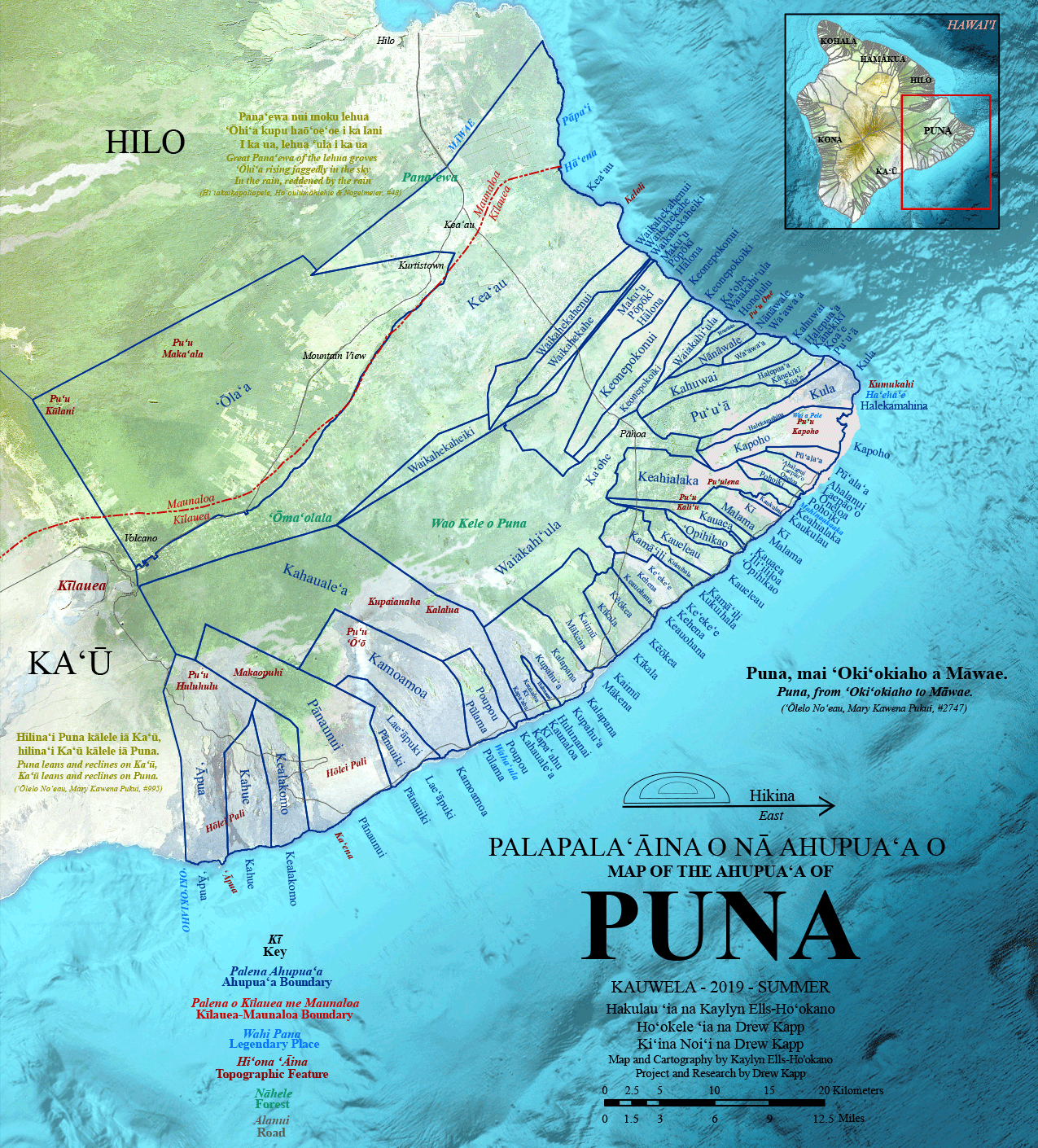
UH/HCC ahupua’a map of Puna, 2019 (source)
First, a note on respect
Ahupuaʻa, aloha ʻāina, mālama ʻāina — these are Kānaka Maoli concepts with deep genealogical, spiritual, and political roots. They are not slogans, and they are not mine. I come to them as a non-Hawaiian resident of Puna, a guest on this land, and my job here is to learn from a Hawaiian system and credit the Hawaiian scholars and practitioners who have carried and revived it — not to claim it as mine in any way. On matters of Hawaiian culture and sovereignty, I follow; I don’t lead. I want to say that plainly before I say anything else.
What the ahupuaʻa actually was
Picture a wedge of land running from the mountain summit down to the sea and out onto the reef — mauka to makai. That’s an ahupuaʻa. Because it usually followed a natural watershed, a single one contained almost everything its people needed, arranged by elevation.
Up top was the forest, mostly left alone so it could keep making rain and recharging the aquifer. The middle slopes were the farm belt: kalo (taro) in irrigated loʻi where there was water, and ʻuala (sweet potato), ʻulu (breadfruit), and other staples in rain-fed and agroforestry systems where there wasn’t. Down at the shore were the loko iʻa — engineered fishponds — and the reef, where protein was raised and gathered. Pigs, dogs, and chickens were also a significant source of protein.
The whole thing was coordinated by a konohiki, a resource manager who allocated water, set seasonal harvest and fishing kapu (rules) so stocks could recover after over-fishing, and organized communal labor. And here’s the part that matters most: rights and responsibilities ran together. To draw water or take fish was to accept the kuleana — the responsibility — of keeping the system healthy for everyone downstream. That’s mālama ʻāina expressed as governance, not as a bumper sticker. The word ʻāina itself literally means “that which feeds.” The whole worldview assumes people and place feed each other, and the rules were built to keep that exchange in balance.
How it actually fed everyone
It’s easy to underestimate the scale of all this, because most of it is now hidden under pasture grass and lava. The record tells a different story.
Dr. Sam ʻOhu Gon III and his colleagues at The Nature Conservancy did the math in a 2018 study, and the result floored me: the total pre-contact human footprint — every cultivated and built acre combined — covered less than 15 percent of the islands, yet supplied 100 percent of human needs. Less than 250 years later, we’ve lost more than half of our native habitat and dropped to roughly 15 percent food self-sufficiency. We’ve completely inverted the achievement.
Dr. Noa Kekuewa Lincoln at UH Mānoa, a new friend of mine, who has spent years mapping these systems, estimates Hawaiians cultivated on the order of a million acres. The dryland field systems were enormous and sophisticated — the Leeward Kohala Field System right here on our island covered something like 25 square miles of engineered, rain-fed cropping. As Lincoln puts it, you don’t build something like that without a large population, a complex political order, and deep ecological knowledge. On the Big Island specifically, Hawaiians farmed productively on young, rocky volcanic soils and across wild rainfall gradients — the very land we often write off now as unfarmable.
And the fishponds. Hawaiians built and ran something like 450 to 500 loko iʻa across the islands, producing roughly 400 to 600 pounds of fish per acre per year — with zero imported feed. They drew their nutrients from the runoff coming down off the farms. So the system literally closed the loop: what washed down from the fields helped feed the fish.
If you want the foundational record of all this, it’s Native Planters in Old Hawaii, the 1972 classic by E.S. Craighill Handy and Elizabeth Green Handy with the great Mary Kawena Pukui. Patrick Vinton Kirch’s archaeology fills in the long arc of how this food civilization grew. The picture is unambiguous: this was a productive, self-sufficient society that fed itself well, not just at subsistence levels.
The original “circular economy”
Our modern economy runs on a straight line: take resources, make stuff, throw away the waste. On an island, every step of that line leaks money and pollution either off-island or into the ground.
The ahupuaʻa ran on a loop instead. The clearest modern way I’ve seen this put comes from Dr. Kamanamaikalani Beamer of UH Mānoa — geographer, legal scholar, former state water commissioner — and the ʻĀina Aloha Economic Futures initiative he helped found. Beamer frames an aloha ʻāina economy around a simple principle: give, take, regenerate. Take only what the system can sustain, give back through care, and design every cycle so the land ends up more abundant than before.
That isn’t a metaphor borrowed from the ahupuaʻa. It’s a description of how the ahupuaʻa worked. Forests protected so they keep making water. Taro patches returning to the soil. Fishponds turning runoff into protein. Harvest kapu letting stocks recover. The whole system was designed, top to bottom, to leave the land able to feed the next generation. An entire economy that decoupled human well-being from environmental damage — centuries before anyone coined the phrase “circular economy.”
The people doing this work right now
None of this is museum stuff. A living movement of Hawaiian scholars, farmers, and ocean stewards is reviving ahupuaʻa practice today, much of it on this island, and they deserve to be named — because the policy ideas below are downstream of their work, not mine.
Beamer, for the economic framework. Lincoln, who runs the Indigenous Cropping Systems Lab, founded the Māla Kaluʻulu breadfruit cooperative in South Kona, and helps steer the Hawaiʻi ʻUlu Cooperative and the Amy Greenwell Ethnobotanical Garden. Gon, for the footprint study. The Handys and Pukui, and Kirch, for the foundational record. Kevin Chang and Kuaʻāina Ulu ʻAuamo (KUA), the grassroots group whose Hui Mālama Loko Iʻa network supports 60-plus community fishpond restorations statewide — KUA’s name means “grassroots growing through shared kuleana.” Davianna Pōmaikaʻi McGregor, whose Nā Kuaʻāina documents the rural communities where this knowledge survived, and Mehana Blaich Vaughan, whose Kaiāulu studies community-based resource management as a present-day model. And the organizations on the ground: the Hawaiʻi ʻUlu Cooperative, KUA, The Kohala Center, Ulu Mau Puanui, the kalo farmers of Waipiʻo, and more.
How we can do better
Reviving the ahupuaʻa isn’t a matter of passing a law — it’s already being led by communities and grounded in Hawaiian knowledge. But the State Legislature controls a lot of the levers that today either block that revival or could unlock it and accelerate it: land, water, permitting, school funding, food-system investment. Here’s where I think the Legislature can make a real difference:
Scale up our tropical staples. This is the single biggest lever we have, and the math is striking. Our own Big Island food sovereignty work shows that ʻulu, kalo, ʻuala, and cassava are already about 85 percent locally self-sufficient — but they make up only around 2 percent of our diet by weight. Imported grains are 15 percent of the diet and zero percent local. Shifting calories from imported grain to these ahupuaʻa staples could swing our overall self-sufficiency by more than ten points, more than any other single move. That means funding mills, flour, freezing, and storage, and requiring real local sourcing of starches in school meals.
Bring back distributed, perennial agroforestry — one yard at a time. The ahupuaʻa never bet everything on one big farm; it spread food across the landscape using perennial, low-labor crops and soil that fed itself. The modern, household-scale version already exists and has been tested right here: the “Prep, Set & Forget” food-forest program from my nonprofit, Think BIG. An established Puna food forest can produce somewhere between 500 and 1,500 pounds a year and can displace $2,000 to $3,000 of grocery spending per household. At even 25 percent participation across our district, that’s roughly $6.3 million a year staying in Puna pockets instead of being sent away— in Hawaiʻi’s lowest-income district that happens to sit in one of the best growing zones. The state and county can help by funding a propagation nursery and seedling giveaways, reforming the zoning that still restricts backyard food production, and offering a better property-tax breaks for established food forests. This is the farm belt of the ahupuaʻa, rebuilt one backyard at a time.
Rebuild a strategic food reserve. Storage was built into the old system. Hawaiians dried and fermented ʻulu and kalo into paʻiʻai, cached ʻuala, and the konohiki kept buffers so a community could ride out a storm or a failed harvest. We’ve abandoned that discipline — hence the three-to-seven-day shelf of food, collectively. I authored the Strategic Food Reserve Act (SB 3162) in this last session, which passed the Senate Agriculture committee unanimously but then died , to rebuild that buffer in modern form: rotating reserves of storable local staples, sized to carry us through a supply cutoff and cycled through institutional kitchens so nothing spoils. A reserve only works if we can actually store local food, which is exactly why the processing infrastructure above matters twice over.
Restore the fishponds — and fix the permitting. Our roughly 450 to 500 historic loko iʻa are a standing aquaculture asset that makes protein with no imported feed. The state’s Hoʻāla Loko Iʻa program already streamlined state permitting after advocacy from Hui Mālama Loko Iʻa; most of what’s left is a federal Clean Water Act tangle. I’d fund restoration and push for a federal fix, treating loko iʻa as the protein complement to a tropical-staple carbohydrate base.
Manage land and water at the ahupuaʻa scale. Right now our agencies regulate forests, streams, farms, and reefs in separate silos — the opposite of how the system worked. Ridge-to-reef management would protect the upland forest as our water engine, keep that water in-stream and in-loʻi where Hawaiian and farm use require it, and treat runoff, reef health, and food production as one connected thing. And we should put Puna’s vast acreage of young, idle agricultural land to work for resilience rather than speculation.
The honest part
A few things this is not. It is not a call to re-create a 1778 economy or to ask anyone to live in the past — it’s about borrowing proven design principles and pairing them with modern tools, from the ʻUlu Cooperative’s flour lines to drip irrigation, agrivoltaics, and cold storage. It does not pretend that most land isn’t privately held now, or that water rights aren’t genuinely contested; those are real constraints honest policy has to work within. And it absolutely is not a non-Hawaiian candidate appropriating a Hawaiian tradition. The revival is Kānaka Maoli-led. My role, and the State’s, is to remove obstacles, fund the work, and follow that leadership.
It’s also honest to say this will take decades, not one legislative session. But the direction is clear, the biggest lever is identified, the practitioners are already at work, and the alternative — staying a few days from empty shelves — just isn’t acceptable for the people of Puna.
Keeping faith with the land
The ahupuaʻa fed everyone here for centuries on less than 15 percent of the land, with nothing imported and nothing wasted. That’s not a myth. It’s documented history, and it’s a living practice being revived right now. Our task isn’t to copy it literally — it’s to keep faith with what it knew: that an island survives by feeding itself, by closing its loops, and by leaving the land more abundant than it found it.
That, to me, is mālama ʻāina applied to the most basic question a community can ask — can we feed ourselves? With the right policy, the right partnerships, and Hawaiian leadership at the center, the answer for the Big Island can once again be yes.
Let’s build back pono.
A few sources and people worth following if you want to go deeper: Gon, Tom & Woodside, “ʻĀina Momona, Honua Au Loli” (Sustainability, 2018); the work of Dr. Noa Kekuewa Lincoln (UH Mānoa Indigenous Cropping Systems Lab) and Dr. Kamanamaikalani Beamer (ʻĀina Aloha Economic Futures); Handy, Handy & Pukui, Native Planters in Old Hawaii (Bishop Museum, 1972); Kuaʻāina Ulu ʻAuamo and the Hui Mālama Loko Iʻa network (kuahawaii.org); the Hawaiʻi ʻUlu Cooperative (hawaiiulu.org); and Think BIG Hawaiʻi’s Big Island food sovereignty work. The detailed policy version, with figures and full citations, is in my “Ahupuaʻa Revival” issue brief.
메타데이터
- post_id
- 2ea013aaa7ad
- slug
- the-ahupuaʻa-revival-how-can-we-learn-from-traditional-hawaiian-food-systems-2ea013aaa7ad
- url
- https://medium.com/@tamhunt/the-ahupua%CA%BBa-revival-how-can-we-learn-from-traditional-hawaiian-food-systems-2ea013aaa7ad
- canonical_url
- https://medium.com/@tamhunt/the-ahupua%CA%BBa-revival-how-can-we-learn-from-traditional-hawaiian-food-systems-2ea013aaa7ad
- author_url
- https://medium.com/@tamhunt
- status
- ok
- fetched_at
- 2026-06-10 08:17:25