Parallel Landscapes: Living with ECC and S4HANA Together
There is a quiet reality inside many enterprises today that few openly talk about.
Parallel Landscapes: Living with ECC and S4HANA Together
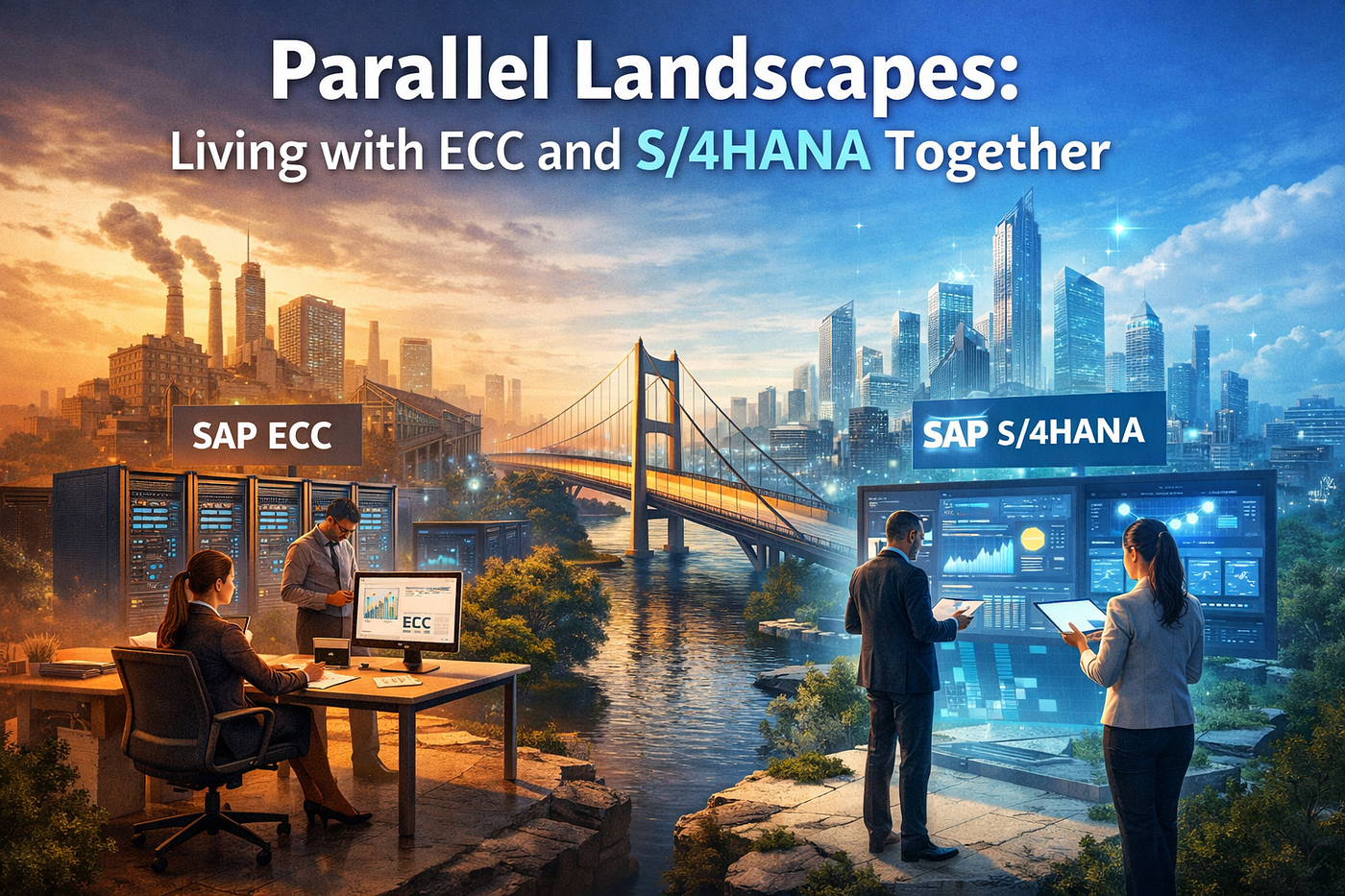
Living Parallel with ECC and S/4Hana together
There is a quiet reality inside many enterprises today that few openly talk about.
We are not fully on S4HANA. We are not fully on ECC. We are living in both.
And honestly, that in between state deserves more discussion than it gets.
If you are working in SAP transformation, IT leadership, finance operations, or enterprise architecture, you probably know exactly what we mean. Your organization did not wake up one morning and flip a switch from SAP ECC to SAP S4HANA. Instead, you are navigating a coexistence model. A parallel landscape. Two cores, one enterprise.
We want to share what we are seeing, what we are experiencing, and what we believe this moment really means.
Why Parallel Landscapes Are the Norm
In theory, the SAP roadmap looks linear. ECC reaches end of support. Enterprises migrate. S4HANA becomes the new digital core.
In practice, it rarely works that cleanly.
Many enterprises are running:
• ECC for legacy finance and manufacturing • S4HANA for new business units • Selective S4HANA modules for innovation • ECC in certain geographies due to regulatory constraints
This is not failure. This is strategy.
The reason is simple. Enterprise systems are deeply embedded in operations. You cannot replace decades of configuration, customization, and business process logic overnight without operational risk.
So organizations stage the transformation.
And staging means coexistence.
What It Feels Like Operationally
Let us be candid. Living in parallel landscapes is not elegant.
You are managing:
• Dual data models • Integration complexity • Cross system reporting • Duplicate master data governance • Mixed user experiences
Finance teams reconcile across systems. IT teams maintain connectors and middleware. Business stakeholders ask why some processes feel modern and others feel legacy.
The complexity is real. But so is the opportunity.
Because this phase forces clarity.
It reveals where process fragmentation exists. It exposes over customization in ECC. It surfaces the difference between technical migration and true transformation.
The Strategic Question We Keep Asking
Is S4HANA a technical upgrade or a business redesign?
When both ECC and S4HANA run together, that question becomes unavoidable.
If you simply replicate ECC structures into S4HANA, you are prolonging the past.
If you use coexistence as a buffer to rethink processes, governance, analytics, and architecture, you are shaping the future.
Parallel landscapes create breathing space. They give enterprises the ability to pilot, validate, and iterate before full scale rollout.
In our view, this is not a weakness. It is a strategic advantage when managed deliberately.
The Real Risk Is Not Dual Systems
The real risk is indecision.
Parallel landscapes become dangerous when:
• There is no defined sunset roadmap for ECC • Ownership between teams is unclear • Data governance is fragmented • Integration architecture is reactive rather than designed
We have seen organizations operate in dual core mode without a convergence strategy. That is where cost multiplies and technical debt compounds.
Living with ECC and S4HANA together requires architectural discipline. It requires strong program governance. It requires executive clarity.
Without that, parallel becomes permanent.
A More Honest Way to Think About S4HANA Migration
We believe the industry conversation has been overly binary.
It is not ECC versus S4HANA. It is not legacy versus innovation. It is continuity plus transformation.
ECC carries operational stability. S4HANA brings real time processing, embedded analytics, and simplified data models.
The transition is evolutionary. Parallel landscapes are not a detour. They are the bridge.
What We Are Advising Enterprises to Do
If you are currently living in ECC and S4HANA together, here are questions we encourage you to reflect on:
- Do you have a clearly defined target architecture state
- Are integration layers centralized and scalable
- Is your data governance unified across both systems
- Have you identified which processes truly need redesign versus technical migration
- Is there a timeline for ECC decommissioning
Without these guardrails, coexistence drifts. With them, coexistence becomes strategic sequencing.
The Human Side of Dual Landscapes
Behind every SAP transformation are people.
Finance controllers adjusting to new reporting structures. IT teams upskilling from ECC technical stacks to S4HANA architecture. Business users navigating two interfaces.
Transformation fatigue is real.
Parallel landscapes prolong the transition period. That means change management must be sustained, not treated as a one time initiative.
We cannot talk about digital transformation without acknowledging the people carrying it forward.
Final Thoughts
Living with ECC and S4HANA together is not a sign of delay. It is a reflection of enterprise scale and complexity.
The real differentiator is not how quickly you move. It is how deliberately you design the path.
Parallel landscapes can be chaos. Or they can be controlled transition environments.
The difference lies in architectural intent, governance maturity, and leadership clarity.
메타데이터
- post_id
- 2ea6ceecb6ae
- slug
- parallel-landscapes-living-with-ecc-and-s4hana-together-2ea6ceecb6ae
- url
- https://medium.com/@SkillsCapital/parallel-landscapes-living-with-ecc-and-s4hana-together-2ea6ceecb6ae
- canonical_url
- https://medium.com/@SkillsCapital/parallel-landscapes-living-with-ecc-and-s4hana-together-2ea6ceecb6ae
- author_url
- https://medium.com/@SkillsCapital
- status
- ok
- fetched_at
- 2026-06-16 19:09:56