5 Best Handwriting to Text Converters in 2026 (Fast, Free & Accurate)
You’ve got pages of handwritten notes sitting on your desk.
5 Best Handwriting to Text Converters in 2026 (Fast, Free & Accurate)
You’ve got pages of handwritten notes sitting on your desk.
Maybe it’s class notes from last week. Or a stack of filled forms your team needs to process. Or a research journal you’ve been meaning to digitize for months.
Here’s the problem:
Retyping everything word by word is a massive time sink. And honestly? You shouldn’t have to do it manually anymore.
The good news:
Handwriting-to-text converters have gotten really good. We’re talking AI-powered tools that can read cursive, handle blurry images, and process multiple files at once. All in seconds.
But not every tool delivers on that promise.
Some choke on messy handwriting. Others hide their best features behind expensive subscriptions. And a few are just plain inaccurate.
So I tested the best ones available right now and put together this list.
These are the tools that actually work, whether you’re a student, a researcher, a teacher, or just someone who wants to stop retyping things.
Let’s get into it.
What to Look for in a Handwriting to Text Converter
Before we jump to the tools, here’s what actually separates a great converter from a frustrating one:
Accuracy on real-world handwriting. This is the big one. Can it handle cursive? Messy writing? Low-resolution photos? Many tools only work well on neat, printed text, which isn’t realistic.
Processing speed. Nobody wants to wait 2 minutes for one page. The best tools return results in seconds.
Free access. A lot of tools advertise “free” but lock the good stuff behind a paywall. Look for tools with genuinely useful free tiers.
Device compatibility. Can you use it on your phone? Your laptop? Any browser? Flexibility matters.
Multi-language support. If you work in languages other than English, this is non-negotiable.
Privacy and data security. You’re uploading personal documents. Make sure the tool doesn’t store or share your files.
Batch conversion. If you have 10 pages of notes to digitize, uploading one at a time is painful. Batch support is a big time-saver.
Now let’s look at the tools that tick all these boxes.
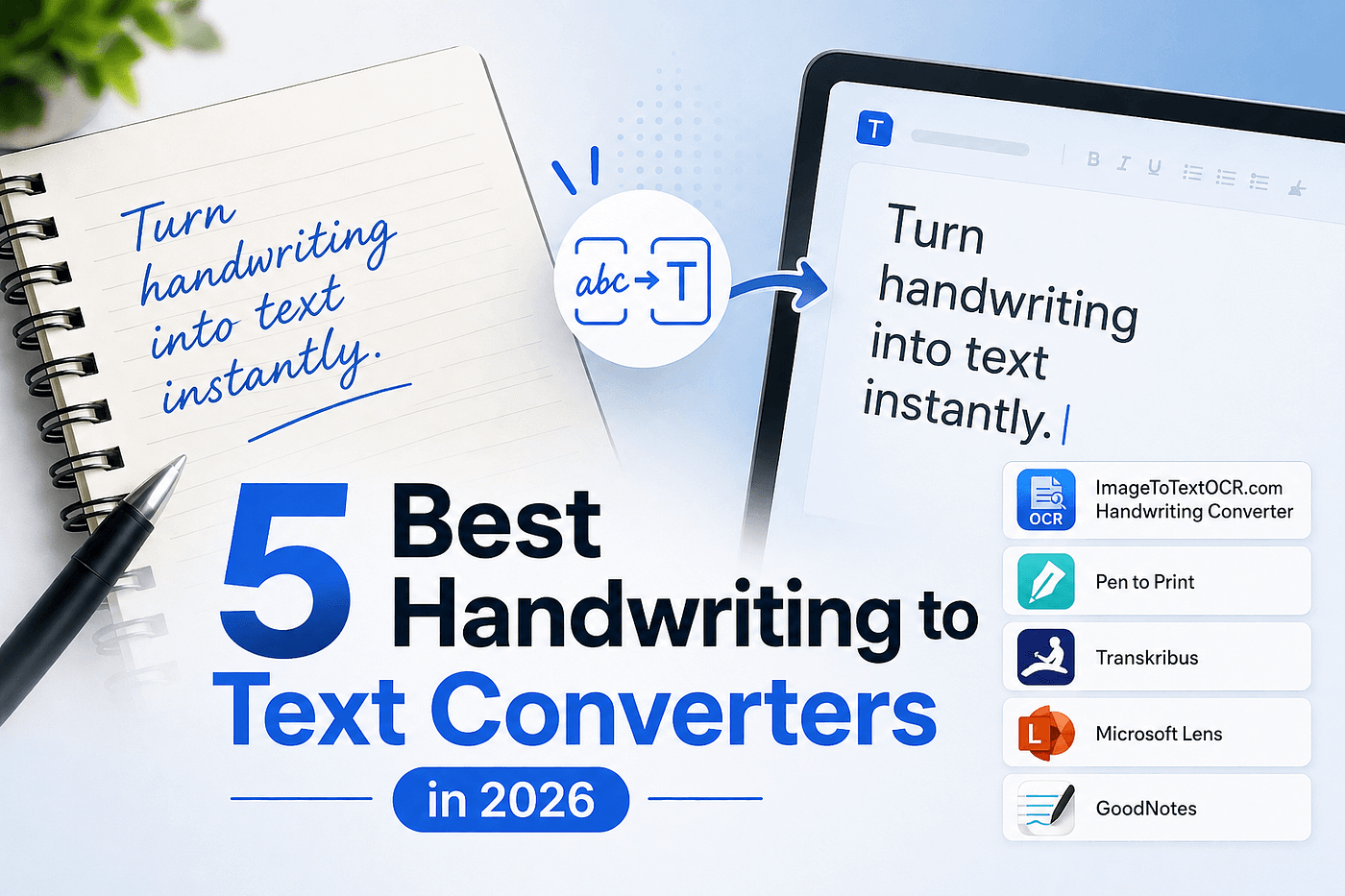
My Top 5 Handwriting to Text Converters for 2026
- ImageToTextOCR Handwriting Converter — Best free, no-signup tool for everyday handwriting digitization
- Pen to Print — Best for preserving document structure and layout
- Transkribus — Best for historical documents and large-scale research projects
- Microsoft Lens — Best for Microsoft 365 users and office workflows
- GoodNotes — Best for iPad users who take notes with Apple Pencil
1. ImageToTextOCR Handwriting to Text Converter
Best free handwriting to text converter, no account required
Pricing: 100% free. No subscription. No signup.
Link: imagetotextocr.com/handwriting-to-text
This is the tool I recommend first, and for good reason.
ImageToTextOCR’s handwriting converter does exactly what most people need. You upload a photo of your handwritten notes, hit convert, and get clean, editable text back in seconds. No account. No credit card. No hoops to jump through.
It’s built specifically for handwriting, not just printed text, which makes a real difference when you’re working with cursive, fast-scribbly notes, or low-quality phone photos.
What Makes It Stand Out
It actually reads cursive. This is harder than it sounds. Most general-purpose OCR tools treat cursive like a foreign language. ImageToTextOCR is specifically trained to handle connected, flowing letterforms, which means your loopy handwriting isn’t going to come out as garbled nonsense.
Batch conversion support. You can upload up to 10 files in a single session. No limit on the number of sessions you run. So if you have 50 pages of notes to digitize, you can power through them quickly without starting over from scratch each time.
Fetch images directly from a URL. Don’t have the file saved locally? Just paste the image URL, and the tool pulls it in automatically. This is a surprisingly useful feature that most competing tools skip entirely.
Works on every device. Whether you’re on Android, iOS, Windows, or Linux, this tool runs in your browser without any installation. Pick up your phone, snap a photo of your notes, and convert on the spot.
20+ language support. As long as the language is Unicode-supported, the tool handles it. So it’s not just English-only. It works across a wide range of scripts and languages.
Zero data storage. Your files are processed securely and automatically deleted from the servers after conversion. Nothing is stored, nothing is shared. That’s a big deal when you’re uploading personal notes, medical documents, or confidential paperwork.
How to Use It (3 Simple Steps)
Using ImageToTextOCR’s handwriting converter is about as simple as it gets.
Step 1: Upload your image. Drag and drop your file, click browse to select it, paste an image directly, or enter a URL. Supported formats include JPG, PNG, GIF, JFIF, HEIC, and PDF.
Step 2: Hit Convert. Use the optional crop tool to frame your handwriting if needed, then click the Convert button. The AI gets to work immediately.
Step 3: Copy or download your text. Once the conversion is done, copy the text to your clipboard or download it directly to your device. That’s it.
The whole process takes under 30 seconds for most images.
Who Should Use It
This tool is a great fit for:
- Students who want to turn handwritten class notes into searchable, editable digital text before exams
- Researchers who need to digitize field notes, interview transcripts, or archival handwriting without manual transcription
- Teachers who want to convert hand-filled student worksheets into digital records
- Writers who prefer drafting by hand and need a fast way to bring their written work into a digital editor
- Anyone processing forms or physical paperwork that needs to be entered into a digital system
Pros
- Completely free with no account or subscription needed
- AI-powered cursive handwriting recognition that actually works on real-world writing
- Batch conversion support for up to 10 files at once
- Works on all devices and operating systems, including Android, iOS, Windows, and Linux
- Supports 20+ languages for non-English handwriting
- Let's you fetch images directly from a URL without saving the file first
- Zero data storage, so your privacy is fully protected at all times
- No daily usage limits whatsoever
Cons
- Free tier is capped at 10 files per session, though you can run unlimited sessions back-to-back
- Accuracy can drop on extremely blurry or very dark images
- Browser-only tool with no dedicated app version
2. Pen to Print
Best for preserving document structure and formatting
Pricing: Free tier available; paid plans start from $11/month
Link: pen-to-print.com
Pen to Print takes a different approach to handwriting conversion.
Where most tools just extract raw text, Pen to Print focuses on preserving the structure of your handwritten document. That includes titles, numbered lists, bullet points, bold and underlined text, and even handwritten tables.
If you’ve ever converted a page of organized notes only to get a wall of unformatted text back, you know exactly why this matters.
Key Features
Document AI Digitizer. This is Pen to Print’s flagship feature. It uses AI to reconstruct document hierarchy, including headers, numbered lists, bullets, and inline images, so your output actually looks like your original notes and not just a raw text dump.
Handwritten math and equations. Got math notes with fractions, exponents, and equations? Pen to Print can convert those into LaTeX or Word format while preserving the full mathematical structure. That’s something almost no other free tool does.
Form and survey data extraction. You can upload hand-filled forms and the tool extracts the data into organized Word or Excel files. A massive time-saver for teams processing physical paperwork at volume.
Cursive and messy handwriting support. Pen to Print claims 98.2% word accuracy for its handwriting OCR engine. In real-world use, it handles cursive and hard-to-read scripts significantly better than general-purpose tools.
Multiple output formats. Export your converted content as plain text, Word, PDF, LaTeX, or Excel depending on what you need.
Who Should Use It
Pen to Print is particularly strong for users who need more than just raw text extraction. It’s a great fit for students with structured notes, office managers processing volumes of handwritten forms, academics working with formatted research documents, and anyone exporting handwriting into Word or Excel for further editing.
Pros
- Preserves full document structure including headings, bullet points, and numbered lists
- Handles handwritten math and equations with LaTeX and Word export support
- Offers multiple output formats including Word, PDF, LaTeX, and Excel
- Strong cursive handwriting recognition with claimed 98.2% accuracy
- Supports form and survey data extraction directly into spreadsheets
Cons
- Free tier is limited in page volume and you hit the cap quickly
- Structured formatting extraction works best on clearly organized handwriting
- Takes some time to learn how to get the most out of the advanced features
3. Transkribus
Best for historical documents and large-scale research projects
Pricing: Free credits available; paid plans for high-volume usage
Link: transkribus.org
Transkribus is in a category of its own.
While most handwriting tools are built for modern, everyday notes, Transkribus was built for a completely different challenge: digitizing historical handwriting at scale.
It was developed by a cooperative of 250+ academic and cultural institutions across Europe. It’s specifically designed to handle things like centuries-old manuscripts, Kurrent script, Fraktur, and other historical writing styles that general OCR tools simply cannot touch.
Key Features
Text Titan I, the flagship AI model. Transkribus’ core model was trained on over 30 million words from historical documents spanning multiple centuries and languages. It reads letter shapes and flow patterns even in the most challenging handwriting samples.
300+ public models. Beyond the default model, Transkribus offers over 300 specialized models trained on specific handwriting styles, languages, and historical periods. If you’re working with 18th-century German manuscripts or medieval Latin scripts, there’s likely a model already built for it.
Train your own custom model. For really specialized projects, you can train a custom AI model on your specific handwriting style. This is overkill for most people, but it’s a game-changer for archivists and researchers working with unique historical collections.
Full-text search across transcribed documents. Once your handwriting is converted, you can search across all your transcribed documents instantly. Incredibly useful for researchers managing large document archives.
GDPR-compliant and Europe-hosted. All processing happens on Transkribus’ own servers in Austria. Your data stays yours and can be deleted at any time.
Who Should Use It
Transkribus is built for a specific audience: historians and archivists digitizing historical manuscripts, researchers working with large document collections, cultural institutions preserving heritage materials, and academics who need specialized handwriting models for niche scripts.
It’s not the right tool if you just want to digitize your class notes quickly. For that, ImageToTextOCR is a much faster and simpler option.
Pros
- Purpose-built for historical and complex handwriting styles that general tools can’t handle
- Offers 300+ specialized AI models covering different scripts, languages, and eras
- Lets you train fully custom models on your own unique handwriting or script
- Full-text search works instantly across all your transcribed documents
- GDPR-compliant with all processing done on Europe-based servers in Austria
Cons
- Way too complex and feature-heavy for everyday note digitization
- Steeper learning curve compared to consumer-facing tools
- Credits-based pricing can get expensive quickly on large-scale projects
4. Microsoft Lens
Best for Microsoft 365 users and office workflows
Pricing: Free, included with a Microsoft account
Link: Available on iOS and Android app stores
If you’re already deep in the Microsoft ecosystem, including OneDrive, Teams, Word, and OneNote, Microsoft Lens is the most seamless handwriting capture tool available.
It’s a free mobile app that uses your phone camera to scan handwritten notes and convert them into editable text. The real power comes from how tightly it integrates with everything else in Microsoft’s suite.
Key Features
One-tap capture and export. Snap a photo of your handwriting, and Lens automatically processes and exports it directly into OneNote, Word, or OneDrive. No file management, no downloads, no switching between apps.
OCR across 30+ languages. Lens supports over 30 languages for text recognition, making it a solid option for multilingual teams and international environments.
Whiteboard and document modes. Beyond handwriting, Lens is also great for capturing whiteboards from meetings and converting them into searchable, shareable text. Useful for teams that still brainstorm on physical boards.
Works with Microsoft 365 at no extra cost. If your organization already pays for Microsoft 365, Lens is just there with no extra subscription needed.
Honest Note on Accuracy
Microsoft Lens is optimized primarily for printed text. For clean, printed handwriting it performs well. For cursive or messy handwriting, accuracy drops noticeably compared to specialist tools like ImageToTextOCR or Pen to Print.
In short, it’s great for casual handwriting capture, especially if you live in Microsoft 365. Not the strongest choice if handwriting accuracy is your top priority.
Who Should Use It
- Office workers who use Microsoft 365 daily
- Teams that need to digitize whiteboard notes from meetings
- Anyone who wants a quick mobile scanning tool that feeds directly into OneNote or Word
Pros
- Completely free with any Microsoft account
- Seamless one-tap integration with Word, OneNote, and OneDrive
- Supports 30+ languages for multilingual text recognition
- Works great for capturing and digitizing whiteboard content from meetings
Cons
- Less accurate on cursive and messy handwriting compared to dedicated OCR tools
- Primarily a mobile app with no dedicated web interface
- Requires a Microsoft account to get started
5. GoodNotes
Best for iPad users who take notes with Apple Pencil
Pricing: Free download; one-time purchase or subscription for full features
Link: goodnotes.com
GoodNotes is a completely different kind of tool.
While every other tool on this list converts photos of handwritten notes, GoodNotes is where you do the handwriting digitally using an Apple Pencil on an iPad.
It’s less of a conversion tool and more of a digital notebook that happens to be exceptionally good at turning your stylus input into editable text on demand.
Key Features
Handwriting-to-text conversion on the fly. Use the lasso tool to select any section of your handwritten notes, then convert it to typed text with a single tap. You can do it selectively, just the parts you need, rather than converting a whole page at once.
Search across all your handwritten notes. This is GoodNotes’ killer feature. You can search your handwriting just like you’d search typed text. GoodNotes reads your handwriting in the background and makes it fully searchable across all your notebooks without you having to convert anything manually.
15+ language support. Handwriting recognition works across 15+ languages, so it’s not limited to English-only note-takers.
Infinite canvas and customizable templates. GoodNotes gives you beautiful paper templates, an infinite canvas for diagrams and freeform notes, and a highly polished note-taking environment overall.
Cloud sync across devices. Everything syncs via iCloud, so your notes are accessible across all your Apple devices.
Important Caveat
GoodNotes only works within the Apple ecosystem. If you’re on Android or Windows, this tool isn’t an option. And it’s designed for active digital note-taking, not for digitizing physical paper notes.
If you’re scanning physical handwritten documents from paper, ImageToTextOCR is the right tool. GoodNotes is for people who have already made the switch to digital note-taking with a stylus.
Who Should Use It
- iPad users with Apple Pencil who prefer handwriting to typing
- Students who want searchable handwritten notes without any manual conversion work
- Professionals who brainstorm and sketch by hand on an iPad
Pros
- Excellent handwriting recognition across 15+ languages
- Search across all your handwritten notes without converting anything manually
- Selective conversion lets you convert only the specific sections you need
- Polished note-taking experience with highly customizable templates
- Cloud sync keeps your notes accessible across all your Apple devices
Cons
- Apple ecosystem only, with no support for Android or Windows users
- Not designed for scanning or converting physical paper notes
- Full features locked behind a paid plan
Verdict
If you’re an iPad user with an Apple Pencil, GoodNotes is one of the best investments you can make for digital note-taking. The searchable handwriting feature alone is worth it. But if you’re trying to digitize physical paper notes, go back to the top of this list.
Quick Comparison: All 5 Tools at a Glance

Which Tool Should You Choose?
Not sure which one is right for you? Here’s the simplest way to decide.
If you just want to digitize handwritten notes quickly and for free, start with ImageToTextOCR. No signup, no fuss, works on any device. It’s the most accessible option on this list.
If your notes have a complex structure like numbered lists, equations, or handwritten tables, go with Pen to Print. It preserves formatting that other tools throw away.
If you’re working with historical or archival handwriting, there’s no competition. Transkribus is the only tool built for this, and it’s not even close.
If you live in Microsoft 365, Microsoft Lens gives you the most seamless workflow for capturing notes and sending them directly into Word or OneNote.
If you’re an iPad user with an Apple Pencil, GoodNotes is the best digital notebook experience available. Your handwriting becomes searchable the moment you write it.
Final Thoughts
Handwriting-to-text conversion has come a long way.
A few years ago, these tools were clunky, inaccurate, and frustrating to use. Today? The best ones handle cursive, process 10 files at a time, support 20+ languages, and return clean usable text in seconds.
The key is choosing the right tool for your specific use case.
For most people, whether you’re a student, researcher, or professional dealing with paper notes, ImageToTextOCR’s handwriting converter is the best starting point. It’s free, fast, accurate, and doesn’t require a single click to sign up.
Try it on your next pile of handwritten notes.
You’ll never go back to retyping.
메타데이터
- post_id
- 2eac01585bd7
- slug
- 5-best-handwriting-to-text-converters-in-2026-fast-free-accurate-2eac01585bd7
- url
- https://medium.com/@ImagetoTextOCR/5-best-handwriting-to-text-converters-in-2026-fast-free-accurate-2eac01585bd7
- canonical_url
- https://medium.com/@ImagetoTextOCR/5-best-handwriting-to-text-converters-in-2026-fast-free-accurate-2eac01585bd7
- author_url
- https://medium.com/@ImagetoTextOCR
- status
- ok
- fetched_at
- 2026-07-18 23:18:34