Denver Nuggets 2026 Offseason Primer — The Financial Situation
An important part of the upcoming offseason for the Denver Nuggets will be how they manage their financial situation. To better understand…
Denver Nuggets 2026 Offseason Primer — The Financial Situation
An important part of the upcoming offseason for the Denver Nuggets will be how they manage their financial situation. To better understand their options and how they might do that, we’ll look at their current situation here. For the purposes of this article, we’re going to be focusing on the framework of their financial situation with their current contracts rather than trying to guess what might ultimately happen with bigger pieces like Jamal Murray, Aaron Gordon, or Christian Braun and how trading one of those guys might impact their books. Before getting started, there are three different salary thresholds to be aware of:
Luxury Tax: This is a purely financial penalty and applies to any team with a salary above $201M for the 2026–27 season.
First Apron: This is the first of two salary “aprons” that do come with some roster building restrictions, rather than just financial penalties. Trade restrictions for teams above the first apron are they cannot take in more salary than they send out in a trade and cannot receive a player via a sign-and-trade. In free agency, teams above the first apron are limited to signing players using the Taxpayer Mid-Level Exception, or TPMLE, ($6.37M for the 2026–27 season) rather than the Non-Taxpayer Mid-Level Exception, or NTMLE, ($15.8M for the 2026–27 season). They are also unable to utilize the Bi-Annual Exception, or BAE, ($5.75M for the 2026–27 season) and cannot sign a player on the buyout market who was originally making a salary higher than the NTMLE. The first apron threshold for the 2026–27 season is $209M.
Second Apron: This is the second, more restrictive salary apron that includes more severe penalties. In addition to all of the first apron restrictions, teams above the second apron also cannot aggregate salaries in a trade (i.e. they cannot send out two players making $5M each to receive one player making $10M), cannot send cash in a trade, and cannot use any trade exceptions that were generated via sign-and-trades. Second apron teams also lose access to the TPMLE and are restricted to only signing players to minimum salary contracts in free agency. The second apron threshold for the 2026–27 season is $222M.
The Nuggets Current Financials
Now that we’ve defined these thresholds, we should look at where the Nuggets stand right now. This is their financial situation looking only at players who are currently under contract for the 2026–27 season:
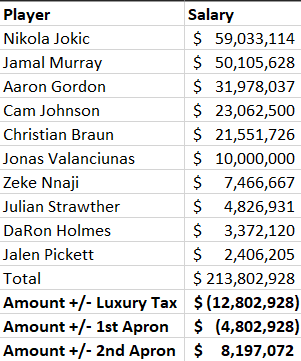
At this moment, the Nuggets are technically a first apron team, but of course they aren’t going to go into the season with this exact roster and no other changes. In fact, they couldn’t do that even if they wanted to. With only 10 players under contract, the Nuggets will be required to add at least four more to get up to 14, the minimum number of standard NBA contracts a team can legally carry. For the purposes of this exercise, let’s assume they fill out those four roster spots with four players on minimum salaries:

These four minimum salaries alone take the Nuggets above the second apron, something that isn’t technically a hard cap but is often treated as such and likely will be by the Nuggets as well. So what can they do to shed some money? One likely option will be waiving and stretching the contract of Jonas Valančiūnas. As long as they do it before July 8th, the waive-and-stretch provision allows the Nuggets to spread the $2M guaranteed in his contract evenly over the next three seasons. Let’s assume they do this and fill his roster spot with another minimum salary player:

The good news here is the waive-and-stretch gets them safely below the second apron. They could even theoretically utilize the full TPMLE to bring in a higher caliber free agent in this scenario:

What about Peyton Watson?
One of, if not the biggest topics that will surround the Nuggets this offseason is Peyton Watson, who is currently a restricted free agent. The good news is the Nuggets absolutely can bring Watson back if they choose. The bad news is they will have to do one of two uncomfortable things to make that happen.
Scenario 1: Go into the second apron
One thing the Nuggets can choose to do is just throw money at the problem and go into the second apron to sign Watson. In this scenario, the Nuggets would lose the access they had to the TPMLE in the previous scenario and Watson would replace one of the minimum contracts they previously signed. Of course we don’t know exactly what kind of contract he’s going to ultimately get, but it will probably be somewhere in the ballpark of $20M for the upcoming season. We’ll use that figure for the purposes of this hypothetical:

To be clear, the Nuggets can legally do this, as they are able to sign Watson for more than the minimum despite that pushing them above the second apron because they have his Bird rights. However, as mentioned previously, most teams consider the second apron to be a hard cap (even though it actually isn’t) and it’s especially hard to imagine the Nuggets allowing their salary to balloon this high without making any major changes after losing in the first round of the playoffs. This brings us to their second option.
Scenario 2: Retain Watson by cutting salary elsewhere
The much more likely scenario here is that, should the Nuggets retain Watson, they will do so by cutting salary elsewhere to stay below the second apron. Cam Johnson appears to be the most likely candidate to be moved in this scenario, and this is what their salary sheet would look like if they were to shed all of Johnson’s salary and replace it with Watson at $20M:

This keeps them comfortably below the second apron and, as discussed previously, would still allow them to use the full TPMLE for a free agent signing:

Alternatively, the Nuggets could also get a player or players back in a Johnson trade that are making less money than him and use that to augment their roster instead of free agency.
What about the luxury tax?
After ducking under the luxury tax line during the 2025–26 season, there has been a lot of fears about the Nuggets doing the same thing in 2026–27. However, with the current status of their books, it will be very hard for them to get under the tax without severely constraining themselves competitively. Even in the rosiest of scenarios presented above from a financial perspective, the Nuggets would still need to cut an additional $13.3M to get below the tax line.
For the purposes of illustration, let’s say the Nuggets trade Johnson and don’t bring back any money, sign Watson for the previously mentioned $20M, and are able to find a taker for Zeke Nnaji’s contract so they can also replace him with a minimum salary:

Even here they find themselves more than $8M above the luxury tax line. Unless Watson’s market doesn’t evolve as expected and the Nuggets are able to sign him for much less than the $20M we’re using here, their most realistic options to get below the tax line will be to trade either Jamal Murray or Aaron Gordon. Trading one of those guys could have merit if done from a competitive perspective, but as a cost cutting measure a move like that should be a non-starter. What this ultimately means is, unless they get lucky with Watson’s free agency, the Nuggets will either be a taxpaying team or they will very transparently prioritize saving money over trying to contend for another championship.
There are a lot of moving parts that will help to determine where the Nuggets fall financially and, in turn, what they can and can’t do this offseason. They could land anywhere from being a non-tax team to a second apron team depending on their approach, but I suspect the most likely scenario is they’ll land in the first apron for the 2026–27 season.
메타데이터
- post_id
- 2eacf886f423
- slug
- denver-nuggets-2026-offseason-primer-the-financial-situation-2eacf886f423
- url
- https://medium.com/@ryanfreemyer/denver-nuggets-2026-offseason-primer-the-financial-situation-2eacf886f423
- canonical_url
- https://medium.com/@ryanfreemyer/denver-nuggets-2026-offseason-primer-the-financial-situation-2eacf886f423
- author_url
- https://medium.com/@ryanfreemyer
- status
- ok
- fetched_at
- 2026-06-26 12:24:55