Futhark: The runic alphabet that bridged the Nordic dialects
Part I of the series “Fewer signs, greater reach: The runic reform”
Futhark: The runic alphabet that bridged the Nordic dialects
Part I of the series “Fewer signs, greater reach: The runic reform”
A linguistic masterstroke from the Viking Age
Around the year 1000 CE, a quiet but profound shift began to unfold across the Nordic world and in parts of the wider Germanic-speaking regions of Europe. From what we now call Sweden, Norway, and Denmark, people gradually moved toward using a simplified runic writing system. The older runic alphabet, known as the elder futhark, with its 24 characters, was replaced by a reduced version of just 16 runes.
This transformation wasn’t simply cosmetic or driven by convenience. It reflected major changes in how people spoke and thought about language. It was, in many ways, a linguistic masterstroke.
Dialectal diversity, orthographic unity
The Viking Age North was far from linguistically uniform. Dialects differed widely between valleys, coasts, and islands. Yet inscriptions in the reduced futhark could be read and understood across long distances.
The secret? Abstraction!
For example, a single rune could stand in for k, g, or ng — leaving it to the reader to infer the correct sound. The same was true for vowels: one character might represent i, e, or even j. This made the script compact and elegant, and more importantly, mutually intelligible across dialect boundaries.
In this sense, the 16-character futhark served as a kind of shared Scandinavian writing system, a flexible tool that kept communication possible despite spoken variation.
Was the transition sudden or slow?
What makes this writing shift even more fascinating is that it happened without any known central authority. There were no universities, no scriptoria, no runological council issuing standardised rules.
And yet, across a vast and rugged landscape, the same 16-character system gained traction. How?
Modern research suggests that the transition was not a sudden invention but a gradual adaptation over generations. Scholars like Michael P. Barnes (Runes: A Handbook) and Michael Schulte (University of Agder) argue that this shift reflected evolving pronunciation patterns in the spoken language. As the phonology of Proto-Norse changed — with diphthongs disappearing and consonant clusters simplifying — the old 24-character futhark became increasingly inefficient.
Rather than reforming the script by decree, runemasters and craftsmen adapted it organically. Through apprenticeship, oral transmission, and widespread mobility, a shared practice took root — one that proved adaptable, memorable, and expressive.
Was runic literacy more widespread than we think?
Much of what we know about runes comes from stone monuments — the famous runestones of Sweden and Denmark. But stone was only one medium. Inscriptions also appeared on bone, wood, and other perishable materials. Most of that has vanished.
A growing number of scholars believe that runic literacy may have extended beyond the elite. Everyday objects like combs, amulets, or wooden sticks often bore inscriptions. If people across classes and regions used runes casually, then the consensus around the younger futhark becomes easier to explain: not through top-down enforcement, but bottom-up familiarity.
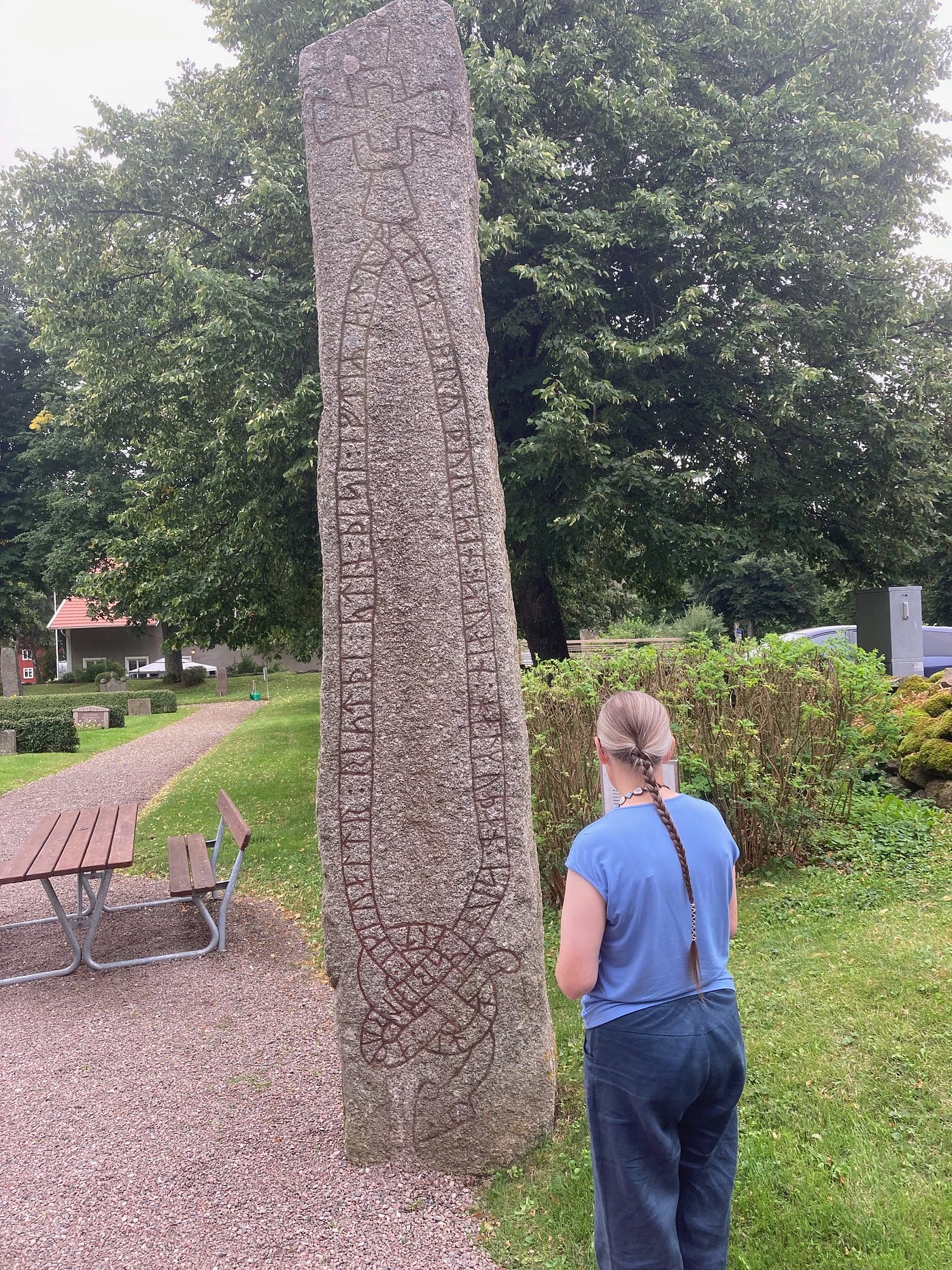
The very high rune-stone in Bjälbo, Ostrogothia, Sweden. © Sverker Jarn
Parallels in China and the Arabic world
Other writing systems have managed to transcend dialectal divisions, too. In China, for example, people from different linguistic backgrounds — speaking Mandarin, Cantonese, Shanghainese, and others — can all read the same written Chinese, despite speaking mutually unintelligible forms of it.
Likewise, Modern Standard Arabic is used in writing and formal communication across the Arab world, even though colloquial dialects differ widely.
In both cases, unity in writing fosters cultural cohesion, even in the face of oral fragmentation.
Could a simplified Nordic script do the same?
Could a shared Nordic script work today?
Imagine reintroducing the reduced futhark in modern Scandinavia. What if Swedish, Norwegian, and Danish all used the same orthographic system, despite pronunciation differences?
Words like kärlek (Swedish), kjærlighet (Norwegian), and kærlighed (Danish) might all be spelled the same. The spoken forms would still differ — but the written language could become a unified platform. By the way, the word means love in English.
It’s a provocative idea. We’ve seen other examples of radical orthographic reform: Norway’s spelling reforms of the 20th century, or Atatürk’s switch from Arabic to Latin script in Turkey. Could the Nordic countries one day adopt a common, simplified spelling? Would that strengthen cultural ties — or risk erasing linguistic identity?
A system ahead of its time
The younger futhark was more than a writing tool. It was a social technology — a way to make meaning portable across borders, dialects, and generations. Its beauty lay not in precision, but in flexibility.
As we rethink how we communicate in a multilingual, digitally connected world, we might do well to remember the 16 signs that once bound the North together — not with rules, but with shared understanding.
📚 Language legacy: proto-Norse and modern languages
Proto-Norse, the language of the elder futhark inscriptions, is the common ancestor of five modern languages: Swedish, Danish, Norwegian, Icelandic, and Faroese.
Its influence also echoes in the English language. Through centuries of contact, especially during the viking age, old Norse left a lasting mark on English vocabulary and grammar.
Everyday English words like sky, window, egg, take, and they all trace back to Old Norse roots. Some scholars also argue that the survival of distinctive sounds like “th” in think and this was reinforced by Norse influence, as both old English and old Norse shared these sounds.
Additionally, Norse likely contributed to the simplification of English grammar and helped shape its modern sentence structures.
Further reading:
- Runes: A Handbook by Michael P. Barnes — clear and authoritative.
- The Nordic Languages: An International Handbook (ed. Oskar Bandle) — an advanced but invaluable reference.
**Up next (Part II): **One script, three languages: Could the futhark reunite the Nordic tongues? A modern thought experiment: could a shared script work today?
메타데이터
- post_id
- 2eb7fc71bc73
- slug
- futhark-the-runic-alphabet-that-bridged-the-nordic-dialects-2eb7fc71bc73
- url
- https://medium.com/@sverkerjarn/futhark-the-runic-alphabet-that-bridged-the-nordic-dialects-2eb7fc71bc73
- canonical_url
- https://medium.com/@sverkerjarn/futhark-the-runic-alphabet-that-bridged-the-nordic-dialects-2eb7fc71bc73
- author_url
- https://medium.com/@sverkerjarn
- status
- ok
- fetched_at
- 2026-07-18 01:40:03