In the Slipstream of Legends: A Day at the Tour de France.
In the Slipstream of Legends: A Day at the Tour de France.
July 14, 2025. A date etched in my memory forever.
I had the surreal opportunity to be in the Team Service Car of Israel Premier Tech (IPT) during Stage 10 of this year’s **Tour de France** — the first mountain stage of the Edition. It still feels like a dream.
This isn’t a race report or a technical breakdown of the stage. It’s a personal story about what it felt like to be part of something I’ve admired for years. Sitting in the car, sharing moments with the team, I got to feel the heartbeat of the Tour de France from the inside.
This unforgettable experience was made possible by my dear friend **Juho Suikkari, former Finnish national champion and founder of the [Saimaa Cycle Tour](https://saimaacycletour.com/en), **one of Finland’s biggest cycling events, drawing nearly 4500 participants every year. I deeply admire him. It was through his thoughtfulness and belief in me that I got this extraordinary opportunity to experience the Tour de France from inside the race convoy. Thank you, Juho, from the bottom of my heart. This memory will stay with me forever.
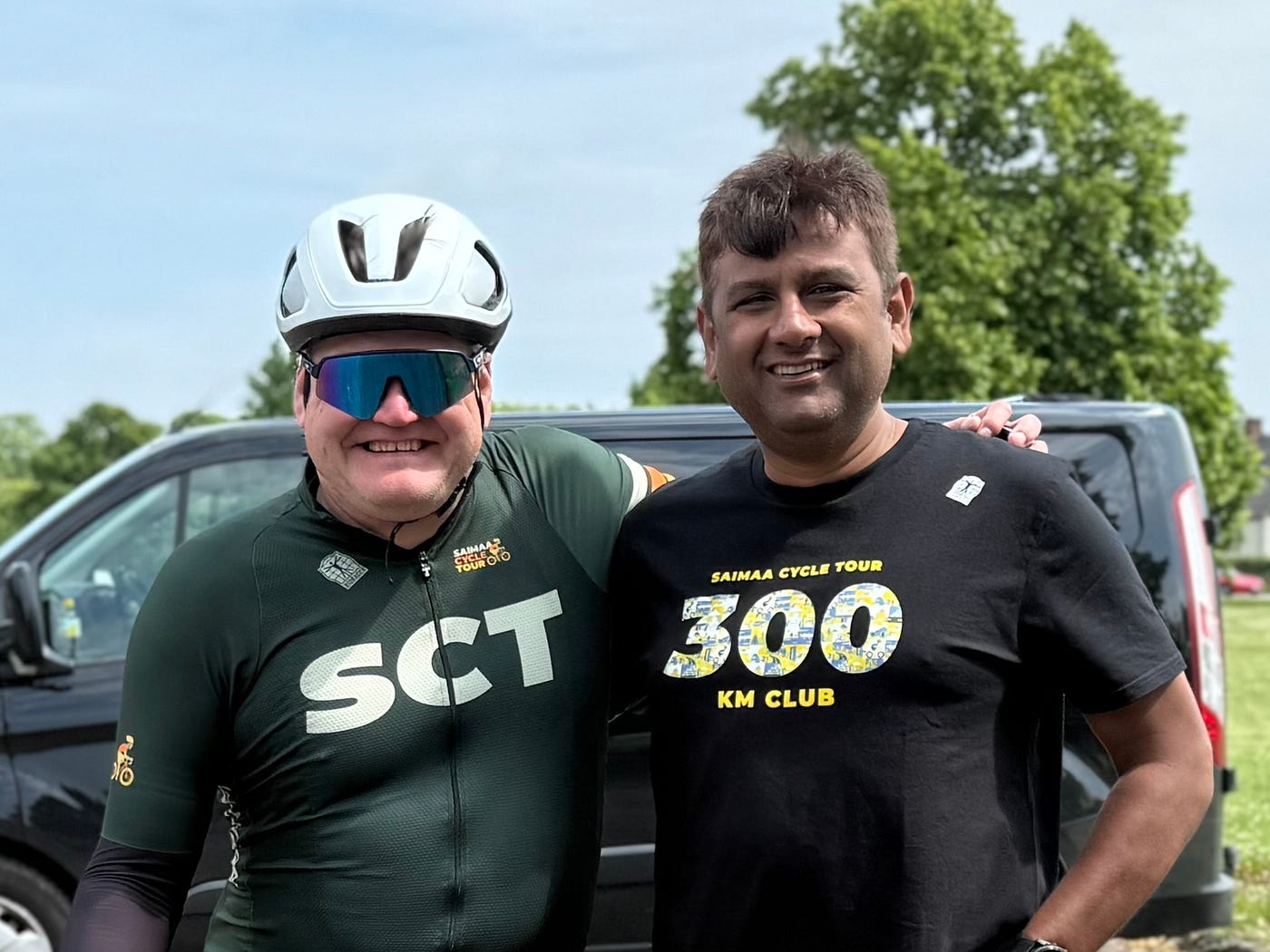
With the man who made this dream a reality, Juho Suikkari. Forever grateful for your support and friendship!
I also owe immense gratitude to **Kjell Carlström, another Finnish national champion, former Tour de France rider, podium finisher, and Team Boss of Israel Premier Tech**. Kjell didn’t just invite me to watch the Tour, he invited me to be a part of it.
His humility, kindness, and leadership left a lasting impression on me. Kjell made me feel not like a guest, but like a valued part of the team. I will always be grateful for his generosity and for trusting me with such a special experience. Thank you, Kjell, for making the impossible feel real.

With the Boss, Kjell Carlström, at the paddock, a truly proud moment.
For those who do not know me, I’m **Chethan Ram from Bangalore, India. Back in 2013, I left my job to pursue my passion and opened a bike store called [Cadence90](https://www.instagram.com/cadence_90). That journey eventually led to the creation of the [Tour of Karnataka](https://tourofkarnataka.com) (TOK), **a cycling event built around the spirit of adventure, community, and a deep love for the sport. TOK has now completed 10 years with the last edition seeing 2 two successive batches with 200 riders. TOK has now expanded beyond India, with two editions held in Sweden (2024 and 2025) and one edition in Finland (2025) under its belt.

The spirit of TOK in one frame. Picture from the 9th Edition with all the 150 riders.
Like many cycling enthusiasts, witnessing the Tour de France in person had always been a lifelong dream. But getting to experience it from inside the race convoy, right in the thick of the action, was beyond anything I could have imagined.
The stage started from Ennezat and finished at the summit of Le Mont-Dore Puy de Sancy. It covered about 165 kilometers with a total elevation gain of around 4,500 meters, making it the first mountain stage of the race. I reached Clermont-Ferrand a day before and stayed nearby, about 20 kilometers from the start, to ensure I’d arrive on time despite limited public transport options, possibly because of Bastille Day.

The elevation profile of Stage 10.
The previous night, Kjell checked where I was staying to see if he could pick me up on the way. Since my location was out of the way, I told him I would make my own arrangements to reach the entrance of the paddock by 11:00 AM. It was a kind gesture that reflected how welcoming and organised the team was, despite being in the middle of the biggest cycling race in the world.
I was so excited about what was coming that I could hardly sleep the night before. I made sure to reach the paddock much earlier than the scheduled time, I didn’t want to be late or miss anything. As I got closer to the location, the excitement in the air was contagious, cars were parked along both sides of the road for kilometers, and fans had already started gathering, eager to catch a glimpse of the Tour. The atmosphere was buzzing even before anything had officially started. As I stood waiting near the entrance, everything felt still on the outside, but inside, my heart was racing. I don’t think I’ve ever been so happy just to stand and wait.
[embed]The fields become parking lots, the countryside comes alive, all for a glimpse of cycling’s biggest show.
Soon, I saw a few team buses arriving, it was a sight in itself! The sponsor caravans followed in full force, adding color, energy, and a festive spirit to the day. All remaining buses lined up and waited for the caravans to pass. In that wait, Kjell stepped out of his car, walked over to greet me, a gesture I’ll never forget. I felt a bit guilty making him walk over, but also incredibly touched.
[embed]Team buses arrive, and the paddock comes alive!
We walked back towards the team vehicles that were lined up to enter the paddock, and that’s where Kjell handed me my official ID badge, my all-access pass for Stage 10. I settled into the back seat of his car, and as if perfectly timed, Pink Floyd’s ‘Wish You Were Here’ played quietly in the background. It felt deeply symbolic, almost surreal.
Inside the paddock, it was cycling heaven. Team buses lined up, mechanics prepping bikes, riders warming up on trainers, the buzz was electric. A crowd gathered near the UAE Team Emirates bus, no points for guessing who everyone was waiting for.
[embed]Out of the shadows, into the spotlight, the champion arrives.
Kjell introduced me to several team members, but the most important introductions were to Dror Pekatch, Director Sportif (DS) and Andreas Back Watt (Team Mechanic), the two gentlemen I’d be riding with during the race in one of the two service cars allowed on the race course.
The other team car was crewed by Steve Bauer, the Sporting Manager, and Sam Bewley, Head Director Sportif.
Dror showed me the team car and smiled, saying, “This is your seat today.” It was the front seat, right next to him, I couldn’t have asked for a better view or a closer connection to the race. Sitting up front in the service car meant being right in the thick of the action, and I was honestly at a loss for words.

My ride for the day, a Škoda that took me beyond the barriers, right into the heart of the tour.
He asked me to explore the TdF Village, enjoy the pre-race atmosphere, and return by 1:00 pm. I wandered around like a wide-eyed fan, which I am, soaking in every moment. Riders were heading to the sign-on podium one by one, completing the start-line formalities and waving to the cheering crowds. The sign-on podium is a pre-race formality where each rider signs their name on an official start sheet before the stage begins. It was a sight to watch them go past, right next to me, some focused, some smiling, all looking razor-sharp. But I kept checking my watch like a school kid before his first school trip.
(A TDF Village is a lively expo-style area near the Tour de France stage start where sponsors, media and fans gather for activities and entertainment before the race begins)

Jonas Vingegaard heading to the sign-on podium, calm, focused and ready.
Back at the car, Dror handed me some fruits and drinks, assuring me that our meals were packed for the long stage ahead. He casually mentioned, “Our boys will be in the breakaway today, we’ll follow them. The other car will stay with the peloton.”
In cycling, a breakaway is when one or more riders escape ahead of the main group (the peloton) during a race. The goal is usually to gain time, try to win the stage, or force other teams to chase. Breakaways can be risky because the peloton often works together to catch them, but they can also lead to exciting and unexpected race outcomes.
It was a small insight, but it made me feel more connected to the day’s plan. I began to see how each car, each decision, played a role in the bigger picture, and I couldn’t wait to see it all unfold from inside.
By the way, each team is allowed only two service cars on the course, which makes every move critical.
As the riders lined up for the start, all the team cars began to line up behind them. Suddenly, there was a pile-up of cars blocking the way. Once the race officially began and the flag was waved, we quickly adjusted the monitors inside the car and set off. Just before we took off, I asked Dror and Andreas for a quick selfie, and they gladly agreed.

Capturing a quick memory with Dror and Andreas.
Just as we set off, an unexpected and somewhat annoying thing happened. The Skoda’s navigation voice started speaking out loud. Every few minutes, it interrupted with directions that didn’t really matter, cutting through the team radio and breaking Dror’s concentration. He tried to turn it off a few times but couldn’t get it to stop. Wanting to help, I quickly grabbed my phone, searched for a fix, and managed to silence it. It was a small gesture, but in that moment, I felt proud to contribute in my own way, earning my place in the car by quieting that persistent noise.
The car I was in had three screens inside. One screen showed the live TV coverage of the race, just like what you’d see if you were watching at home. Another screen displayed real-time stats of all the riders, their positions, speeds, time gaps, everything you’d need to make quick decisions. The third screen had the Veloviewer.
Veloviewer is an App that runs on tablets inside the team car, presenting current map and elevation profiles of the race route, distance to upcoming waymarkers (climbs, sprints, feed zones, hazards), and even real-time location tracking of both riders and team vehicles.

Welcome to the cockpit, where data drives the race.
It felt like mission control inside that car. The DSs don’t just drive, they manage a live battlefield with eyes everywhere. It all looks so simple when you watch it on TV, but sitting inside the team car, I realized just how much technology and coordination goes on behind the scenes.
People had lined up on both sides of the road, eagerly waiting to catch a glimpse of the riders. Even after the race had started and we were on the move, the crowd was still there, cheering and waving. That’s when it hit me, they wouldn’t leave until the very last vehicle had passed. That’s the kind of love and respect cycling commands here.
[embed]Not just for the riders, the fans cheer everyone, right till the final car. That’s the spirit of the Tour.
Cycling isn’t just a sport in Europe, it’s part of the culture. In fact, throughout the entire 165-kilometre stage, there were hardly any stretches without spectators. No matter the town or terrain, the roads were filled with people, living and breathing the race alongside us.
As we exited the neutral zone (the controlled, slow-paced start of the stage), we began moving forward through the convoy of team cars, trying to get closer to the front. Soon, a message came over the team radio, three riders from IPT had made it into the breakaway.
When the breakaway gained about a 30-second lead over the peloton (the main group of riders), I eagerly asked Dror if we would catch up to them immediately. He explained that team cars are only permitted to move ahead once the breakaway’s lead reaches at least one minute. Until then, we had to remain positioned within the convoy.
While we waited, we received another message on the radio, Pascal Ackermann had a flat tyre. The problem was, we were still stuck behind several other service cars, and reaching him wouldn’t be easy. That’s when I truly began to feel the pressure and intensity of being inside the team car during a live race.
Without wasting a second, Dror hit the gas and began weaving through the convoy. At the same time, he sent a radio message saying he would take care of Ackermann, while the other IPT service car can focus on supporting the breakaway and the peloton.
[embed]Accelerating through the pack, every second counts.
It was absolutely thrilling to watch all this coordination unfold from inside the car. And it was in that moment that I understood how hard it actually is to reach a rider during a mechanical issue. Watching on TV, I used to wonder why the team cars couldn’t get there faster — but from inside the convoy, I saw the reality, blocked roads, other cars, and strict race rules. It’s anything but easy.
After a tense and fast drive, we finally reached Ackermann. Before I even fully realized we’d stopped, Andreas, the mechanic, had already jumped out of the car and replaced the wheel. In just a few seconds, Ackermann was back on the road.
[embed]Andreas magic, fast fix, and Ackermann rides on.
Since he lost time due to the flat, he was allowed to draft behind the team car, meaning he could ride closely behind us to reduce wind resistance and help him catch up. He chose to draft behind our car, and what I saw next took my breath away.
Dror was driving at around 75 km/h, and Ackermann was right behind us, just a few inches from the bumper, holding his line perfectly. Watching that from the front seat was both incredible and a little terrifying. It was yet another unforgettable moment from inside the race, one you can never truly feel by just watching from the sidelines.
[embed]He’s cool at 75 km/h behind a car. I’m having a small panic attack in the passenger seat.
As the race settled into rhythm, the radio started crackling with rider requests. Our IPT riders were calling in for water and hydration — a moment that brought the Tour de France alive in a whole new way for me.
Watching this on TV, I’d always thought handing bottles to riders looked pretty straightforward. But from inside the team car, cruising at 50 km/h, I quickly realized it’s an art form. Dror, handled the whole operation with skill and calm. Holding out a bottle from a moving car to a rider on a bike going at high speed? Not easy. But these guys have done it a thousand times, and they’ve mastered it.
One of our riders radioed in asking for Coke, a quick sugar hit that can make a difference on a tough stage like this. But we were running low. Dror immediately radioed ahead and arranged for us to collect some Coke cans from the next feed zone.
This was the perfect chance for me to witness how the feed zones work, something every cycling fan has seen on TV, a part of racing that looks simple on TV, but is actually a carefully choreographed operation. As riders pass by, they grab these bags mid-ride, often at speeds of 40–50 km/h. It looks simple, but it requires perfect timing and trust — one missed handoff could mean going hungry until the finish line.
The feed zone is a designated area along the course where soigneurs stand with musettes to hand over the same to the riders. Soigneurs are the team staff responsible for handing out musettes (small bags with food and drinks) to riders as they pass through. Positioned on the side of the road, soigneurs must be quick and precise to ensure each rider safely grabs their bag without slowing down. Their role in the feed zone is vital for keeping riders fueled and hydrated during long, grueling stages.
We pulled in behind the soigneurs’ area just long enough to pick up our extra supplies, Coke included and were back on the move. Just watching how quickly and efficiently everything was organized amazed me. The soigneurs had everything laid out in advance, clearly marked, ready to be handed over in a matter of seconds.
[embed]Coke refilled, ready to take on the rest of the day.
After grabbing our supplies, we pushed on into the relentless heat of a mountain stage. The sun was beating down, making every pedal stroke feel heavier than the last for the riders. Mountain stages aren’t just physically demanding, they’re also a spectacle and nowhere is that more evident than on the steep uphills, where the crowd gathers in full force.
On TV, we always see these climbs with spectators on either side, but driving through the same sections in the team car gave me goosebumps. The narrow roads were packed tight with fans, sometimes shoulder to shoulder, leaving hardly any room to maneuver. You could feel their energy closing in from all sides, the cheers, whistles, and cowbells creating a roaring wall of sound. It’s an incredible experience, exhilarating but also intense, as riders have to focus not just on the climb, but on safely navigating through the throng of passionate supporters.
[embed]Packed roads, roaring fans, and no room to breathe, welcome to the mountain stage.
While all of this was unfolding, radios crackling, bottles flying out, the car zipping between groups, I couldn’t hold back my curiosity. I kept firing questions, one after another, and Dror, despite juggling so much at once, answered every single one patiently. His calmness, his clarity, and his willingness to share the inside workings of pro cycling in the middle of the chaos really stood out to me.
By this time, the breakaway had a four-minute lead, I asked Dror whether he thought they could hold it to the finish. He pointed to a specific section on the Veloviewer elevation profile and explained, “If they can extend the gap to five minutes by this point, the peloton won’t have enough road or time to bring them back.” He followed it up with a detailed breakdown of the time gaps, gradients, and expected speeds. The clarity and precision of his assessment left me genuinely impressed.
Dror used to ask me sometimes to check a few numbers on the stats monitor, like distance covered or the time gap between groups. It felt great to help him out and made me feel like I was truly part of the race, not just a guest.
But the real pressure came from how IPT riders were spread out across the race, we had some in the breakaway, some in the peloton, and a few had started to slip into the grupetto *(Grupetto is *the group of riders at the back who band together to survive the stage within the time limit, especially on tough mountain days). He pulled up next to the Team Lotto** car, asked me to roll down the window, and politely requested their help: “Can you cover our guys at the back for a bit while I move up to the front?” They agreed without hesitation. Dror then put out a message on the radio that Lotto was covering our riders.
After ensuring the riders in the front group were taken care of, Dror pulled up beside one of the IPT riders and said, “I’ll head back to the grupetto and make sure someone covers you from here.” He also informed the Shimano Neutral Service team to look after the Israel riders while he stayed with the grupetto.
This moment showed me the incredible coordination and teamwork happening behind the scenes, how quick decisions and clear communication make sure every rider gets the support they need, no matter where they are in the race.
[embed]Dror making sure the Israel riders are covered as he moves back to the grupetto.
And it’s not just about teammates helping teammates. When other team riders run out of water, they flag down any team car. I saw this firsthand when a Movistar rider rode up to our car asking for a bottle. Dror handed one over immediately and, with a smile, said humorously, “I’ll send the invoice to Movistar!” Even in high-pressure situations, there’s still room for humour.
[embed]Even when the pressure’s on, a little humor goes a long way.
I also noticed that team cars carry extra bottles, not just for the riders, but for the fans too. Whenever the car was stationary, kids and spectators gathered around, hoping for a bottle as a souvenir. Dror and Andreas always obliged with a smile, handing them out generously. It’s a small act, but it shows the connection between the sport and its fans. Those bottles might just be plastic, but for someone standing on the roadside in the French mountains, they’re a piece of the Tour.
Then came one of the most jaw-dropping parts of the day, a fast downhill section. The riders hit 95 km/h, and our car stayed right behind them, matching speed. It was wild. I’ve never felt so alert and alive in a car. One wrong move and the consequences are huge. But Dror handled the wheel like a fighter pilot. I could feel the trust between him and the riders, they were used to each other. It was fast, precise and beautifully dangerous.
[embed]Right behind the riders at full speed.
Inside the car, we weren’t forgotten either. We had a steady supply of snacks and hydration like apples, bananas, sandwiches, energy bars, and all the drinks the riders use.
As we approached the final stretch of the stage, Dror turned to me with a smile and asked, “Want to try what the riders drink?” There was no way I was going to say no. I nodded eagerly and in no time, Andreas reached into the cooler, and the next moment, I had the bottle in my hand. It had the number ‘45’ written on it in black marker. I looked at it curiously and asked, “What does this number stand for?” “That one has 45 grams of carbohydrates,” Dror explained. Each bottle is labeled by how much fuel it gives the riders.
It was one of those small but unforgettable moments, holding in my hand the same kind of bottle that fuels the riders up and down the mountains. I took a sip, and even though it was just sports nutrition, it somehow felt symbolic.

Not just any drink, the one that powers the peloton. Cheers from the team car with Dror!
I knew right away I had to keep the bottle, it wasn’t just a bottle anymore. It had become a memento of the day I got to be inside the heart of the Tour de France. Later that evening, I asked Dror and Andreas to sign it for me. These two had been my companions through every twist and turn of the stage, patiently answering my questions, sharing stories, and showing me what goes into supporting a team at this level.
That bottle, with their signatures on it, now sits proudly on my shelf. For me, it’s not just a souvenir, it’s a piece of cycling history, and a reminder of the day I lived a dream.
I also asked for one more bottle, not to drink, but to keep. I had something in mind for it.
As we approached the finish line, I saw the riders descending after a grueling mountain stage. Although the race was officially over, the ride wasn’t finished yet. The team buses weren’t parked at the finish line, so the riders had to descend the same climb they had just conquered, riding another 4 kilometers through traffic to reach the bus parking area.
Riders were given whistles to help them move safely. They kept blowing them to alert people, cars, and support vehicles to make way. It was amazing to see, even after finishing such a demanding stage, the riders stayed focused and calm, navigating through the crowd with whistles in their mouth.
[embed]Whistle power after the stage
It made me realise how much goes on behind the scenes — the little things that never make it to the TV screen. The day doesn’t end when the finish line is crossed. There’s still more to do, more distance to cover.
For Israel–Premier Tech, the stage delivered significant results:
- Joe Blackmore made a strong move in the breakaway and finished 6th, nearly four minutes ahead of the peloton.
- Michael Woods also featured well, ending up 3rd in the King of the Mountains standings, which was a great individual performance.
While the stage win went to Simon Yates and Ben Healy claimed the yellow jersey, IPT’s riders showed grit and were visible throughout the day, especially in the break and on the climbs. For a team not focused on GC, Stage 10 was a powerful day of exposure, aggressive racing, and personal achievement.
And for me, this was more than just a ride in a team car. It was a chance to live a dream, witness the true spirit of the sport, and come away with memories that will stay with me forever. Stage 10 of the Tour de France 2025 wasn’t just a race, it was an experience of a lifetime.
After the stage wrapped up, the work wasn’t quite done yet, not for the riders, and not for the staff either. The entire team had to make the journey to Toulouse, over 340 kilometers away, where the next stage would begin. Thankfully, the next day was a rest day, which gave everyone a chance to regroup and recharge.
Kjell knew I would be traveling to Toulouse, so he had made arrangements for me to travel with the team in the same service car. After a few hours on the road, we finally reached the city around 10:15 PM. And waiting there with his trademark smile was Kjell Carlström, the man who made this entire experience possible for me. What a gentleman, what a leader!
For me, the Tour de France is probably the most complex event to organize, with everything constantly on the move for 21 consecutive days. The level of coordination required to keep the race running smoothly is staggering. But if there’s one key lesson I took away, it’s that the Tour is far more than just a bike race, it’s a mobile community built on teamwork, mutual respect, and an unshakable passion for cycling. Being able to witness and experience this from within the heart of the race was truly an honor and a privilege I will carry with me forever.
Now, it was time for one last small but meaningful mission.
I pulled out the second bottle I had taken from Dror and asked Kjell to sign it, a signature from the man who opened this rare door for me. Both bottles now bear the names of the two people who shared this unforgettable day with me, Dror and Andreas, my companions in the car, and Kjell, the one who made it all possible.

Two bottles, three signatures, and a story I’ll never forget.
These aren’t just water bottles. They are stories. Memories. Symbols of a day that I’ll never forget, my day inside the Tour de France.
메타데이터
- post_id
- 2ebc2c389ebf
- slug
- in-the-slipstream-of-legends-a-day-at-the-tour-de-france-2ebc2c389ebf
- url
- https://medium.com/@chethan.ram/in-the-slipstream-of-legends-a-day-at-the-tour-de-france-2ebc2c389ebf
- canonical_url
- https://medium.com/@chethan.ram/in-the-slipstream-of-legends-a-day-at-the-tour-de-france-2ebc2c389ebf
- author_url
- https://medium.com/@chethan.ram
- status
- ok
- fetched_at
- 2026-07-18 18:12:35