Discipline Is Built Before the Crisis Arrives: The Organizational Evidence
Sarah Marshall | The Operating Edge Newsletter
Discipline Is Built Before the Crisis Arrives: The Organizational Evidence
Sarah Marshall | The Operating Edge Newsletter
The organizations that hold together under pressure are not holding together because their people are more disciplined as individuals.
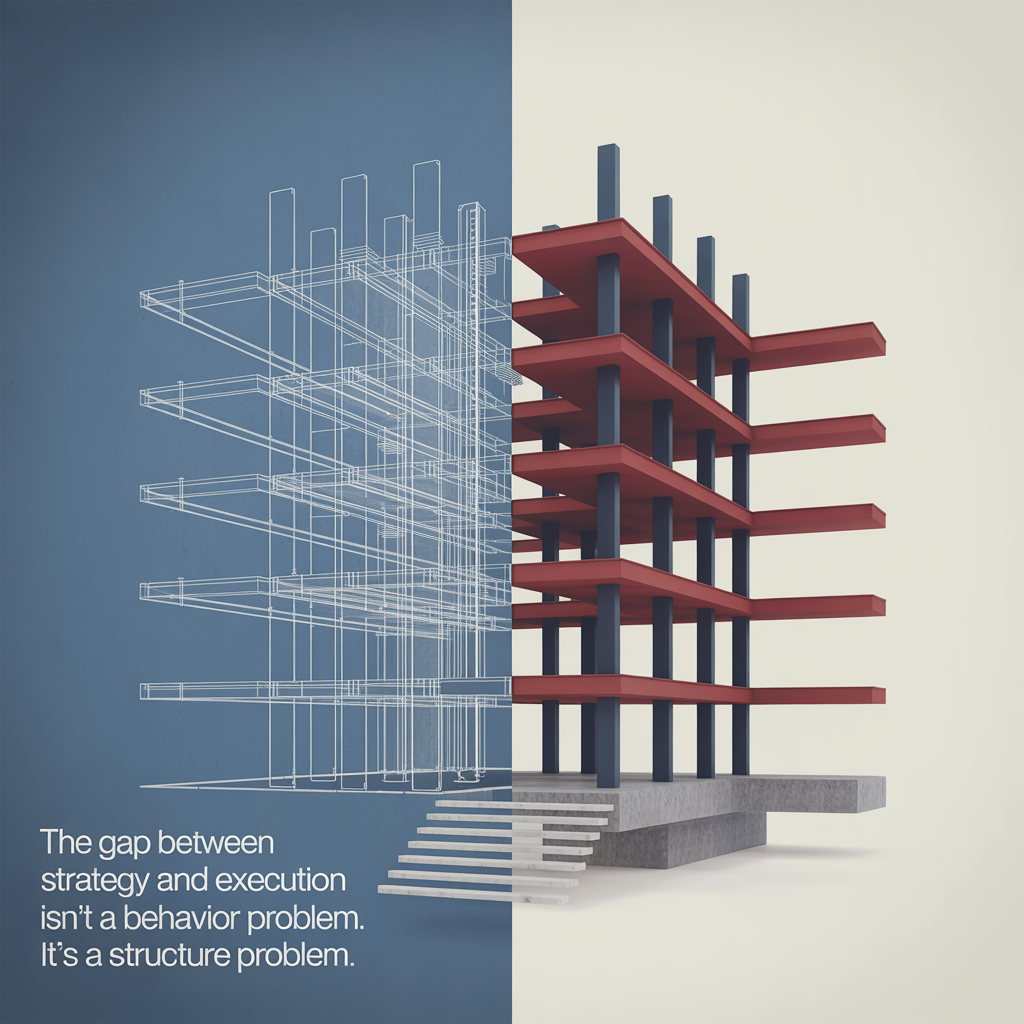
They are holding together because discipline is designed into how they operate: sensing mechanisms that surface problems before they compound, decision rights that move toward expertise rather than staying fixed by hierarchy, review rhythms that enforce course correction while it is still possible. The structure does the work that intention cannot reliably do under stress.
Karl Weick and Kathleen Sutcliffe spent years studying organizations that maintained reliable performance in conditions that should have produced far more failures than they did. What they found was not a culture story. It was an operating system story.
McKinsey’s research on organizational health reaches the same conclusion from a different direction: the structural conditions that make disciplined execution possible are present before the pressure arrives, or they are absent when the pressure tests them. The performance advantage compounds across disruption cycles. It is not episodic.
The new piece in The Operating Edge series covers the organizational evidence: what high-reliability research and execution data together tell us about where discipline actually lives in an organization, and what it takes to build it before you need it.

Discipline provides the structure upon which organizations weather the storm.
There is a particular kind of organization that performs differently when conditions deteriorate. Not immune to disruption, not better in every dimension, but noticeably more capable of maintaining operational coherence when pressure is high, information is incomplete, and the margin for error is narrow. Researchers studying these organizations have been asking the same question for decades: what are they structurally doing differently?
The answer is not what most organizations assume.
The previous piece in this discipline series examined the neuroscience: how the brain encodes behavioral patterns through repetition and retrieves them under stress, and why the patterns available under pressure are the ones built before the pressure arrived. This piece moves to the organizational level. The same principle operates at the system scale, and the organizational evidence is specific enough to be actionable.
What High-Reliability Research Actually Found
Karl Weick and Kathleen Sutcliffe spent years studying what they called high-reliability organizations: air traffic control systems, nuclear aircraft carriers, wildfire incident command teams, and nuclear power plants. These are operating environments where failure is costly, conditions are persistently complex, and the margin for error is structurally narrow. What made the research productive was that these organizations had found ways to maintain reliable performance in conditions that, by conventional logic, should have produced far more failures than they did.
The finding that matters most for organizational leaders is this: the reliability was a product of how the operating system was structured to manage information, error, and uncertainty before any specific crisis arrived. It was not a product of exceptional individual performance.
Weick and Sutcliffe identified five principles that characterized how these organizations operated. Read together, they describe a specific kind of organizational discipline: structural rather than cultural, embedded in operating protocols rather than declared in values statements.
The first is preoccupation with failure. High-reliability organizations treat near-misses and weak signals as diagnostic information, not as confirmation that the system is working. They have built sensing mechanisms that surface anomalies before those anomalies compound into something unmanageable. Preoccupation with failure is a designed-in operational practice, with structural expression in review rhythms, escalation protocols, and the norms that govern what gets surfaced and by whom.
The second is reluctance to simplify. These organizations resist the organizational tendency to reduce complex situations to familiar categories. They maintain what the research calls interpretive discipline: the structural capacity to keep asking what else might be true before committing to a course of action. This is enforced through protocol and practice, not through individual cognitive effort applied in the moment.
The third is sensitivity to operations. High-reliability organizations maintain real-time situational awareness at the level where work is actually happening. The people closest to operations have both the authority and the obligation to surface what they are seeing. Authority to surface problems is a structural condition. Organizations that lack it do not get the information they need until the information is already late.
The fourth is commitment to resilience. These organizations invest in the capacity to detect, contain, and recover from problems before those problems exceed the system’s ability to manage them. The investment is made before the failure, which is the point: resilience built in response to a crisis is crisis management, not organizational capability.
The fifth is deference to expertise. When conditions require rapid decisions, authority migrates to the people with the most relevant knowledge, regardless of their position in the hierarchy. Decision rights are designed to move where they are needed. Organizations that hold decision rights fixed by org chart position consistently underperform in conditions that require rapid, locally-informed response.
What the five principles describe in aggregate is an operating system built to maintain discipline under exactly the conditions that dissolve it in most organizations.
What the Execution Research Adds
The HRO research was developed primarily in safety-critical environments. The question practitioners reasonably ask is whether the same structural logic holds across organizations operating in less operationally extreme conditions. McKinsey’s research on organizational execution and health suggests it does, consistently.
Organizations that execute consistently are distinguished not by the quality of their strategy or the ambition of their goals, but by the disciplined operating infrastructure they maintain around how decisions get made, how priorities are communicated and reviewed, how performance is tracked and surfaced, and how course corrections happen. These are operating system characteristics. They are present before the pressure arrives, or they are absent when the pressure tests them.
McKinsey’s research on organizational health adds a calibration that matters for leaders making investment decisions: organizations in the top quartile on health measures deliver returns to shareholders nearly three times higher than bottom-quartile organizations over a ten-year horizon. Health, in this research, is defined operationally. It is the capacity to align around strategy, execute effectively, and renew as conditions change. The measurement is structural capability, not engagement sentiment. And the performance advantage compounds across time because disciplined operating systems produce better information, faster course corrections, and more reliable coordination across every operating cycle.
The research does not describe disciplined organizations as organizations whose people try harder. It describes organizations that have built different infrastructure: infrastructure that enforces disciplined behavior structurally rather than relying on individual intention to supply it under pressure.
Discipline Is a Structural Output
The neuroscience established that discipline at the individual level is a property of systems built through repeated practice before pressure arrives. The brain under stress reverts to what it has most deeply encoded. The organizational version of this principle has additional complexity because it involves the coordinated behavior of many people across many functions simultaneously.
When an organization faces disruption, it executes from its existing operating infrastructure. If that infrastructure includes clear decision rights, functional coordination mechanisms, reliable information flows, and review processes that surface problems while they are still addressable, the organization has structural resources to draw on. If those conditions are absent or inconsistently present, the response to disruption is improvisation. Improvised discipline in a crisis is not discipline. It is reaction, and reaction is slower, less coordinated, and more costly than the structural alternative.
This is why the organizational evidence aligns so precisely with the neuroscience: you cannot build discipline in the moment you need it. The conditions that make disciplined execution possible must be designed into the operating model before the pressure arrives to test them.
What the HRO research adds is specificity about what those conditions look like in organizations that have actually achieved reliable performance under sustained pressure. They are designed operational practices: sensing mechanisms, decision protocols, coordination structures, and review rhythms that enforce disciplined behavior at the system level. They are buildable. They have a structural address.
The Diagnostic Question for Practitioners
For COOs and operations leaders, the organizational evidence reframes the diagnostic question in a specific and useful way.
When execution degrades under pressure, the conventional diagnostic begins with people: who needs to step up, where is accountability insufficient, what behavior needs to change. The organizational evidence points to a different starting point: what structural conditions were absent before the pressure arrived?
The HRO principles provide a diagnostic scaffold. Does your organization have built-in mechanisms for surfacing weak signals before they become failures? Do your operating protocols enforce interpretive discipline, the structural capacity to resist premature closure on complex situations before you have enough information? Do the people closest to operations have both the authority and the obligation to surface what they are seeing? Are decision rights designed to migrate toward expertise, or are they fixed by hierarchy in conditions that require local knowledge to move fast?
These are structural diagnostics. The answers describe the state of your organization’s execution discipline before the next disruption arrives. And the McKinsey data is direct on the consequence: organizations with strong structural conditions outperform those without them across time horizons long enough to include multiple disruption cycles. The advantage is not episodic. It is structural, and it compounds.
What Comes Next
This series has now examined execution discipline from two angles: the neuroscience of how individual discipline is encoded and retrieved under pressure, and the organizational evidence of how that same principle operates at the system level. The conclusion across both bodies of evidence is the same: discipline is a structural property, built before pressure arrives, embedded in operating systems rather than declared in culture statements.
The next capability in the framework is Coherence: the organizational condition in which strategy, structure, process, and behavior are aligned tightly enough that the organization moves as a unified system rather than as a collection of individually capable parts. Like discipline, coherence has a structural address. Unlike discipline, its failure mode is less visible until the misalignment compounds into something that cannot be managed locally.
That is where the next article goes.
Sarah Marshall is the Founder and CEO of Operations Architect and the author of The Operating Edge: Building an Organization That Thrives in Disruption. Subscribe to The Operating Edge newsletter for weekly research-grounded content on building organizations that deliver.
OrganizationalDiscipline #HighReliability #ExecutionStrategy #OperatingModel #COO #OperationsLeadership #OrganizationalHealth #StructuralDesign #TheOperatingEdge #OperationsArchitect
메타데이터
- post_id
- 2ebecae0df19
- slug
- discipline-is-built-before-the-crisis-arrives-the-organizational-evidence-2ebecae0df19
- url
- https://medium.com/@sarah.l.p.marshall/discipline-is-built-before-the-crisis-arrives-the-organizational-evidence-2ebecae0df19
- canonical_url
- https://medium.com/@sarah.l.p.marshall/discipline-is-built-before-the-crisis-arrives-the-organizational-evidence-2ebecae0df19
- author_url
- https://medium.com/@sarah.l.p.marshall
- status
- ok
- fetched_at
- 2026-07-19 12:59:13