Exploratory Testing with AI: Using Claude to Analyze Web Applications
Exploratory testing has always been one of the most valuable skills in Quality Assurance. Unlike scripted testing, exploratory testing…
Exploratory Testing with AI: Using Claude to Analyze Web Applications
Exploratory testing has always been one of the most valuable skills in Quality Assurance. Unlike scripted testing, exploratory testing allows testers to freely investigate an application, discover unexpected behaviors, and uncover issues that predefined test cases may miss.
With the rise of Artificial Intelligence, tools like Claude are changing how exploratory testing can be performed. Instead of manually navigating every page and documenting findings, testers can now provide a website URL to Claude and leverage AI-assisted analysis to accelerate the testing process.
What is AI-Powered Exploratory Testing?
AI-powered exploratory testing combines traditional exploratory testing techniques with Large Language Models (LLMs) such as Claude. The AI acts as a virtual tester that can:
- Navigate through application workflows
- Analyze user interfaces
- Identify usability issues
- Detect broken links and navigation problems
- Evaluate form validations
- Generate detailed bug reports
- Produce comprehensive testing summaries
This allows QA engineers to focus more on critical thinking and less on repetitive documentation tasks.
How It Works
A typical workflow looks like this:
- Provide the application URL to Claude.
- Define the testing objective (e.g., login flow, registration process, checkout journey).
- Allow Claude to explore the application.
- Claude analyzes pages, forms, buttons, links, and user interactions.
- The AI generates a structured exploratory testing report.
Example Prompt
Focus Areas:
- Navigation
- Forms and Validation
- Responsiveness
- User Experience
- Error Handling Provide:
- Test Summary
- Issues Found
- Severity Assessment
- Recommendations
- Detailed Report
Sample AI-Generated Report Structure
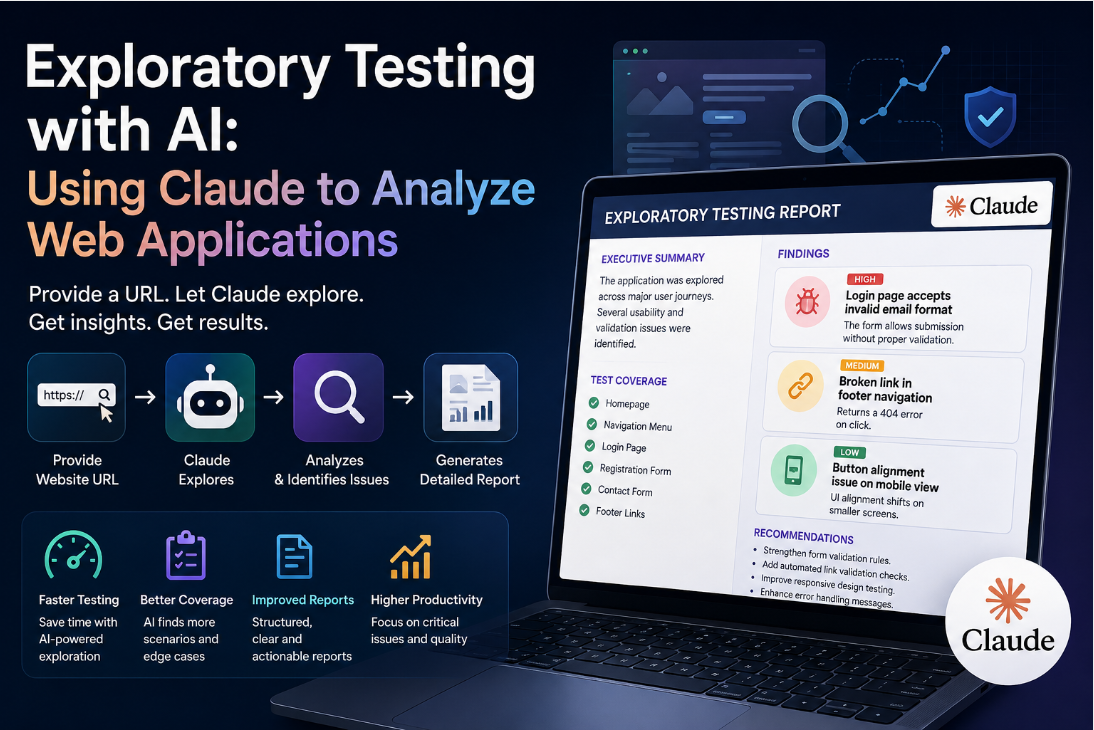
Executive Summary
The application was explored across major user journeys, including navigation, authentication, and form interactions. Several usability and validation issues were identified.
Test Coverage
- Homepage
- Navigation Menu
- Login Page
- Registration Form
- Contact Form
- Footer Links
Findings
High Severity
Issue: Login page accepts invalid email format.
Expected Result: The system should display validation errors.
Actual Result: The form allows submission.
Medium Severity
Issue: Broken link in footer navigation.
Expected Result: Link should navigate to the correct page.
Actual Result: Returns a 404 error.
Low Severity
Issue: Button alignment inconsistency on mobile view.
Expected Result: Buttons should remain aligned across devices.
Actual Result: UI alignment shifts on smaller screens.
Recommendations
- Strengthen form validation rules.
- Add automated link validation checks.
- Improve responsive design testing.
- Enhance error handling messages.
Benefits of Using Claude for Exploratory Testing
Faster Test Execution
Claude can analyze large portions of an application significantly faster than manual exploration alone.
Improved Documentation
AI automatically generates structured reports, reducing the effort required for reporting findings.
Better Coverage
The AI can suggest additional scenarios that testers may overlook.
Increased Productivity
QA teams can spend more time investigating critical risks instead of creating repetitive documentation.
Limitations
While Claude can be extremely helpful, it should not completely replace human testers.
AI may:
- Miss business-specific requirements
- Misinterpret complex workflows
- Lack domain knowledge
- Require human validation of findings
The most effective approach is combining human expertise with AI assistance.
Conclusion
AI-powered exploratory testing using Claude represents a significant step forward for modern QA teams. By providing a URL and clear testing objectives, testers can quickly obtain valuable insights, identify defects, and generate professional reports. Rather than replacing QA engineers, AI acts as a powerful testing partner that enhances efficiency, coverage, and reporting quality.
The future of software testing is not Human vs AI — it’s Human + AI working together to deliver higher-quality software faster than ever before.
메타데이터
- post_id
- 2ec123716ab8
- slug
- exploratory-testing-with-ai-using-claude-to-analyze-web-applications-2ec123716ab8
- url
- https://medium.com/@zubairkhansh/exploratory-testing-with-ai-using-claude-to-analyze-web-applications-2ec123716ab8
- canonical_url
- https://medium.com/@zubairkhansh/exploratory-testing-with-ai-using-claude-to-analyze-web-applications-2ec123716ab8
- author_url
- https://medium.com/@zubairkhansh
- status
- ok
- fetched_at
- 2026-06-09 15:37:30






