The Wall Street Moment on Solana
How Backpack Securities and Sunrise DeFi are dissolving the line between traditional equities and on-chain finance and why it changes…
The Wall Street Moment on Solana
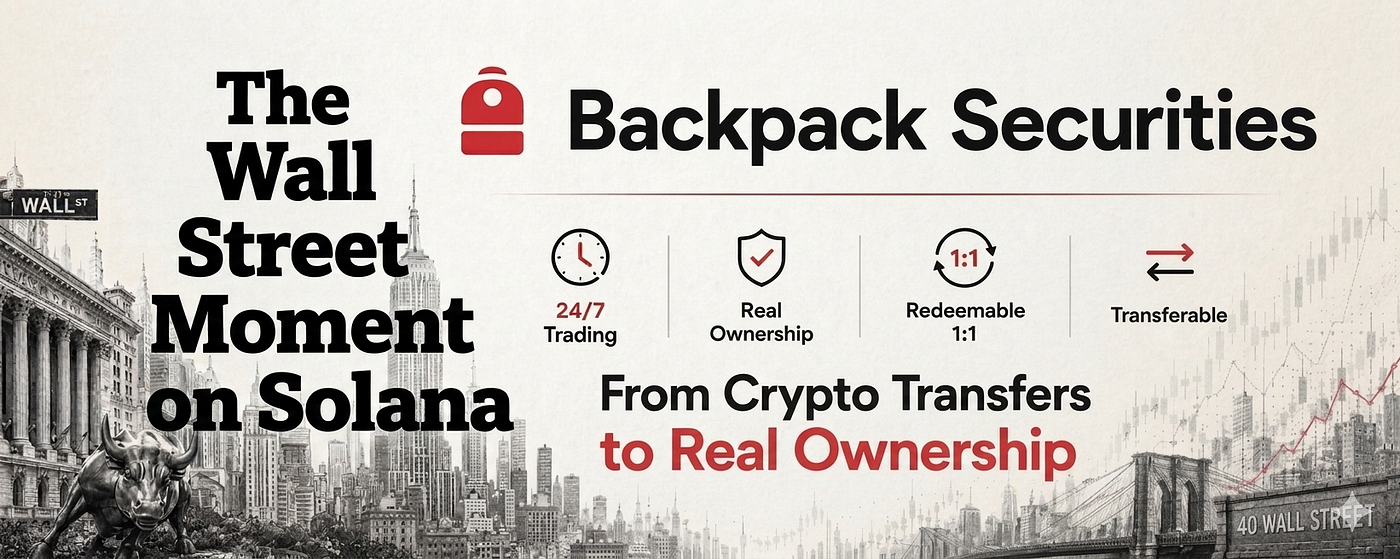
How Backpack Securities and Sunrise DeFi are dissolving the line between traditional equities and on-chain finance and why it changes everything for crypto users worldwide.
Introduction
Something quietly extraordinary happened on June 12, 2026. On the same morning SpaceX began trading on the Nasdaq, the largest IPO in recorded history at $1.75 trillion, anyone with a Solana wallet could buy a tokenized version of that exact same stock. Not a synthetic bet. Not a price-tracking derivative. A real SpaceX share, held in custody by a regulated U.S. brokerage, living as a token on a public blockchain, tradeable 24 hours a day, seven days a week.
However, that moment was not an accident. It was the result of a deliberate and technically ambitious collaboration between two companies, Backpack Securities and Sunrise DeFi that have been quietly building the infrastructure to bring traditional financial markets onto Solana. This piece breaks down what they have built, why it matters, which stocks have already been tokenized, how these tokens actually function, and whether they can be used across Solana’s DeFi ecosystem in protocols like Meteora, Raydium, and Orca.
The Problem They Are Solving
To understand why this matters, you first need to understand what is broken about the current system.
If you live in Lagos, Nairobi, Jakarta, or São Paulo and you want to buy a share of Apple, Nvidia, or SpaceX, you face a layered set of barriers: foreign brokerage requirements, currency conversion fees, limited trading hours, paperwork, and in many cases — outright exclusion from certain IPOs. Even when you manage to open a U.S. brokerage account, trading stops at 4 PM New York time. Earnings reports that drop after market close? You wait until the next morning to react. A weekend market-moving event? You watch, helpless.
“Traditional financial rails are ready for an upgrade. Solana’s blockchain is powering the next evolution in capital markets.”
Solana Foundation
Meanwhile, crypto markets never close. A DeFi protocol on Solana processes trades at any hour, in any time zone, with settlement in under a second and fees measured in fractions of a cent.
The question Backpack Securities and Sunrise DeFi are answering is this: what if stocks could work exactly the same way?
Who Built This and How
Backpack Securities
Backpack began as a Solana-native wallet and exchange, founded by former FTX-affiliated executives and builders deeply embedded in the Solana ecosystem. It built its early reputation through its wallet product, its derivatives exchange, and its connection to the Mad Lads NFT collection. Over time, Backpack expanded into regulated global markets and received financial licensing across multiple jurisdictions.
With Backpack Securities, the company crossed a critical threshold: it became a regulated U.S. broker-dealer that purchases real shares of publicly listed companies, holds them in licensed custody, and issues corresponding tokens on Solana. The legal foundation is robust — ownership is backed by New York law under UCC Article 8, with eligibility for dividends and corporate actions, and positions can be transferred via ACATS and DTCC rails, the very same systems that move stocks between Charles Schwab and Fidelity.
Backpack is the regulated, accountable brokerage layer that makes the whole thing legitimate. When you hold a Backpack tokenized stock, a real share of that company is sitting in a legal custody vault with your name’s entitlement behind it.
Sunrise DeFi
Sunrise is the infrastructure layer that makes these tokenized stocks liquid and usable across the Solana ecosystem. Built on Wormhole Labs’ bridge technology, Sunrise functions as Solana’s asset gateway, it takes external assets and brings them on-chain with deep, day-one liquidity and immediate integration with major decentralized exchanges.
Before moving into tokenized equities, Sunrise had already coordinated more than $360 million in spot volume across six prior token launches on Solana. For every tokenized stock, Sunrise handles issuance infrastructure, liquidity routing, and protocol integration ensuring that from the moment a token goes live, there are liquid markets ready for it.
Think of the model this way: “Backpack buys the real shares and holds them in a vault. Sunrise mints the on-chain representation and routes it into the ecosystem”. Together, they form a complete pipeline from Wall Street to your Solana wallet.
The Stocks That Have Been Tokenized
As of late June 2026, Backpack Securities and Sunrise DeFi have issued the following tokenized equities on Solana each one backed 1:1 by a real share held in regulated custody:
$SPCX, SpaceX
Tokenized on June 12, 2026, the same day SpaceX listed on Nasdaq. The first newly public equity in history with a simultaneous on-chain market. Available across Raydium, Meteora, Jupiter, Byreal.
$350M+Cumulative volume and 10,000+Holders in week one
$MU, Micron Technology
Launched June 22, 2026, two days before Micron’s Q3 earnings print. America’s only high-bandwidth memory producer for AI chips. First tokenized equity to debut directly into a major earnings catalyst.
$1T+Market cap at launch and 24/7 On-chain trading
$SNDK, SanDisk
The third consecutive tokenized equity from the Backpack and Sunrise partnership. SanDisk went independent in February 2025 after spinning off from Western Digital. Already trading on Jupiter and Raydium with up to 10x margin available on some platforms.
1:1 Real share backing and ACATS Redemption rails
The trajectory is clear. Backpack and Sunrise are building a repeatable playbook: bring each significant new equity listing particularly high-demand names tied to AI, semiconductors, and technology, on-chain the moment they hit public markets. Every launch refines and validates the infrastructure for the next one.
How These Tokens Actually Work
This is where precision matters. Here is the exact mechanism, step by step:
1 Real Share Acquisition
Backpack Securities purchases actual shares of the underlying company through standard regulated brokerage channels. These shares are held with a licensed custodian under U.S. securities law, the same way a traditional brokerage holds your shares.
2 Token Minting via Sunrise
Sunrise issues SPL tokens (Solana’s native token standard) on a strict 1:1 ratio against the shares in custody. One share in the vault equals one token on-chain. If more shares are purchased, more tokens are minted. If tokens are redeemed, shares are released and tokens are burned.
3 Ecosystem Distribution
Tokens go live simultaneously across Solana’s DeFi infrastructure. Liquidity pools are available on Raydium, Meteora, and Jupiter from day one. Wallets like Backpack, Phantom, and Solflare display the tokens natively alongside all other Solana assets.
4 24/7 Trading and DeFi Composability
From the moment they go live, these tokens trade around the clock. Nasdaq hours do not apply. A trader in Lagos can buy SPCX at 2 AM on a Saturday. A trader in Singapore can react to Micron earnings the second the report drops, no waiting for market open, no after-hours restrictions.
5 Redemption Back Into the Real World
Any eligible holder can redeem their tokens for the underlying shares. Tokens are returned to Backpack Securities, which releases the corresponding shares and can transfer them into any traditional brokerage account through ACATS and DTCC rails. The bridge runs both ways.
Do They Hold Real Value? Are They the Same as Traditional Stocks?
This is the most important question and it deserves a direct, honest answer.
Yes, with important nuances you need to understand.
Backpack’s tokenized equities sit at the strongest end of the spectrum in terms of real backing. Each token corresponds to a real share purchased by a regulated broker-dealer and held in licensed custody. Holder rights are protected under UCC Article 8 of New York law. Tokens are redeemable for the underlying shares. Positions can be transferred to a standard brokerage account through the exact same rails institutions use.
“Every $SPCX is backed by a real SpaceX share, redeemable 1:1 into your brokerage account.”
— Backpack Securities
This is fundamentally different from synthetic tokens that merely track price using oracles, or from purely speculative crypto assets with no underlying collateral. When you hold SPCX, there is a real SpaceX share in a vault that corresponds to your token.
However, three nuances every user must understand:
Pricing Can Deviate Off-Hours
During U.S. market hours, arbitrageurs keep the on-chain price tightly aligned with the Nasdaq price. Typical slippage on liquid names is just 0.1–0.5%. But when Nasdaq is closed overnight, on weekends, or on holidays the on-chain price floats based purely on supply and demand from DeFi traders. Premiums and discounts can open up. On Juneteenth 2026, for example, tokenized stock markets on Solana logged $213 million in 24-hour volume while NYSE and Nasdaq stayed shut a live demonstration of both the opportunity and the price discovery complexity.
Access Is Jurisdiction-Dependent
Many of these products are currently available only to non-U.S. persons under Regulation S. U.S. retail access remains restricted for now. This is not a product flaw, it reflects the regulatory reality of bridging securities onto a public blockchain but it is something users must verify before participating.
Counterparty Risk Exists (Just as in TradFi)
The safety of these tokens depends on Backpack Securities properly custodying the underlying shares. This is not unique to tokenized stocks — traditional brokerages carry the same counterparty risk — but it is worth understanding that the chain of trust runs through a regulated institution, not a smart contract alone.
Bottom Line on Value
For eligible holders, these tokens represent real economic ownership of real securities. They are not synthetic. They are not speculative price trackers. They are genuine financial instruments with a legal claim on an underlying asset and that is what separates them from most of what has come before in tokenized finance.
Using Tokenized Stocks in DeFi, LP, Lending, and Beyond
This is where the thesis becomes genuinely exciting and where tokenized stocks unlock capabilities that traditional finance simply cannot offer.
Yes, these tokens can be deployed across Solana’s full DeFi ecosystem. Here is exactly what that looks like in practice:
Meteora: Liquidity Pools / LP
Uses a Dynamic Liquidity Market Maker (DLMM) architecture that concentrates liquidity into price bins, maximizing capital efficiency. Was one of the first venues to support SPCX liquidity pools on launch day. Its 11× capital turnover means LPs can generate meaningful fees even with modest deposits.
Raydium: Primary AMM / LP
Solana’s dominant AMM by total value locked and the primary liquidity venue for tokenized equities. Supports concentrated liquidity positions and offers RAY token rewards for strategic pools compounding LP yields beyond just trading fees.
Orca: Concentrated LP / Whirlpools
Offers Whirlpool concentrated liquidity pools with zero exploits to date. Led Solana DEX volume as recently as April 2026 with $162 million in a single 24-hour session. LP positions earn fees on every trade passing through the pool.
Kamino: Lending / Collateral
The largest money market on Solana with ~$1.48B in TVL, Kamino accepts tokenized equities as collateral. Deposit your SPCX or SNDK, borrow stablecoins against them, and deploy that capital elsewhere, without selling your equity position.
Jupiter: DEX Aggregator
Routes tokenized stock trades across all venues simultaneously to find the best price. Scans Raydium, Meteora, Orca, and others in milliseconds. Gives tokenized stocks the same competitive, deep liquidity as any native Solana asset.
What LP on These Pools Actually Means
When you provide liquidity on a SPCX/USDC pool on Meteora or Raydium, you are depositing both SpaceX tokens and USDC into a pool. Every trader who swaps through that pool, buying or selling SPCX, pays a small fee, which you earn proportionally to your share of the pool. You maintain continuous exposure to SpaceX’s price movement while earning yield on every trade. That combination, equity exposure plus fee income, is a product that does not exist in traditional brokerage accounts at the retail level.
What Collateral Borrowing on Kamino Means
Depositing SPCX as collateral on Kamino and borrowing USDC against it means you can access liquidity without selling. You keep your SpaceX exposure, you have stablecoins to deploy in other strategies, and when you close the position, you reclaim your shares. This is a sophisticated financial tool, effectively a crypto-native margin loan secured by a real equity, compressed into a few wallet transactions.
“A share now becomes a tool that you can borrow against, use in yield strategies, or move fractional pieces across apps. Composability creates new product surfaces that didn’t exist in TradFi.”
— Backed Finance / xStocks Alliance
Why This Is Important for Crypto Users Right Now
The significance of what Backpack Securities and Sunrise DeFi have built extends beyond any single stock or any single trade. Five reasons this moment matters:
1. Global Access Without Gatekeepers
Someone in West Africa, Southeast Asia, or Latin America who previously had no practical path to U.S. equity markets can now hold, trade, and deploy real U.S. stocks through a Solana wallet. The paperwork is gone. The foreign brokerage requirements are gone. The minimum deposit restrictions are gone.
2. Capital Never Sleeps
Traditional stock markets operate roughly 6.5 hours per day, five days per week, about 16% of available time. Tokenized stocks on Solana operate the other 84% too. For traders and investors outside U.S. time zones, this is not a minor convenience. It is a structural, compounding advantage in information and reaction speed.
3. Stocks Become Composable Financial Legos
When a stock becomes an SPL token on Solana, it can be plugged into any protocol in the ecosystem. It becomes collateral, a liquidity pool asset, a yield strategy input, or a building block for structured products that do not yet exist. The design space is genuinely new. We are in the early period of discovering what is possible when real-world assets are composable by default.
4. Real-World Value Anchors DeFi
A long-standing criticism of DeFi is that it is a closed loop, crypto assets used as collateral for crypto loans to buy more crypto assets. Tokenized stocks inject real-world economic activity into that loop. When SPCX is used as collateral on Kamino, or traded in a Meteora pool, the economic substance of a $1.75 trillion aerospace and technology company flows directly through Solana’s infrastructure. That is a meaningful shift in what DeFi represents.
5. The Numbers Confirm the Demand Is Real
This is not speculative. Solana now captures approximately 97% of all tokenized equity spot trading volume across every blockchain. The SPCX launch generated $350 million in on-chain volume within its first week. Single-day tokenized equity volume on Solana recently printed at $380 million. Citigroup projects the tokenized asset market will reach $8 trillion by 2030. McKinsey’s projection sits at $2 trillion. The market is not anticipating future demand, it is actively demonstrating present demand, right now.
The Broader Landscape, Who Else Is Building This
What distinguishes Backpack’s approach from the field is the integration of full brokerage infrastructure within a single account. Competitors typically offer tokenized wrappers or synthetic exposure, but Backpack supports ACATS and DTCC transfers meaning users can move positions between on-chain custody and traditional brokerages using the exact same rails institutional investors use. It is the closest thing currently available to a true, seamless bridge between Wall Street and Solana.
Conclusion
For years, the crypto community has talked about the convergence of traditional finance and decentralized finance, the moment when the two systems stop being parallel and start being one. Backpack Securities and Sunrise DeFi are building that bridge in real time, and Solana is the network it runs on.
The SpaceX IPO was a stress test at scale. The mechanism held. The demand was real. Micron followed. SanDisk followed. More will follow.
For crypto users, the message is clear: your Solana wallet is no longer just a gateway to cryptocurrencies and tokens. It is increasingly a gateway to the real economy to AI hardware companies, to newly public tech giants, to ETFs tracking the S&P 500. And unlike a traditional brokerage account, your wallet lets you use those assets as composable financial tools in a system that never sleeps.
메타데이터
- post_id
- 2ec8b61e175b
- slug
- the-wall-street-moment-on-solana-2ec8b61e175b
- url
- https://medium.com/@alphacoin123/the-wall-street-moment-on-solana-2ec8b61e175b
- canonical_url
- https://medium.com/@alphacoin123/the-wall-street-moment-on-solana-2ec8b61e175b
- author_url
- https://medium.com/@alphacoin123
- status
- ok
- fetched_at
- 2026-07-30 05:45:41



