Was Hitler’s Architect the “Good Nazi”?
Breaking Down the Speer Myth
Was Hitler’s Architect the “Good Nazi”?
Breaking Down the Speer Myth
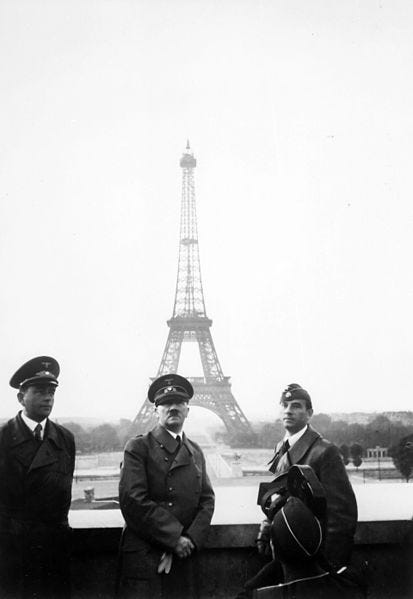
Speer (left) with Hitler in Paris, 1940 (Wikimedia Commons).
In January 1931, twenty-six-year-old architect Albert Speer went to see Adolf Hitler speak at the University of Berlin. Like many educated Germans, Speer was a little sceptical of the Führer’s demagoguery. But he was also disillusioned with politics, wondering why the Weimar Republic’s leaders could not explain the country’s problems in clear and simple terms.
Hitler knew how to play to different audiences. Knowing he was speaking to professionals and university graduates, he wore a sombre blue suit in the place of his uniform. He did not shout and scream, but spoke calmly about his plans for the future. He did not mention the Jews. Speer found himself warming to the Nazi leader. “Here, it seemed to me, was hope” he wrote in his memoir. “Here were new ideals, a new understanding, new tasks”. Speer joined the Nazi Party, becoming member number 474,481.
He rose quickly, and became a personal favourite of Hitler, who loved architecture and saw Speer as a visionary. In February 1942, with Germany’s armies stalled in the snow before Moscow, Hitler appointed Speer as Minister for Armaments. The architect was now a member of Hitler’s cabinet.
Speer maintained an impressive level of production throughout the War — by using slave labour from Germany’s occupied territories to man his factories. Speer demanded workers from Fritz Sauckel, the head of the Nazi labour program. And Sauckel supplied them, often by rounding up the entire population of villages throughout occupied Europe and shipping them to Speer’s factories. By the end of the War, he had conscripted more than one and a half million men, women and children.
With Nazi Germany crumbling at the end of the War, Speer lost faith in Hitler. As Allied armies poured into Germany in March and April 1945, he refused to carry out Hitler’s scorched earth tactics and destroy Germany’s infrastructure. Nonetheless, he remained loyal to the Führer, visiting him in Berlin shortly before his suicide. Like the other surviving members of the Nazi Government, he captured by the British Army at Flensburg, and then placed on trial as a major war criminal at Nuremberg.
The Speer Myth

Speer on trial at Nuremberg (Wikimedia Commons).
Speer was contrite. With tears in his eyes, he accepted that he was part of a regime responsible for terrible crimes and accepted his part of the defendants’ collective responsibility. But he denied that he personally knew of the Holocaust.
At a Nazi conference at Posen on 6 August 1943, Heinrich Himmler had spoken of “wiping the Jews from the face of the earth”. Speer admitted he was at the conference, but claimed that he had left before Himmler spoke. In the summer of 1944, his friend Karl Hanke, Gauleiter [provincial governor] of Lower Silesia warned him never to inspect a certain concentration camp in Upper Silesia. Hanke was shaken, having seen something which he was not permitted to describe and could not describe even if he was. “I did not investigate — for I did not want to know what was happening there” Speer wrote. The camp, of course, was Auschwitz. Speer accepted that this “deliberate blindness” left him “morally contaminated”.
In his final statement at Nuremberg, he warned about the dangers of totalitarianism in a technological age but said nothing in his own defence. The Court accepted that he was ignorant of the worst crimes of the Third Reich, recognised that he had disobeyed Hitler’s orders in order to limit further destruction in Germany, and sentenced him to twenty years’ imprisonment for the use of forced labour. Sauckel, who had procured the slave labourers for Speer, was less-adept in his defence. He was also tried at Nuremberg and sent to the gallows.
“Twenty years. Well, that’s fair enough” Speer wrote. “They couldn’t have given me a lighter sentence, considering the facts, and I can’t complain”. He, like the other leaders who had received prison sentences, was sent to Spandau Prison in Berlin. He served out his sentence and was released in 1966.
Speer turned his prison writing into two autobiographical books, Inside the Third Reich (1969) and Spandau: The Secret Diaries (1975). They became bestsellers and guaranteed him financial security in retirement. Inside The Third Reich, in particular, remains the definitive insider account of the Nazi Government. He made himself widely-available to historians and the media. In Spandau, he had learned both English and French from his guards and so could speak directly to his former enemies. He created a public image of himself as a technocrat who had ended up in over his head, someone who had never personally ordered an atrocity but was ravaged by guilt for willfully blinding himself to the atrocities of others. Educated, urbane, and introspective, without a trace of fanaticism, racism or brutality, he was able to win over audiences. He continued to appear in public up until the end of his life, dying on 1 September 1981 in London, where he had been recording an interview for the BBC.
By accepting guilt for a grave sin of omission, Speer was able to avoid guilt for even graver sins of commission. Historian Eugene Davidson wrote in the preface to a 1970 English-language edition of Inside the Third Reich that “…Speer played no role whatever in the Jew-baiting or in the exterminations”. He added: “the Minister for Armaments and War Production had no business that required him to be concerned with rumours of any death mills”. British historian Hugh Trevor-Roper, author of The Last Days of Hitler (1947), interviewed Speer after his capture and found this intelligent and sophisticated man a sharp contrast with the “jackasses” in the Nazi leadership. Joachim Fest, German historian and acclaimed biographer of Hitler, was also impressed by Speer and collaborated with him on his writing. Speer became accepted as “the Good Nazi”, the apolitical architect who was just trying to good a good job and happened to be in the wrong place at the wrong time.
Challenging the Myth

Speer interviewed on British TV, 1975 (Thames TV)
But after his death, historians began to pick the Speer Myth apart. How could a man who was so senior in the Nazi hierarchy and so personally close to Hitler be so ignorant of his crimes? Over the years, it became more obvious that Speer had lied. He was not apolitical; he genuinely believed that the Nazis were protecting Germany from Communism. He had inspected concentration camps. And in 2007, a letter surfaced proving that Speer had been lying about his ignorance of the Holocaust. “There is no doubt — I was present as Himmler announced on October 6 1943 that all Jews would be killed” he had written in 1971 to Hélène Jeanty, the widow of a Belgian resistance leader. “Who would believe me that I suppressed this, that it would have been easier to have written all of this in my memoirs?”
A new image of Speer emerged. A fiercely ambitious, manipulative, cunning and utterly ruthless politician. A man who could not accept a quiet career as a provincial architect and was willing to work with anyone who promised him the status and recognition he craved. A man who doctored production figures and took credit for the work of his predecessors to cast his management of the armaments industry in the best possible light, then let others take the blame for the use of slave labour which made his war production possible.
There is probably some truth to both images of Speer, the positive and the negative. He had lied to save himself from being hanged, and his remorse over his involvement in the Nazi Government was certainly genuine. But he had been content to use the Nazi Party to advance himself without caring how many innocent people were trampled for him to achieve his ambition. As Martin Kitchen concluded in Speer: Hitler’s Architect (2015):
What makes Speer so particularly frightening was that this hollow man, resolutely bourgeois, highly intelligent, totally lacking in moral vision, unable to question the consequences of his actions, and without scruples, was far from being an outside. He was of the type that made National Socialism possible. The Third Reich would never have been so deadly effective had it relied on the adventurers, thugs, half-craze ideologues, racist fanatics and worshippers of Germanic deities that the people the public image of the regime. Speer is the outstanding representative of the widespread type that made the regime possible.
Or as historian Sebastian Haffner put it, we can get rid of the Hitlers and Himmlers but not the Speers. They are still with us, immediately recognisable and every bit as dangerous. One of the people who saw this clearly was, interestingly, Speer himself. In a note on 11 October 1946, he wrote:
It seems to me that the Himmlers, Bormanns and Streichers do not explain Hitler’s success with the German people. On the contrary, Hitler was buttressed by the idealism and devotion of people like me. We, who put everything else first, made it all possible. Crooks and criminal elements are always there. They explain nothing.
Albert Speer could, at times, be strikingly perceptive.

메타데이터
- post_id
- 2ecd1814fc58
- slug
- was-hitlers-architect-the-good-nazi-2ecd1814fc58
- url
- https://medium.com/@adam-m-wakeling/was-hitlers-architect-the-good-nazi-2ecd1814fc58
- canonical_url
- https://medium.com/@adam-m-wakeling/was-hitlers-architect-the-good-nazi-2ecd1814fc58
- author_url
- https://medium.com/@adam-m-wakeling
- status
- ok
- fetched_at
- 2026-06-21 15:33:18




