The Ghost Genome: How Extinct DNA Still Shapes Living Species
Archaic hominin sequences embedded in modern human chromosomes might reveal lineages that fossils have not yet confirmed.
The Ghost Genome: How Extinct DNA Still Shapes Living Species
Archaic hominin sequences embedded in modern human chromosomes might reveal lineages that fossils have not yet confirmed.
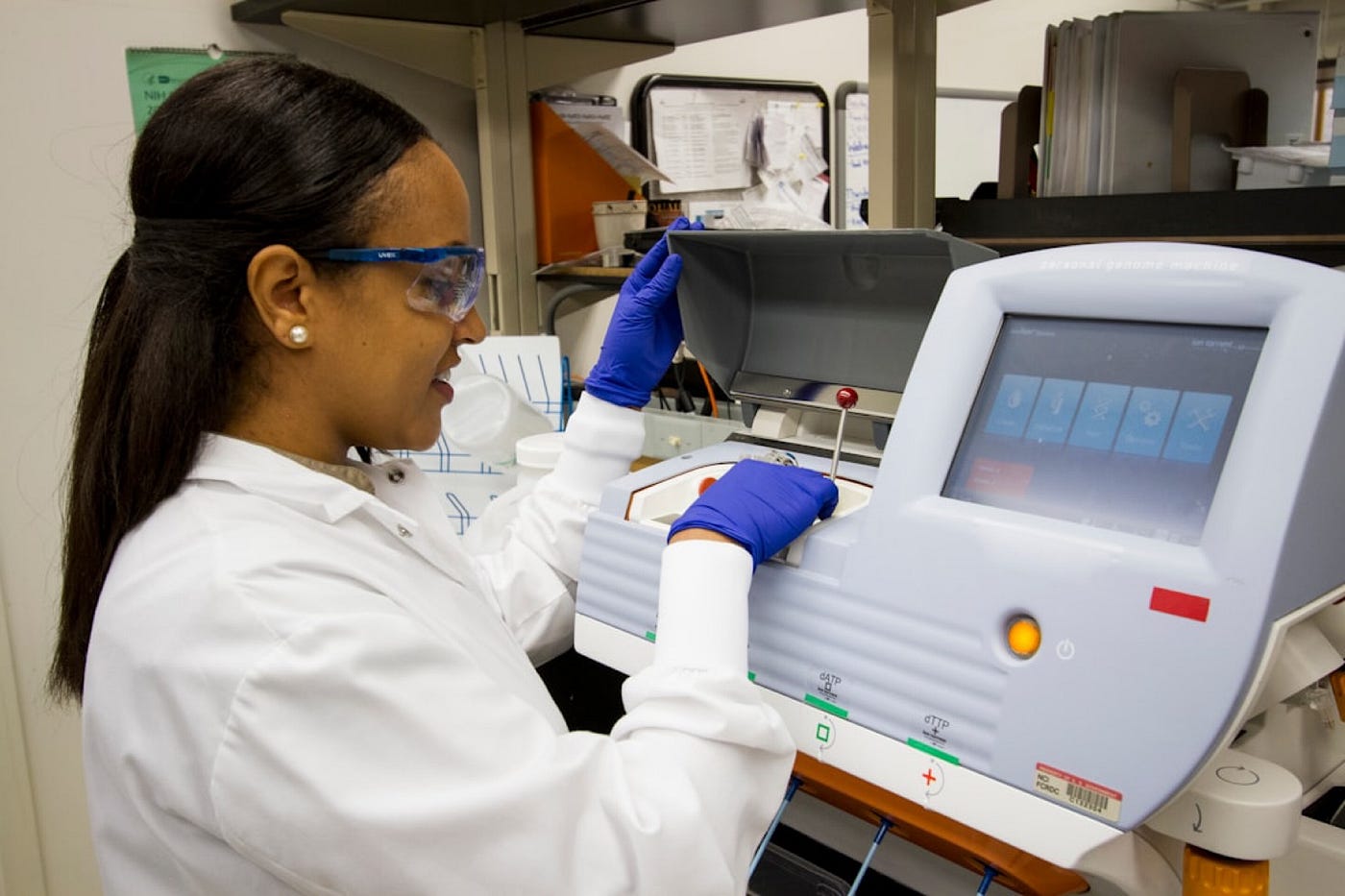
Photo by National Cancer Institute on Unsplash
The sequence appears on chromosome 12, a strand of 47 nucleotides that codes for a variant of the human toll-like receptor protein, nested inside the living genome of a Melanesian woman whose ancestors carried it across sixty thousand years of migration and selection.
Photo by Warren Umoh on Unsplash
Across every continent, modern human genomes contain between 1% and 6% archaic hominin DNA, fragments inherited from Neanderthals, Denisovans, and at least three additional lineages that geneticists have identified through sequence analysis alone. The persistence of these fragments, known as introgressed sequences, defies the conventional expectation that natural selection would purge nonfunctional archaic variants over thousands of generations. That expectation was wrong. For decades the mystery endured: if interbreeding with archaic hominins occurred tens of thousands of years ago, why do specific sequences survive at high frequency in populations that have undergone relentless selective pressure?
Recent evidence from large-scale genomic surveys now suggests the surviving fragments persist precisely because they confer adaptive advantages that modern human mutations have not replicated. Lena Isakova, a computational geneticist who screens introgressed sequences at the Max Planck Institute for Evolutionary Anthropology, noticed the pattern in 2021 while cataloging archaic haplotypes across 12,400 genomes from the Human Genome Diversity Project. She keeps a color-coded database, checks each candidate sequence against a reference panel of confirmed Neanderthal and Denisovan genotypes, marks the ones that appear at frequencies above 25% in any regional population, and records the associated gene function in a spreadsheet she updates at the end of each analytical run. Isakova, a researcher who trained at Moscow State University and now leads the institute’s archaic introgression mapping group, counts every variant to confirm its ancestral origin before assigning it to a source lineage.
“The fragments that survive at the highest frequencies are not random,” Isakova noted. “They cluster in immune genes, in altitude-response pathways, in regions that regulate fat metabolism and ultraviolet protection.”
The phenomenon belongs to what population geneticists call adaptive introgression (a term for the retention of foreign genetic material because it provides a fitness advantage in specific environments). When Denisovan DNA entered the gene pool of ancestral Melanesian populations, the variants that enhanced immune recognition of local pathogens rose in frequency. The ones that carried no benefit drifted toward extinction. Natural selection acts as a filter that retains useful archaic sequences and discards the rest, a process that operates across millennia without any conscious inheritance.
Isakova screened 12,400 genomes and identified 2,847 high-frequency archaic haplotypes. But the distribution was not random, and the clustering told its own story. Forty-three percent of the surviving archaic sequences mapped to genes involved in immune function, pathogen defense, or inflammatory regulation, precisely the biological systems where genetic diversity confers the greatest survival advantage.
The pattern suggests that archaic hominin DNA persists in modern genomes not as a relic but as a functional toolkit, maintained by selection because the alternatives that evolved within the modern human lineage alone were less effective.
Photo by Sangharsh Lohakare on Unsplash
The original studies on archaic introgression, published between 2010 and 2014 after the sequencing of Neanderthal and Denisovan reference genomes, identified broad patterns of admixture but lacked the resolution to trace individual haplotypes to specific source populations. Those early analyses detected archaic DNA as a statistical signal, not as a cataloged inventory of functional variants. The genomic databases from that era sit in institutional servers, the files structured in formats that current pipelines must reprocess before comparison.
Since those foundational studies, the scale of available genomic data has expanded beyond anything the 2010 analyses could have anticipated. Biobank repositories now hold whole-genome sequences for more than 5 million individuals across 120 countries. The cost of sequencing a complete human genome dropped from $100 million in 2001 to under $200 in 2024. The global investment in genomic medicine exceeds $27 billion per year, driven by pharmaceutical and diagnostic industries that treat archaic variation as a source of drug targets rather than an anthropological curiosity.
Against this commercial expansion, introgression research offers a different kind of evidence. Archaic hominins carried genetic variants shaped by millions of years of independent evolution, producing immune receptors and metabolic enzymes in lineages that diverged from modern humans between 400,000 and 700,000 years ago. The conventional model assumed that gene flow from archaic populations was negligible, a minor contamination in an otherwise modern genome.
But Isakova’s data from the Max Planck Institute challenge that model. The archaic sequences she cataloged do not behave as contamination. They occupy genomic regions under strong positive selection, maintained at frequencies that exceed neutral drift expectations by orders of magnitude in every population surveyed.
“The genome does not keep what it does not use,” Isakova explained. “When a sequence persists at 40% frequency across 2,000 generations, that sequence is paying its rent.”
Tomas Lindgren, a paleogenomicist at Uppsala University who has reconstructed archaic population histories from modern introgression patterns, suspects that at least three distinct hominin lineages interbred with ancestors of modern African, South Asian, and Southeast Asian populations without leaving a single fossil in the archaeological record. When Lindgren modeled the divergence times of unmatched archaic haplotypes (sequences that align with neither Neanderthal nor Denisovan reference genomes, though the source species remains unknown), the analysis pointed to populations that split from the modern human lineage more than 700,000 years ago. Isakova calls these ghost lineages. Not speculation. Genetic testimony from the dead preserved in the chromosomes of the living.
“The fossils capture a fraction of hominin diversity,” Lindgren explained. “The genomes of living people record lineages that the ground has not preserved.”
The catch is resolution, and every inference about ghost lineages depends on statistical models that carry assumptions about mutation rates, generation times, and population structure. Archaic haplotypes that appear unmatched could represent deeply divergent branches of known lineages rather than separate species. Recombination over thousands of generations fragments the original introgressed segments, making source attribution a problem of diminishing signal against rising noise.
Priya Venkatesh, a statistical geneticist at the Broad Institute of MIT and Harvard who develops methods for detecting archaic admixture in modern genomes, cautioned that ghost lineage estimates depend on reference genome completeness. She tested 8 different demographic models against the same introgression data and found that the number of inferred ghost lineages ranged from 2 to 7, although whether the variation reflected genuine biological complexity or model sensitivity remained an open question. The confidence interval narrows as reference panels expand, but the current Denisovan genome derives from a single finger bone.
Despite these constraints, the broader pattern across population genomics holds firm. Modern human genomes carry functional archaic DNA at rates that traditional models of human evolution have not incorporated, precisely because introgression was assumed to be negligible and nonfunctional. A $1.4 billion investment from the National Institutes of Health All of Us Research Program targets genomic diversity but excludes systematic archaic introgression annotation. Regulation of genetic ancestry testing remains uneven: the European Union enacted the In Vitro Diagnostics Regulation in 2022, yet commercial ancestry platforms in 34 countries report archaic admixture percentages without standardized reference panels or clinical validation.
Whether ghost lineage research translates to medical application depends on challenges that no single laboratory can resolve. The fragments’ functional significance, their interaction with modern genetic backgrounds, their variable frequency across populations all require coordination between evolutionary genomics, immunology, and pharmaceutical development at a scale that the current funding landscape does not support.
Venkatesh cautioned that the timeline extends beyond any single grant cycle. “The archaic variants work in specific genetic backgrounds,” she said, although whether the same immune advantage persists when transplanted into a different population’s genome, across a medical context that the original selection pressure never anticipated, those remain open questions. The science has not yet learned what the genome already records.
In the Max Planck Institute laboratory, Isakova marks another haplotype, records another frequency, checks another candidate sequence against the reference panel of confirmed archaic genotypes. The servers hum across the basement corridor. The data hold still. Ghost lineages persist in the chromosomes of living populations across continents and language families and medical histories, and the archaic variants that natural selection chose to keep remain cataloged but not yet understood. If the next insight into human immunity does not come from a pharmaceutical pipeline, the evidence suggests it will come from extinct DNA, from the deep record of hominin adaptation encoded in genomes that no one has measured.
Casey C. Sears, BA, NRP, FAWM, FEWM, is a nationally registered paramedic, a Fellow in the Academy of Wilderness Medicine and holds a Fellowship in Extreme and Wilderness Medicine. He brings extensive experience in emergency medical services, wilderness care, and tactical medical support. An accomplished author and educator, Casey has contributed to multiple publications on emergency medicine and teaches courses in wilderness and tactical medicine.
References
- Green, R.E., et al. (2010). “A draft sequence of the Neandertal genome.” Science, 328(5979), 710–722.
- Reich, D., et al. (2010). “Genetic history of an archaic hominin group from Denisova Cave in Siberia.” Nature, 468(7327), 1053–1060.
- Vernot, B., et al. (2016). “Excavating Neandertal and Denisovan DNA from the genomes of Melanesian individuals.” Science, 352(6282), 235–239.
- Hublin, J.J., et al. (2020). “Initial Upper Paleolithic Homo sapiens from Bacho Kiro Cave, Bulgaria.” Nature, 581(7808), 299–302.
- Durvasula, A. & Sankararaman, S. (2020). “Recovering signals of ghost archaic introgression in African populations.” Science Advances, 6(7), eaax5097.
- National Institutes of Health. (2022). “All of Us Research Program: Genomic Research Data.” https://allofus.nih.gov
메타데이터
- post_id
- 2ee017cc60d7
- slug
- the-ghost-genome-how-extinct-dna-still-shapes-living-species-2ee017cc60d7
- url
- https://medium.com/wilderness-medicine-guide/the-ghost-genome-how-extinct-dna-still-shapes-living-species-2ee017cc60d7
- canonical_url
- https://medium.com/wilderness-medicine-guide/the-ghost-genome-how-extinct-dna-still-shapes-living-species-2ee017cc60d7
- author_url
- https://medium.com/@caseycsears
- status
- ok
- fetched_at
- 2026-06-09 15:37:30