“Like wata from stone”: Unearthing buried Caribbean Queer history
It was November 2019 and during a marathon hang-out session my friend Vic Garnes and I decided we needed to make the fact that queer people…
“Like wata from stone”: Unearthing buried Caribbean Queer history
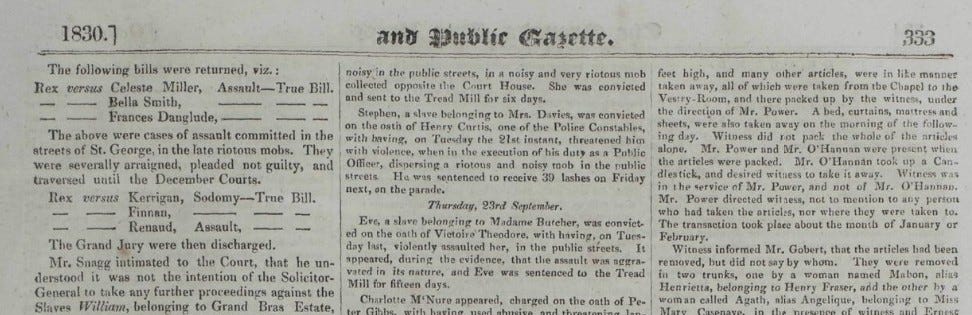
Image from The Public Gazette in Grenada; October 6, 1830
It was November 2019 and during a marathon hang-out session my friend Vic Garnes and I decided we needed to make the fact that queer people have always been in the Caribbean waaaaay more publicized. We said we needed a book, a documentary, a social media page, maybe even a podcast to tell these histories and stories! While my friend Vidyaratha Kissoon in Guyana had already been involved in archiving some of this history, we wanted a wider scope, a more multimedia approach and to hear directly from persons about their living experiences as well. So we started the We Were Always Here: Queer Caribbean History page on Facebook and Instagram.
To get the ball rolling and encourage submissions, I shared some of the stories that we already knew about and these got encouraging responses. Fast-forward to almost 7 years later and this project has evolved. While I’m still hopeful for oral histories and people sharing their queer stories and ephemera, that has been slow to materialize. In the interim I’ve been trying to unearth the queerness present in mainstream archives, to have more tangible stories and expand the tiny peek we’ve been allowed into our queercestry (queer ancestry); I even completed a PhD during this time, partially so that I could dig deeper into these archives.
Knowing where to search and what to search in the Caribbean was a confusing and frustrating process. Recently more of my community have become interested in queer history and I realized that many don’t know where to start looking either. Here I can share some hard-earned tips and pointers on where to look and how to access sources so that others can better hit the ground running.
Newspapers

The microfiche machine reader at the University of the West Indies Cavehill campus
Newspapers and newspaper archives are an obvious information source but their access can be tricky in the Caribbean. Many current newspapers are also online but sometimes they can only be searched with a subscription, and even then they only go back two decades if you’re lucky. I’ve also noticed that some newspapers regularly scrub what they archive and though I collected a URL to a story two years ago, now the link is broken.
Some older newspapers are archived online and the Digital Library of the Caribbean has quite a few. All of the issues of The Barbadian from 1822 to 1861 are available online at the Endangered Archives Programme. The challenge is that the images are not searchable, so you would have to sit down and read through extremely fine print to get some nugget of information. Actually if you want easily searchable versions of most older Caribbean newspapers you would have to be subscribed to agencies like Readex (which are only practically accessible through large universities), or have access to the libraries of large Global North universities like Harvard.
This brings us to physical newspaper archives. Older newspapers and ones that have gone defunct can often be found in national archives, while copies of newer ones can be housed in the national library, university campus and by the newspaper itself. Some newspapers don’t allow you to come into their offices or library, but will have staff source articles if you can give them details of the topic, date etc.
In Barbados I was able to use the West Indies Collection at the University of West Indies Cavehill campus (required some bureaucracy getting permission from the head librarian on campus and paying a small fee) where the Advocate newspaper is archived on microfiche. Issues of the same newspaper are also available online from 2013 (and the years 1950 to 1952) at the digital library of the Caribbean site. Unfortunately the Advocate is the more conservative newspaper and my PhD work showed that they covered much less local LGBTQ+ content than other Barbadian newspapers.
In Guyana contemporary issues of the two main newspapers are bound into huge tomes and kept at the National Library. Here they allow you to thumb through the volumes at your leisure and take any pictures, although you might want to ensure you bring a mask, wipes and patience!

A couple of years’ worth of newspapers at the Guyana National Library

My hands after a few hours searching these newspapers
Archives
I’ve found formal archives less easy to access and more difficult to find pertinent information within. Many of them you need to visit in person and some you can’t take any pictures or even photocopy the necessary pages (because their photocopier is conveniently broken). Apart from designated National Archives there are institutional archives, libraries and collections which could unexpectedly reward you. An example for me was the Shilstone Memorial Library which is the reference and research library for the Barbados Museum & Historical Society. Here I was surprised to find a decent collection of queer newspaper articles under the “gender” folder when searching for information on another topic. Museum, military, hospital, and other private collections and libraries could all potentially have queer history hidden in them.
Given the subject and potential for a negative reaction, I’ve been reluctant to disclose to librarians and gatekeepers of institutions exactly what I’m looking for, unless it was essential to gaining access. However, this changed when I happened to start chatting with a fellow archive user who had so much relevant information and then roped in the librarian to set me down a path to gathering information on an individual I would’ve never known existed, much less pursued. So now I would advise to use your discernment, but definitely consider discussing the topic with these gatekeepers and you might find unlikely allies.
The thing about the Caribbean is that we were all colonized at some point, and for many, the majority of our older documents actually reside in archives within those colonizer countries. While you can get an idea of what The National Archives in the UK, for example, holds with regards to Caribbean history, most of it can only be accessed by visiting in person. Even the collections of many Caribbean luminaries are held overseas. While I was in Scotland I tried to access the papers of a prominent Barbadian figure held at Oxford University and the process was so daunting that I still couldn’t manage it even though I was in-country. So planning ahead is essential!
Some countries have had multiple colonizers so records will likewise be scattered. Guyana was three Dutch colonies for longer than it was an English one, so not only are those archives held in the Netherlands, but they’re also in Dutch, lending another layer of difficulty to be overcome.
Books and Theses

Screen shot from the book “Twenty-five years in British Guiana” by Henry Kirke
Going through old books is a tedious but sometimes richly rewarding experience. Travelogues and books with an “anthropological” lens often discuss a wide range of topics, including the “gossip” and colorful local characters from that time. These books can of course be found in libraries, but the Internet Archive also has a substantial collection that can be downloaded and perused more leisurely.
Many theses are also available for free download online and can have surprising information. Once, when reading a thesis on the lives of enslaved people in Guyana for an unrelated project, I was pleasantly surprised to see the story of the “particular friendship” (and its subsequent break up) between two enslaved men documented.
Thinking outside the box

Picture from 1928 British Guiana Gazette
There are many other places queer history can, and will, peek out at you. It’s important to be vigilant and keep an open mind about how queerness is being described, because very rarely will any of our modern terms be used. Some strategies I’ve used to widen the net have included joining heritage/history groups on social media (especially Facebook), paying attention to people’s posts on social media platforms, going to estate auctions, and talking to local historians. Somewhere there’s a collection of old photographs, and letters just waiting to be explored, and hopefully you’ll be in the right place and time to do that.
There are court records, ship logs, and National Gazettes that could be searched in person or online (for example at The Online Books Page) for distressing terms like ‘unnatural’, ‘abominable’, ‘buggery’, and ‘sodomy’.
Digging through Caribbean history can be daunting and frustrating, with many logistical challenges. Looking at all of that past and not clearly seeing our queercestry is sad; we’re there but many times just dancing out of sight, and extracting our stories from that mountain can seem as hard as squeezing water out of a stone. But thanks to the persistent work of a few, and the hopeful addition of more hands, we can continue to chip away at that stone.
메타데이터
- post_id
- 2ee75055cebf
- slug
- like-wata-from-stone-unearthing-buried-caribbean-queer-history-2ee75055cebf
- url
- https://medium.com/community-archives/like-wata-from-stone-unearthing-buried-caribbean-queer-history-2ee75055cebf
- canonical_url
- https://medium.com/community-archives/like-wata-from-stone-unearthing-buried-caribbean-queer-history-2ee75055cebf
- author_url
- https://medium.com/@nastassiaromanova
- status
- ok
- fetched_at
- 2026-06-14 11:28:49