The Agentic Web and Anti-Grid Aesthetics: Re-Engineering Web Architecture for 2026
The global internet infrastructure has officially transitioned into a new era. Following the ground-breaking development tracks revealed at…
The Agentic Web and Anti-Grid Aesthetics: Re-Engineering Web Architecture for 2026
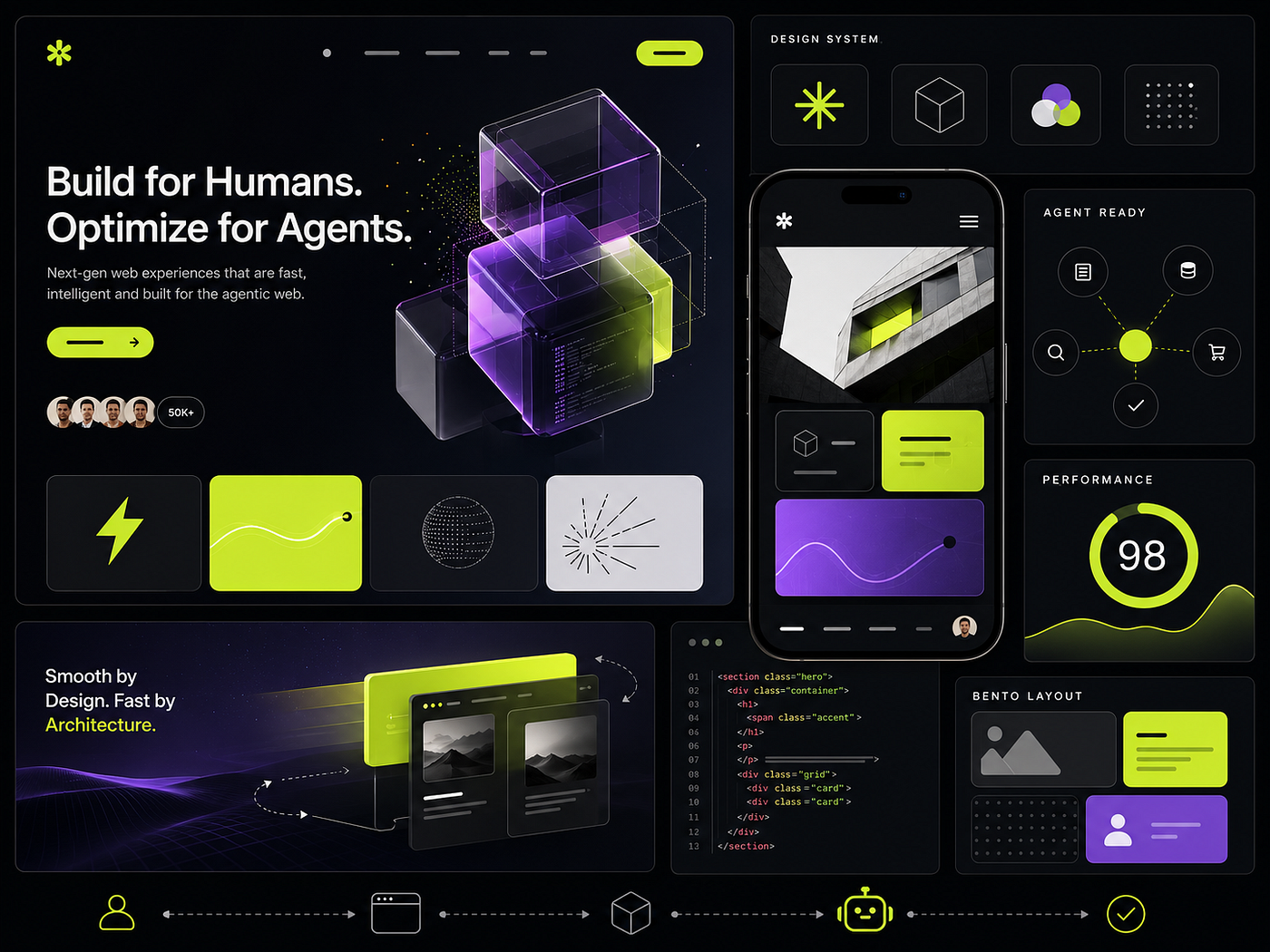
The global internet infrastructure has officially transitioned into a new era. Following the ground-breaking development tracks revealed at Google I/O 2026, websites are no longer passive digital brochures designed exclusively for human scrolling. We are moving rapidly into the age of the Agentic Web — an ecosystem where web platforms must act as interactive toolkits optimized for both human users and advanced AI agents.
Simultaneously, a massive design revolution is taking place on the front-end. After nearly a decade of sterile, copy-pasted corporate minimalist layouts, audiences are suffering from intense visual fatigue. Perfect grids and lifeless flat shapes are completely losing engagement.
The immediate future belongs to heavy visual contrast, responsive modular systems, and performance-first coding. To survive this double-sided shift, smart enterprises are abandoning legacy templates and partnering with the Best Web Designing Services India hosts to rebuild their digital interfaces into automated, conversion-focused hubs.
The Double Threat: Why Traditional Web Code Fails in 2026
Building a website using outdated frameworks or rigid standard layouts creates massive vulnerabilities in your business pipeline today. When your system core cannot dynamically interact with shifting data protocols and advanced computational engines, it quickly transforms into an expensive piece of digital shelf-ware.
1. Incompatibility with AI Agents
If your backend architecture relies on unstructured data dumps and lacks semantic HTML structures or WebMCP (Model Context Protocol) toolkits, AI agents cannot read your web services. In 2026, consumer workflows involve digital assistants autonomously browsing the internet to book tickets, compare pricing matrix modules, or source reliable corporate service partners. If AI cannot scrape and understand your site instantly, your brand simply ceases to exist in modern generative search engines.
2. The Homogenization Trap
When a consumer visits a web portal that looks exactly like every other stock template in their industry, user cognitive engagement drops to zero. Standard layouts with identical hero sections, predictable icon arrays, and safe corporate blues create severe visual boredom. If your user interface has no unique character or intentional visual friction, user retention plummets within the first 1.8 seconds of viewport loading.
3. Core Web Vitals Leakage
Heavy, unoptimized styling frameworks and excessive third-party plugin dependencies create major rendering delays on mobile interfaces. In an era where search engines enforce extreme speed and visual stability rules, a layout delay of even 200 milliseconds results in your platform being demoted down the indexing ranks.
To eliminate these underlying architectural risks, forward-thinking organizations are adopting Responsive Web Application Development to build faster, semantic, and highly adaptive consumer journeys.
3 Radical Trends Redefining Web Design & Development
To capture premium conversions and establish undisputed industry authority, your web presence must adapt to these three dominant macro-trends shaping user behavior and algorithmic delivery systems:
1. Bento Box Modular Layouts & “Outlined Play”
Influenced by native dashboard structures and mobile application interfaces, Bento Grid Layouts are taking over modern UI design. By packing content into beautifully separated, highly responsive modular boxes, websites reduce user cognitive load.
Combined with the “Outlined Play” trend — which replaces smooth, borderless shapes with thick, bold outlines and playful asymmetrical elements — brands are creating high-energy, memorable visual paths that command full attention. This approach respects the user’s scan path while establishing a unique visual identity that shatters traditional corporate monotony.
2. View Transition Architecture & Native CSS Capabilities
Static page reloads and heavy, JavaScript-bloated loading loops are completely obsolete. The modern development baseline requires fluid, element-scoped view transitions built directly on next-generation web boundaries.
By utilizing advanced native CSS capabilities like container queries, scroll-driven animations, and cascade layers rather than heavy external libraries, interfaces transition seamlessly between page states. This creates an immersive, app-like experience without sacrificing critical site performance metrics or bloating your code bases.
3. Agentic Optimization & Clean Semantic Code
Websites are now being engineered as fully programmable interfaces. By deploying clean, type-safe semantic structures, structured JSON-LD schemas, and exposed API endpoints, developers ensure that autonomous agents can effortlessly navigate layout pathways.
This enables AI systems to cleanly interact with contact forms, extract accurate pricing parameters, and automate scheduling pipelines directly on behalf of the customer, turning your web presence into an active transactional asset capable of processing multi-tier workflows without direct manual intervention.
Performance Matrix: Generic Templates vs. High-Performance Web Ecosystems
When analyzing your digital assets, it is critical to evaluate whether your platform is built to scale conversion velocity or simply take up server space:
Engineering VariablePre-Built Commodity TemplatesCustom Semantic Web ArchitectureUser Experience (UX)Rigid, non-customizable frameworks that cause immediate bounce rates due to visual fatigue.Dynamic, behavior-responsive paths engineered to maximize conversion velocity and user trust.Search Relevancy (SEO)Bloated, unoptimized code lines that slow down mobile viewports and damage organic crawl budgets.Built natively with lightweight schemas, structured micro-data, and perfect Core Web Vitals from day one.Systemic IntegrationFragmented structure; operates as an isolated storefront with limited real-time API setups.Acts as a unified corporate hub connected cleanly into your business tech stack and internal CRM software.Visual FootprintLifeless, over-minimalized layouts that dilute absolute brand identity and drop recall values.Saturated, high-contrast visual engineering designed to capture immediate user focus and authority.
Deconstructing Cognitive Load: The Psychology Behind the Grid Break
The human brain is a natural pattern-recognition machine. When a user explores the modern digital landscape, they encounter thousands of structural components every single hour. Because the human mind wants to conserve processing power, it develops strong cognitive filters to bypass things that look familiar.
This behavior means that standard, predictable websites are filtered out instantly by your potential clients. To disrupt this cognitive automation, design teams are utilizing deliberate structural asymmetry and high-contrast styling hierarchies.
Breaking the Monotony Safely
Breaking the grid does not mean throwing your user interface elements into chaotic, unreadable disarray. It requires a deep understanding of structural alignment rules. By utilizing standard grid layers underneath your design but breaking those lines with specific, intentional elements — such as overlapping media frames, floating typography blocks, or high-contrast outlined interactive nodes — you create a precise point of visual friction.
This specific friction alerts the viewer’s brain that the content they are looking at is fresh and worth processing, boosting your brand’s message retention.
The Mathematics of Spatial Pacing
Every element placed on a user interface takes up mental space. Clean space should not be looked at simply as empty surface area; it functions as a critical visual tool. By engineering accurate spatial contrast, you control exactly how a viewer’s eyes move across your layout.
When you pair this spatial design with bold Bento Modules, you create clear structural boundaries. This lets the user process complex data tiers effortlessly, allowing your system to deliver value propositions without overwhelming the target audience.
Technical Optimization: Future-Proofing for Agentic Automation
As we move through 2026, your web architecture’s secondary job is becoming its most critical: serving automated software clients. When an AI model processes your database to answer an end-user’s direct voice inquiry, it doesn’t care about your custom color palettes or smooth motion transitions. It searches exclusively for raw semantic logic, fast processing speeds, and clean data relationships.
Structuring for System Interoperability
To keep your web properties relevant in an AI-driven search ecosystem, your development practices must prioritize strict data accessibility. This requires moving away from non-semantic <div> nesting and embracing a native, meaningful markup strategy.
Your headers, main sections, navigational loops, and article modules must be structured cleanly so machine readers can map your site’s hierarchy without run-time parsing errors.
Scalability and System Maintenance in Modern Environments
A website is not a static project that you build once and forget; it operates as an active, evolving digital infrastructure. If your underlying codebase is cluttered with unorganized scripting libraries and non-standard stylesheets, making minor updates becomes an expensive operational headache.
Building a clean code infrastructure means ensuring that your platform remains agile, modular, and easy to scale as your business expands its operations.
Component-Driven Development
Modern full-stack web engineering relies heavily on modular, reusable components. By breaking your user interface down into standalone, independent building blocks (such as modular buttons, card matrices, and navigational bars), you ensure complete visual consistency across every single sub-page.
If your design guidelines or brand parameters require a visual update down the line, your development team can adjust the core template block once, instantly pushing the update across your entire system without manually reworking thousands of lines of individual code.
Secure, Multi-Tier Hosting Solutions
High-performance platforms require robust, reliable server infrastructures to maintain maximum operational uptime. Deploying your custom codebases across decentralized content delivery networks (CDNs) guarantees that your platform loads instantaneously for users regardless of their location.
By separating your client-side visual layers from your server-side databases through secure API layers, you create an unshakeable layer of security. This protective structure shields your customer records and business logic from data breaches, ensuring a safe, smooth, and dependable user experience.
Own Your Interface. Dominate Your Niche.
The digital ecosystem does not reward forgettable visual presence or slow technical infrastructure. Relying on outdated templates means giving away valuable leads, premium traffic, and compounding brand authority directly to your competitors.
Your company does not need to sit quietly behind a generic digital storefront. You deserve a fast, secure, hyper-authentic web identity built to grab human focus, execute automated code perfectly, and drive predictable business growth.
Ditch the safe corporate templates and step into the future of custom digital engineering. Unlock the full scaling potential of your enterprise with professional Custom Full-Stack Web Development paired with world-class visual design solutions from Akaria Innovations. Eliminate your backend bottlenecks, engage your audience across every single viewport, and establish undisputed market leadership today.
메타데이터
- post_id
- 2ee924b79884
- slug
- the-agentic-web-and-anti-grid-aesthetics-re-engineering-web-architecture-for-2026-2ee924b79884
- url
- https://medium.com/@akariainnovations/the-agentic-web-and-anti-grid-aesthetics-re-engineering-web-architecture-for-2026-2ee924b79884
- canonical_url
- https://medium.com/@akariainnovations/the-agentic-web-and-anti-grid-aesthetics-re-engineering-web-architecture-for-2026-2ee924b79884
- author_url
- https://medium.com/@akariainnovations
- status
- ok
- fetched_at
- 2026-06-09 15:37:30