The Bilingualism Problem Nobody Sees: Lessons from Nigeria’s Multilingual Reality
Introduction: Whose Multilingualism Are We Studying?
The Bilingualism Problem Nobody Sees: Lessons from Nigeria’s Multilingual Reality
Introduction: Whose Multilingualism Are We Studying?
Imagine growing up in Nigeria.
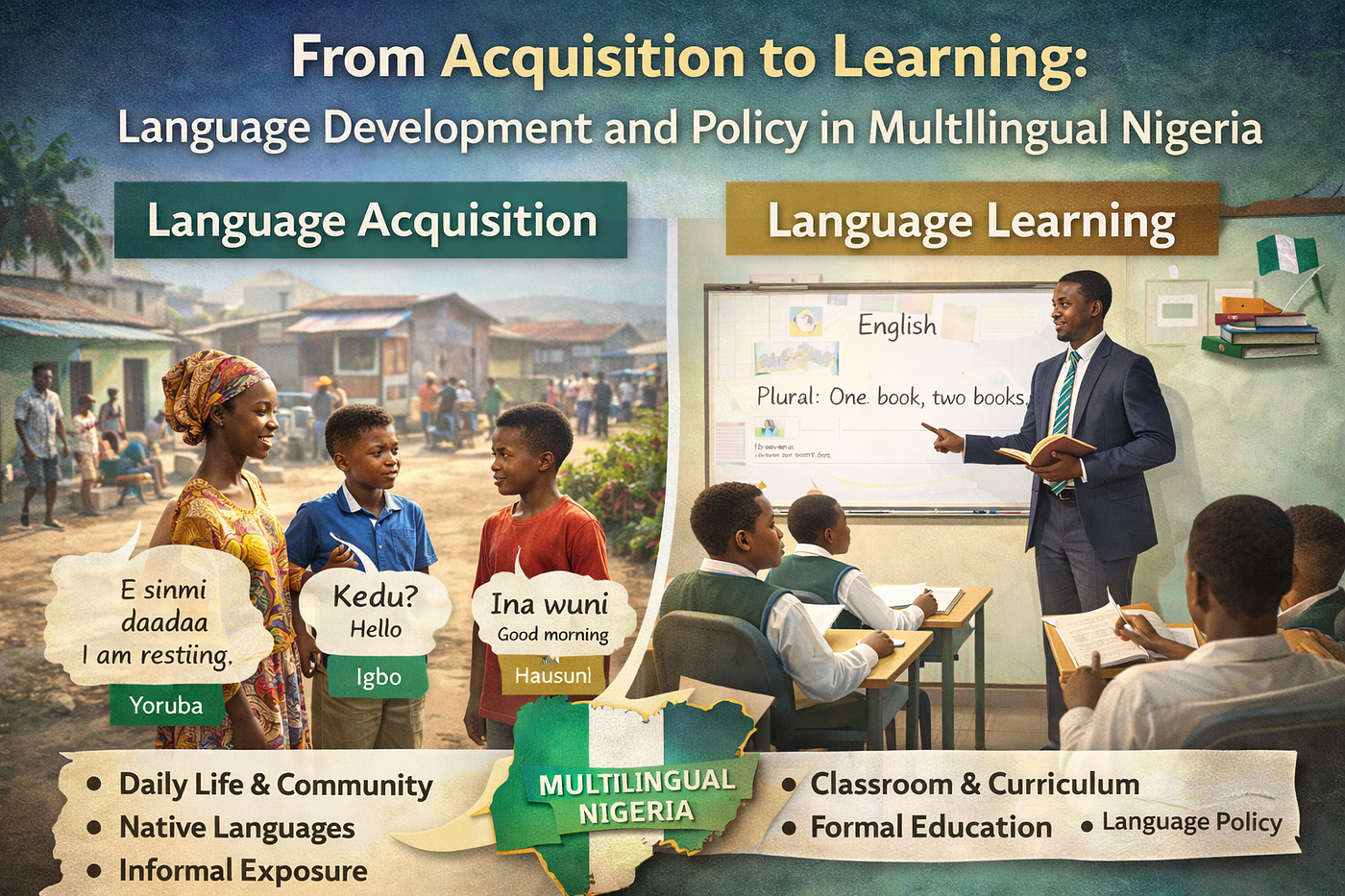
You speak Yoruba with your grandmother. Nigerian Pidgin with friends. English at school. Perhaps Hausa in the market. You switch effortlessly between these languages, not because anyone taught you to be multilingual, but because this is simply what everyday life demands.
Now consider this uncomfortable possibility:
Much of what bilingualism research tells us about multilingualism has been developed from societies where multilingual people are the exception rather than the norm.
What if the problem is not that Africa’s multilingual realities are understudied?
What if they fundamentally challenge how we theorize multilingualism itself?
This concern echoes the influential critique of WEIRD populations, Western, Educated, Industrialized, Rich, and Democratic societies, in the behavioural sciences. Henrich, Heine, and Norenzayan (2010) argued that researchers routinely generalize from populations that are among the least representative of humanity. Although their critique was not directed specifically at bilingualism research, its implications for language science are profound.
In Second Language Acquisition (SLA) and bilingualism studies, much of what we know derives from North American and Western European contexts, where multilingual speakers often exist as minorities within societies organized around monolingual norms (Ortega, 2017, 2019). These studies have produced important insights, but they also raise an important question: Can theories built primarily from minority multilingual experiences adequately explain multilingualism as a global human phenomenon?
This question becomes particularly pressing when viewed from Africa.
Across much of the continent, multilingualism is not exceptional. It is ordinary. Individuals routinely navigate multiple languages across home, education, religion, trade, governance, and social interaction. Yet these multilingual realities remain underrepresented in the theoretical foundations of bilingualism research (Bokamba, 2018; Heugh, 2019).
This article argues that bilingualism research suffers from its own version of the WEIRD problem. While psychological science has been criticized for relying heavily on Western, Educated, Industrialized, Rich, and Democratic (WEIRD) populations, bilingualism research has largely been built from what I call Minority Multilingualism, contexts where multilingual individuals exist within predominantly monolingual societies.
Nigeria points to a different reality: Majority Multilingualism, a sociolinguistic condition in which multilingual competence is the ordinary and expected experience of most people.
This distinction matters because it may require us to rethink some of the foundational assumptions of bilingualism research itself.
The Hidden Bias in Bilingualism Research
The empirical foundations of bilingualism research have been shaped largely by studies of immigrant bilinguals, heritage language speakers, foreign language learners, and minority-language communities in Western societies.
These populations have generated valuable knowledge about language development, linguistic identity, and cognitive processing. However, they share an important sociolinguistic characteristic: multilingualism frequently exists against a backdrop of monolingual expectations.
As a result, many influential research questions implicitly assume that multilingualism is a marked condition:
- How do bilinguals differ from monolinguals?
- How do speakers maintain separate language systems?
- What cognitive advantages or disadvantages emerge from bilingualism?
- How do multilingual speakers negotiate minority-language identities?
Such questions are entirely legitimate. However, they emerge from specific social conditions rather than universal ones.
As Ortega (2019) argues, multilingualism should not be treated as a peripheral phenomenon requiring special explanation. Instead, it should be recognized as a central feature of human linguistic experience.
The challenge, then, is not whether existing bilingualism research is valuable. The challenge is whether it adequately represents the multilingual realities experienced by much of the world’s population.

Africa and the Ordinary Nature of Multilingualism
African sociolinguistic realities present a striking contrast to many of the contexts that dominate bilingualism research.
For decades, African linguists have emphasized that multilingualism constitutes the ordinary condition of social life across much of the continent (Bamgbose, 2000; Bokamba, 2018; Wolff, 2000). Rather than being confined to minority communities, multilingual practices often permeate entire societies.
Bokamba (2018) argues that African multilingualism presents significant challenges to assumptions embedded within dominant theories of second language acquisition. In many African contexts, speakers routinely acquire and use three, four, or even more languages throughout their lives. These multilingual repertoires emerge not as exceptions but as expected outcomes of participation in social, economic, and cultural life.
Similarly, Heugh (2019) notes that African educational systems frequently operate within multilingual realities that are inadequately captured by theories developed in largely monolingual Western contexts.
These observations suggest that multilingualism may not be a special linguistic condition requiring explanation. Instead, it may represent one of humanity’s most common linguistic experiences.
Nigeria and the Reality of Majority Multilingualism
Nigeria provides one of the clearest illustrations of Majority Multilingualism. Linguists have long observed that multilingual language use is woven into the country’s social, educational, religious, and economic life (Bamgbose, 1995, 2000; Jowitt, 2019). Rather than functioning as isolated linguistic systems, English, Nigerian Pidgin, and indigenous languages coexist within dynamic communicative repertoires that reflect everyday patterns of interaction. This reality challenges assumptions that language acquisition can always be understood through clearly bounded L1–L2 distinctions.
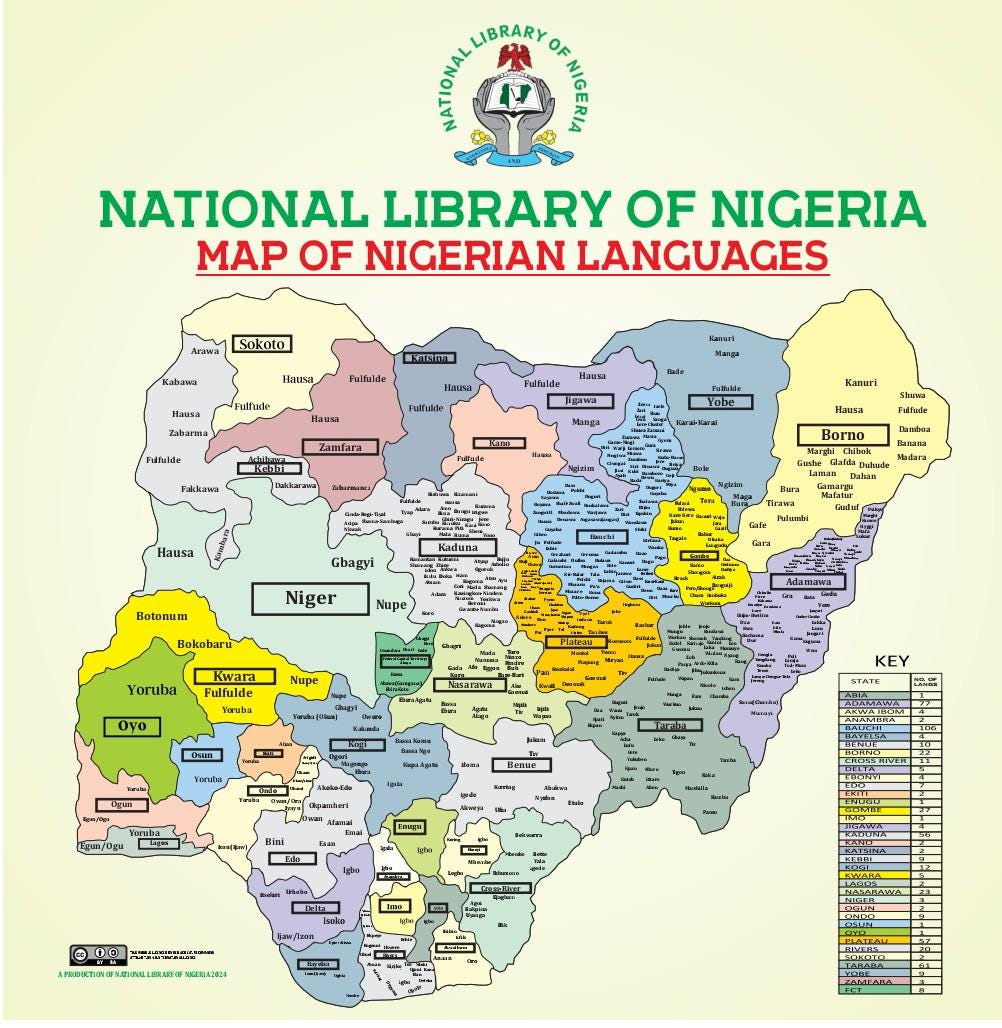
Home to more than 500 languages, Nigeria is among the most linguistically diverse countries in the world. Language use extends far beyond simple bilingualism. Individuals often navigate indigenous languages, English, Nigerian Pidgin, regional lingua francas, and additional community languages within their everyday interactions.
A child may speak Yoruba, Hausa, Igbo, Tiv, Efik, or another indigenous language at home; encounter English in formal education; use Nigerian Pidgin among peers; participate in religious activities through additional linguistic varieties; and engage with yet other languages through trade, migration, or digital media.
Such experiences are neither unusual nor exceptional.
They are ordinary!
You may also consider a university student in Lagos. She speaks Yoruba at home, uses English during lectures, switches to Nigerian Pidgin with friends, participates in church activities conducted partly in English and partly in indigenous languages, and encounters Hausa through commerce and digital interactions.
None of this is unusual.
Yet theories of bilingualism have rarely treated such linguistic trajectories as the starting point for understanding multilingualism.
This raises an important question: if these experiences are ordinary for millions of people, why do they remain peripheral in our theories?
It is from this reality that I propose the concept of Majority Multilingualism.
Defining Majority Multilingualism
Majority Multilingualism refers to a sociolinguistic condition in which multilingual competence constitutes the expected linguistic experience of most members of a community and serves as a foundation for social participation, identity formation, communication, and learning.
The concept of Majority Multilingualism is not simply another label for societal multilingualism. Rather, it highlights a theoretical asymmetry in bilingualism research. Existing theories have largely emerged from contexts where multilingual speakers negotiate life within monolingual norms. Majority Multilingualism shifts the analytical focus to societies where multilingualism itself structures education, identity, commerce, and social participation. The question therefore changes from Why are some people multilingual? to What happens when multilingualism is the default condition of society?
While African scholars have long documented the prevalence of multilingualism across the continent (Bamgbose, 2000; Bokamba, 2018; Wolff, 2000), the concept of Majority Multilingualism seeks to foreground its theoretical implications. Rather than treating multilingualism as an attribute of individuals, the framework draws attention to multilingualism as a societal condition. In doing so, it shifts the focus of inquiry from multilingual speakers operating within monolingual environments to multilingual societies as the primary sites of language learning, use, and development.
An Ecological Perspective on Multilingual Development
Majority Multilingualism is best understood through an ecological lens.
Traditional bilingualism research often assumes relatively identifiable linguistic environments. Researchers commonly distinguish between Language A and Language B and investigate how varying levels of exposure influence development.
However, Nigerian multilingualism frequently resists such neat categorization.
Language experiences emerge through overlapping social networks involving family members, neighbours, schools, religious institutions, markets, workplaces, media platforms, and digital communities.
Language learning therefore occurs within dynamic linguistic ecosystems rather than clearly bounded language environments.
From an ecological perspective, multilingual competence is not merely the acquisition of multiple languages. It is the capacity to navigate complex and fluid communicative environments where linguistic boundaries are constantly negotiated.
This perspective aligns with growing calls within multilingualism research to move beyond static conceptions of language and toward more socially situated understandings of multilingual experience (Ortega, 2019).

Three Assumptions Majority Multilingualism Challenges
- Monolingualism Is the Default
Many bilingualism studies continue to treat monolingual speakers as the baseline against which multilingual speakers are compared.
Yet from a global perspective, multilingualism may be more representative of human linguistic experience than monolingualism.
The Nigerian case suggests that monolingualism may itself be a socially specific condition rather than a universal norm.
2. Languages Exist as Clearly Separate Systems
Research frequently assumes identifiable boundaries between languages.
However, communication in Nigeria often involves code-switching, translanguaging, borrowing, and repertoire-based language use.
The challenge may therefore be less about understanding how speakers separate languages and more about understanding how they strategically combine linguistic resources.
3. Language Input Can Be Easily Measured
Conventional bilingualism research often quantifies exposure to Language A versus Language B.
In majority multilingual contexts, language exposure is distributed across extensive social networks and multiple domains of interaction.
Understanding multilingual development therefore requires attention not only to language quantity but also to language ecology.
The New WEIRD Problem: When Artificial Intelligence Learns the Same Biases
There is a striking irony here. The same multilingual realities that have often remained peripheral in bilingualism theory risk becoming peripheral in artificial intelligence. Large Language Models increasingly shape education, communication, and knowledge production. If these systems are trained predominantly on data reflecting Global North linguistic experiences, they may reproduce similarly narrow understandings of multilingualism.
The underrepresentation of African languages and Nigerian Pidgin in contemporary AI systems mirrors a longer history of exclusion within language science, where multilingual realities in Africa have frequently been treated as marginal rather than theoretically central (Adelani et al., 2021, 2024; Bokamba, 2018).
The implications of Majority Multilingualism extend beyond bilingualism research.
They are increasingly visible in the development of artificial intelligence.
Large Language Models (LLMs) such as ChatGPT, Gemini, Claude, and other generative AI systems are trained on vast quantities of digital language data. Yet, like much of traditional language science, these systems are overwhelmingly shaped by linguistic resources originating from a relatively small number of globally dominant languages.
Recent research has demonstrated substantial inequalities in the representation of African languages within natural language processing and artificial intelligence. Adebara et al. (2022) note that many African languages remain severely underrepresented in language technologies, creating significant disparities in the quality of AI systems across linguistic communities. Similarly, Adelani et al. (2021) argue that African languages continue to face structural exclusion within contemporary NLP research despite the continent’s immense linguistic diversity.
The consequences are not merely technical.
When language technologies are trained primarily on data from dominant languages and sociolinguistic contexts, they risk reproducing assumptions about language that already shape much of bilingualism research. In effect, AI systems may inherit the same WEIRD biases that Henrich et al. (2010) identified in the behavioural sciences.
Nigeria illustrates this challenge clearly.
The everyday linguistic realities of many Nigerians involve dynamic interactions among indigenous languages, Nigerian English, Nigerian Pidgin, and other multilingual resources. Yet these forms of communication remain significantly less represented in digital datasets than varieties of English associated with North America and Europe.
Recent studies have begun to document these limitations. Adelani et al. (2024), for example, demonstrate that generative AI systems often struggle with Nigerian Pidgin and other African linguistic varieties because these forms remain underrepresented in training data. Such findings suggest that contemporary AI systems may be better equipped to process multilingual contexts that are well represented in training data while exhibiting comparatively weaker performance on African multilingual realities that remain underrepresented.
This raises an important question for both language science and artificial intelligence:
If multilingualism is the ordinary condition of life for millions of people, why do our theories, and increasingly our technologies, continue to treat it as peripheral?
From the perspective of Majority Multilingualism, the challenge is not simply to include more African languages in existing models. It is to recognize that multilingual societies offer alternative foundations for understanding how language is learned, organized, and used.
The future of language science may therefore depend on moving beyond theories and technologies built primarily around minority multilingual experiences and toward frameworks that reflect the multilingual realities of the world’s linguistic majority.
Majority Multilingualism is not intended to replace existing theories of bilingualism. Rather, it seeks to broaden the empirical and theoretical foundations upon which those theories rest. By bringing multilingual societies into the centre of inquiry, researchers may develop more globally representative accounts of language learning, use, and development.
Why Majority Multilingualism Matters
The significance of Majority Multilingualism extends well beyond Nigeria.
Across Africa, South Asia, Southeast Asia, and other regions of the Global South, multilingualism frequently constitutes the ordinary condition of social life.
Yet these realities remain underrepresented in the theoretical foundations of bilingualism and SLA research.
The challenge facing the field is therefore not merely methodological. It is theoretical.
Can theories developed primarily from minority multilingual contexts adequately explain multilingualism as a global phenomenon?
Majority Multilingualism suggests they cannot do so fully.
Instead, multilingual societies should be viewed not as peripheral sites for validating existing theories but as central sites for generating new ones.
Conclusion: From the Margins to the Centre
The future of bilingualism research may depend on its willingness to rethink where theory begins.
Nigeria reveals a multilingual reality that differs substantially from the contexts around which many contemporary theories have been constructed. Far from being exceptional, this reality may be closer to the linguistic experiences of much of humanity.
The concept of Majority Multilingualism offers one way of understanding this reality.
It invites researchers to shift their attention from multilingual individuals operating within monolingual societies to multilingual societies in which multilingualism itself constitutes the norm.
If bilingualism research seeks genuinely global explanations of language learning and use, then Nigeria and similar contexts should not occupy the margins of theory.
They should help define its centre.
Therefore, the question for bilingualism research is no longer whether multilingual societies should be included in our theories. The question is whether theories built largely without them can claim to explain multilingualism at all. If much of humanity lives under conditions of Majority Multilingualism, then perhaps the future of bilingualism research lies not in treating such contexts as exceptions to existing theories, but in recognising them as essential foundations from which new theories of multilingualism can emerge.
References
Adebara, I., Li, H., & Abdul-Mageed, M. (2022). One thousand and one directions: Benchmarking and analyzing NLP representation learning for African languages. Proceedings of the 60th Annual Meeting of the Association for Computational Linguistics (Volume 1: Long Papers), 2747–2763. https://doi.org/10.18653/v1/2022.acl-long.196
Adelani, D. I., Abbott, J., Neubig, G., D’Souza, D., Kreutzer, J., Lignos, C., Palen-Michel, C., Buzaaba, H., Rijhwani, S., Ruder, S., Mayhew, S., Azime, I. A., Muhammad, S. H., Emezue, C. C., Nakatumba-Nabende, J., Ogayo, P., Anuoluwapo, A., Gitau, C., Mbaye, D., … Niyongabo Rubungo, A. (2021). MasakhaNER: Named entity recognition for African languages. Transactions of the Association for Computational Linguistics, 9, 1116–1131. https://doi.org/10.1162/tacl_a_00416
Adelani, D. I., Doğruöz, A. S., Shode, I., & Aremu, A. (2024). Does generative AI speak Nigerian Pidgin? Issues of representativeness and bias for multilingualism in large language models. arXiv. https://arxiv.org/abs/2404.19442
Bamgbose, A. (1995). English in the Nigerian environment. In A. Bamgbose, A. Banjo, & A. Thomas (Eds.), New Englishes: A West African perspective (pp. 9–26). Mosuro Publishers.
Bamgbose, A. (2000). Language and exclusion: The consequences of language policies in Africa. LIT Verlag.
Bamgbose, A. (2006). Language policy in Nigeria: Challenges, opportunities and constraints. Keynote address presented at the Nigerian Millennium Sociolinguistics Conference, University of Lagos.
Bokamba, E. G. (2018). Multilingualism and theories of second language acquisition in Africa. World Englishes, 37(3), 432–446. https://doi.org/10.1111/weng.12330
Eberhard, D. M., Simons, G. F., & Fennig, C. D. (Eds.). (2025). Ethnologue: Languages of the world (28th ed.). SIL International.
Henrich, J., Heine, S. J., & Norenzayan, A. (2010). The weirdest people in the world? Behavioral and Brain Sciences, 33(2–3), 61–83. https://doi.org/10.1017/S0140525X0999152X
Heugh, K. (2019). Multilingualism in African education: Theory and practice. In A. Ouane & C. Glanz (Eds.), Optimising learning, education, and publishing in Africa: The language factor (pp. 105–126). UNESCO Institute for Lifelong Learning.
Jowitt, D. (2019). Nigerian English. De Gruyter Mouton. https://doi.org/10.1515/9781501501228
Ortega, L. (2017). New CALL–SLA research interfaces for the 21st century: Towards equitable multilingualism. CALICO Journal, 34(3), 285–316. https://doi.org/10.1558/cj.33855
Ortega, L. (2019). SLA and the study of equitable multilingualism. The Modern Language Journal, 103(S1), 23–38. https://doi.org/10.1111/modl.12525
Owolabi, K. (2006). Language policy in Nigeria: Problems, prospects and perspectives. In O. Ndimele (Ed.), Language and economic reforms in Nigeria (pp. 1–14). M & J Grand Orbit Communications.
Wolff, H. E. (2000). Language and society. In B. Heine & D. Nurse (Eds.), African languages: An introduction (pp. 298–347). Cambridge University Press.
메타데이터
- post_id
- 2eeba943bb83
- slug
- the-bilingualism-problem-nobody-sees-lessons-from-nigerias-multilingual-reality-2eeba943bb83
- url
- https://medium.com/@danabdul_69417/the-bilingualism-problem-nobody-sees-lessons-from-nigerias-multilingual-reality-2eeba943bb83
- canonical_url
- https://medium.com/@danabdul_69417/the-bilingualism-problem-nobody-sees-lessons-from-nigerias-multilingual-reality-2eeba943bb83
- author_url
- https://medium.com/@danabdul_69417
- status
- ok
- fetched_at
- 2026-08-28 19:18:36