Performance Boost: Using L2CAP Socket Over GATT for Bluetooth Data Traffic
Bluetooth Low Energy (BLE) was designed for low-power, infrequent data transmission. For years, developers relied on the Generic Attribute…
Performance Boost: Using L2CAP Socket Over GATT for Bluetooth Data Traffic
Bluetooth Low Energy (BLE) was designed for low-power, infrequent data transmission. For years, developers relied on the Generic Attribute Profile (GATT) as the default way to transfer data between devices. But as BLE expands into more demanding use cases — such as audio streaming, firmware updates, and high-frequency sensor data — GATT begins to show its limitations.
Enter the L2CAP CoC (Credit-based Flow Control Mode) — a lesser-known, but powerful, alternative for BLE data transfer that unlocks significant performance improvements.
📶 GATT: Reliable, but Constrained
GATT is the most popular profile for BLE communication. It’s structured, interoperable, and works well for small, infrequent payloads. However, it wasn’t designed with high-throughput applications in mind. Here’s why:
- MTU Size: Although modern devices can negotiate larger MTU sizes (e.g., 247 bytes), each write/notify still carries significant overhead.
- Request-Response Model: GATT operations are serialized. You typically wait for a response before sending the next packet.
- Overhead: The ATT protocol layered over L2CAP includes extra headers and parsing logic, adding processing time and complexity.
This works fine for things like heart rate data or device control, but bottlenecks quickly appear when you push large files or stream continuous data.
🚀 L2CAP CoC: The Powerhouse for Data Transfer
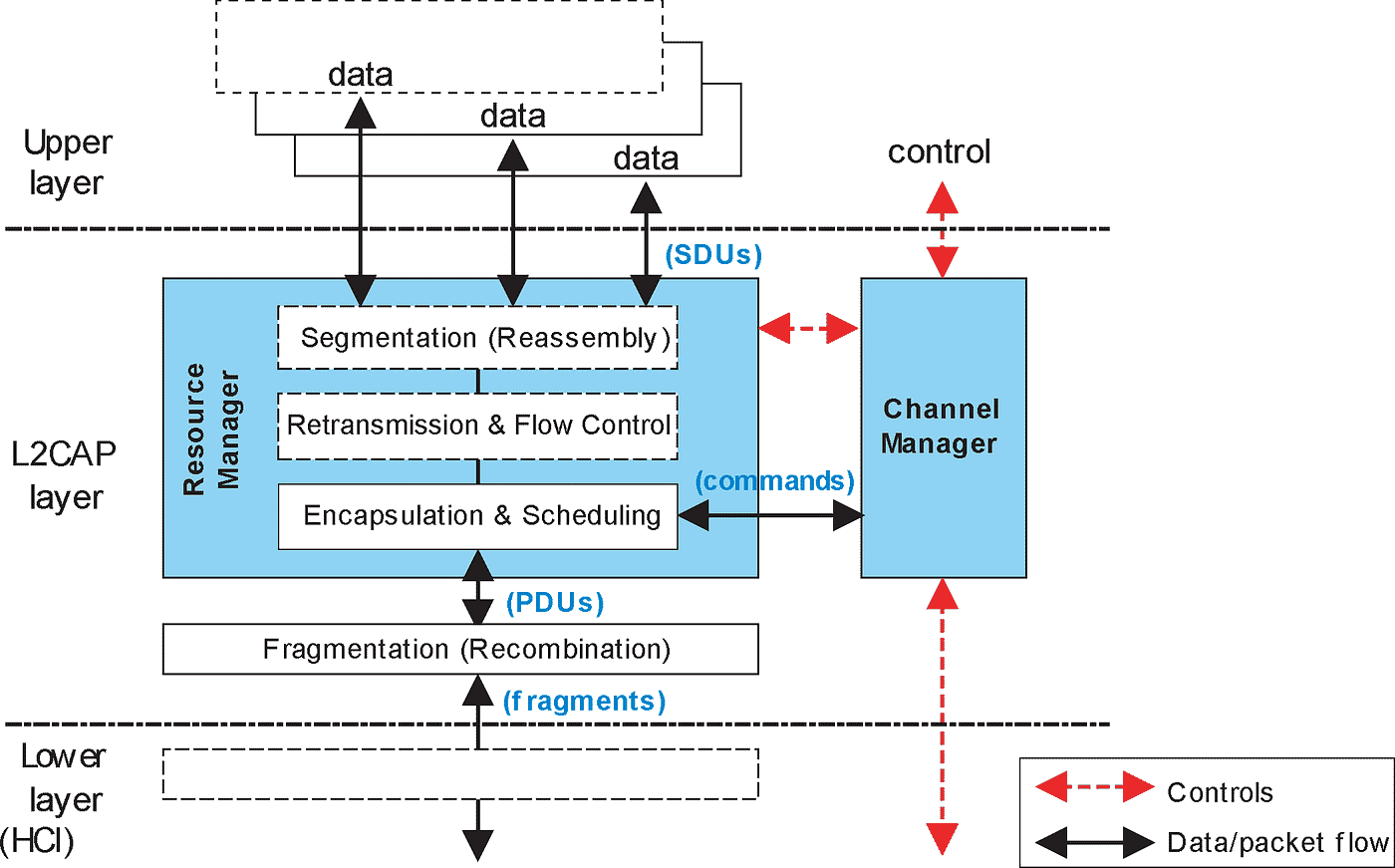
L2CAP (Logical Link Control and Adaptation Protocol) is the layer beneath GATT. BLE introduced a mode called L2CAP Credit-Based Flow Control Mode (CoC) in Bluetooth 4.2 and enhanced it in later versions.
What’s Different?
- Raw Socket-like API: Similar to TCP sockets, it allows stream-based data transfer.
- Higher Throughput: Because it bypasses the GATT/ATT layer, data moves faster and more efficiently.
- Lower Latency: Fewer protocol handshakes and smaller header overhead.
- Custom Protocol Design: Developers have full control over framing and parsing, enabling optimized proprietary protocols.
📊 Benchmark: GATT vs L2CAP Socket
Let’s compare a simple benchmark transferring a 1MB firmware file over BLE:
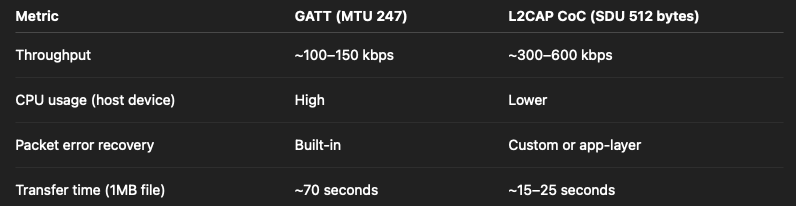
Note: Actual performance depends on controller firmware, buffer size, connection interval, and PHY configuration (e.g., 1M vs 2M).
🛠️ Implementation Highlights
On Android or Linux systems, you can access L2CAP via BluetoothSocket with TYPE_L2CAP_LE. Here’s an outline:
BluetoothDevice device = ...;
BluetoothSocket socket = device.createInsecureL2capChannel(channelId);
socket.connect();

OutputStream out = socket.getOutputStream();
out.write(myData);
On the peripheral side (e.g., Nordic, TI, or ESP32), the SDK often exposes sd_ble_l2cap_ch_setup() or similar APIs to open L2CAP CoC channels and handle credits manually.
🔐 Security Considerations
GATT traffic benefits from encryption and pairing by default. With L2CAP, you need to ensure:
- LE Secure Connections are established before data transfer.
- Application-level framing to avoid parsing ambiguities.
- Credit exhaustion doesn’t cause DoS (denial of service) scenarios.
Most modern stacks handle this securely, but developers must be cautious.
🧠 When Should You Use L2CAP?
Use L2CAP CoC when:
- You need high-throughput data transfer (e.g., audio, large logs, OTA firmware).
- You’re building proprietary protocols and don’t need cross-vendor GATT compatibility.
- You can manage your own flow control and framing.
Stick to GATT when:
- Your device is simple and needs interoperability.
- You rely on off-the-shelf BLE tools for communication.
- Power and code complexity are more important than raw speed.
🔮 The Future of BLE Data Transfer
As BLE expands into new domains — such as LE Audio and real-time IoT data feeds — developers must look beyond GATT. L2CAP sockets unlock the performance and flexibility needed for demanding use cases. While GATT will remain the default for simple scenarios, understanding and leveraging L2CAP can provide a serious edge in performance-sensitive applications.
✍️ Final Thoughts
Bluetooth is evolving. If you’re still relying solely on GATT, it might be time to rethink your architecture. L2CAP sockets offer a high-performance path forward, provided you’re ready to take control over the transport.
Got an embedded or Android project hitting performance limits? Try L2CAP — it might just be the turbo boost you need.
메타데이터
- post_id
- 2ef42cd6dfcf
- slug
- performance-boost-using-l2cap-socket-over-gatt-for-bluetooth-data-traffic-2ef42cd6dfcf
- url
- https://medium.com/bluetooth-demystified/performance-boost-using-l2cap-socket-over-gatt-for-bluetooth-data-traffic-2ef42cd6dfcf
- canonical_url
- https://medium.com/bluetooth-demystified/performance-boost-using-l2cap-socket-over-gatt-for-bluetooth-data-traffic-2ef42cd6dfcf
- author_url
- https://medium.com/@nikheelvs
- status
- ok
- fetched_at
- 2026-06-17 08:20:12