Everyone Thinks High Oil Prices Are Great for EVs. The Data Says It’s Complicated.
Oil just whipsawed from $61 to $118 a barrel. Here’s what that actually does to the electric vehicle market and the counterintuitive truth…
Everyone Thinks High Oil Prices Are Great for EVs. The Data Says It’s Complicated.
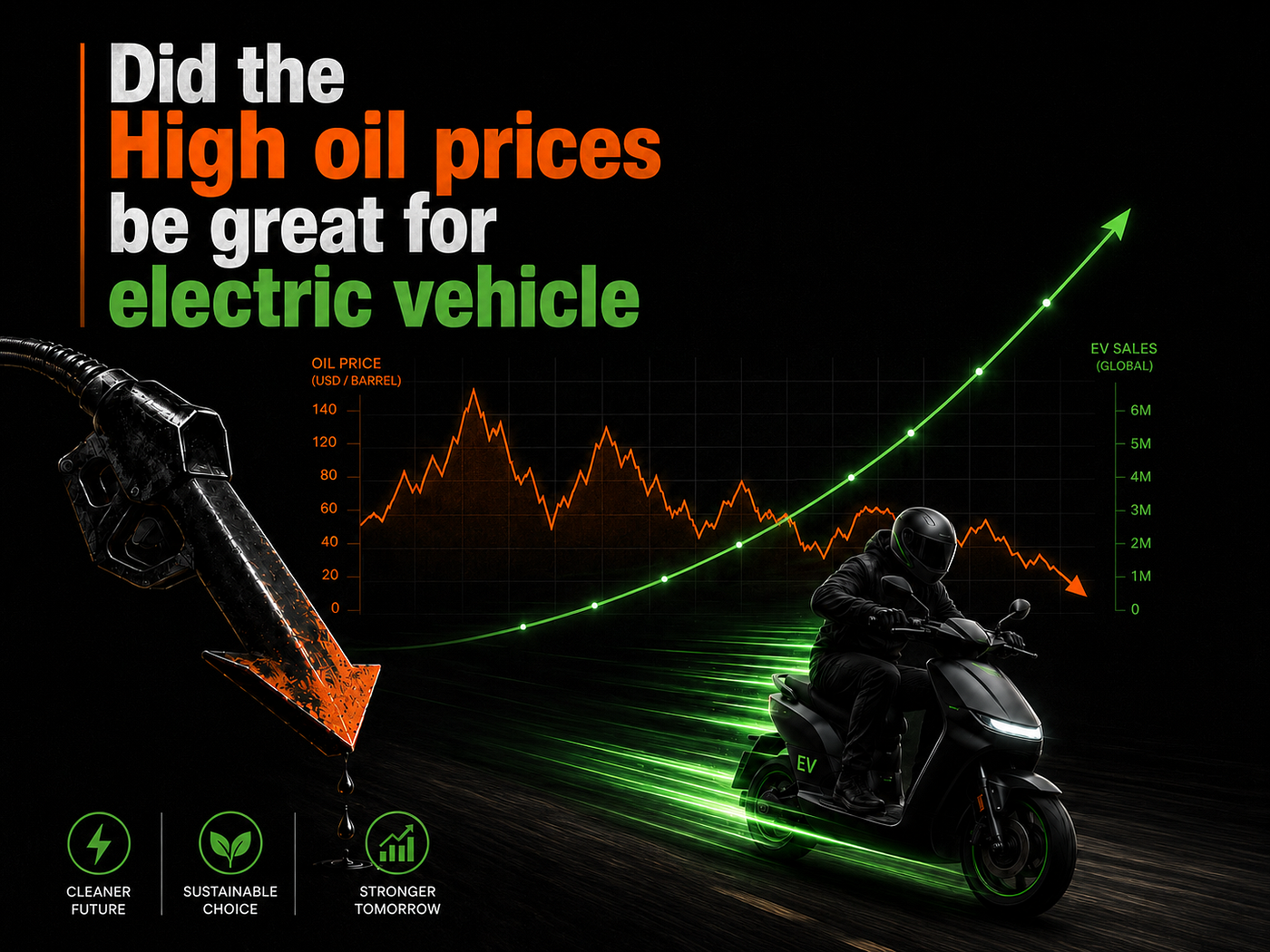
Oil just whipsawed from $61 to $118 a barrel. Here’s what that actually does to the electric vehicle market and the counterintuitive truth most people miss.
There’s a story we all tell ourselves about oil and electric cars. It goes like this: petrol gets expensive → people get angry at the pump → everyone rushes out to buy an EV → Tesla and BYD throw a party.
It’s clean, it’s intuitive, and it’s mostly wrong.
I went deep on this question after watching crude oil go on a wild ride in 2026. Brent started the year around $61 a barrel. Then, after military action in the Middle East in late February and the effective shutdown of the Strait of Hormuz, it rocketed to $118 the biggest inflation-adjusted quarterly jump in oil prices since at least 1988, according to the U.S. Energy Information Administration. American drivers watched petrol cross $3.99 a gallon and diesel hit $5.40. By late May it had cooled back to the mid-$90s on hopes of a U.S.–Iran deal.
So here’s the perfect real-world experiment. If expensive oil is rocket fuel for EVs, we should be able to see it.
Let me show you why the answer is so much more interesting than “yes.”
The inconvenient fact that breaks the whole theory
In April 2025, oil briefly fell below $60 a barrel. Cheap petrol. The exact opposite of an EV-friendly environment.
And yet 2025 turned out to be the biggest year for electric vehicles in history.
According to the IEA, the world bought 21 million electric cars in 2025, up more than 20% and for the first time, one in four new cars sold globally was electric. China blew past a milestone nobody expected so soon: more than half of all cars sold there were electric.
Read that again. EV adoption hit record highs while oil was cheap. If low oil prices were supposed to kill EVs, somebody forgot to tell the buyers.
This is the single most important thing to understand about this entire debate:
Oil price is a secondary driver of EV adoption, not the primary one. The things that actually move the needle are the upfront price of the car (which is really theprice of the battery), government policy, how many good models you can choose from, and whether you can conveniently charge. Oil price sits on top of all that as an accelerant. Sometimes a powerful one. Sometimes almost irrelevant. And occasionally, it backfires entirely.
Two forces pulling in opposite directions
When oil goes up, two things happen to the EV market at the same time, and they fight each other.
Force #1: The running-cost effect (good for EVs). Expensive petrol makes the gap between “fueling a petrol car” and “charging an EV” much wider. The EV’s total-cost-of-ownership advantage grows, and the payback period shrinks. This is the channel everyone imagines, and it’s real.
Force #2: The macro effect (bad for EVs). Oil is in everything transport, plastics, fertiliser, food logistics. When it spikes, inflation rises. To fight inflation, central banks keep interest rates high. And here’s the catch: EVs cost more upfront and are more often bought on loans, so they’re more sensitive to expensive credit than a cheap petrol scooter or hatchback. On top of that, squeezed households delay every big purchase including the EV they were eyeing.
The net effect on the EV market is Force #1 minus Force #2.
In a gentle, gradual oil rise, the running-cost benefit wins, and EVs gain. In a violent, recession-inducing spike the kind a Strait-of-Hormuz crisis produces, the macro damage can temporarily win, and the entire car market slows down. EVs still grab a bigger slice of the pie, but the pie itself shrinks.
Who actually wins? Follow the people who do the math monthly
Here’s the cleanest way to think about it: the more someone spends on fuel, the harder high oil pushes them toward electricity.
A weekend driver who does 15 km on a Sunday barely notices a petrol hike. A delivery rider doing 120 km a day feels it like a punch. So high oil doesn’t push everyone equally it pushes hardest on the people and vehicles that burn the most fuel.
Ranked from most to least sensitive:
-
Electric two- and three-wheelers are the biggest winners. Cheap to buy, easy to charge from a wall socket, ridden long distances daily by price-sensitive owners. This is where the switch is cheapest and the fuel savings are most felt. In India, two-wheelers alone are about 56% of all EV sales. This is the engine of the transition.
-
Taxis, ride-hailing, and delivery fleets. These run 150–400 km a day. When fuel is expensive, an EV can pay for itself in months. Fleet operators don’t buy on emotion; they re-run the spreadsheet constantly and switch the moment the math flips.
-
Electric buses. High diesel prices blow holes in government transport budgets, which strengthens the case for electrifying public fleets. This is decided in tenders and treasury meetings, not showrooms.
-
Electric trucks are rising fast. Diesel is the dominant cost in trucking, so high oil sharpens the case dramatically. China proved it’s scalable: electric heavy-truck sales tripled in 2025 to over 200,000 units. Range and charging corridors still hold it back elsewhere.
-
Private electric cars are the least sensitive. This is a surprise. Regular car buyers obsess over the sticker price and the monthly EMI far more than the fuel bill. High oil helps at the margin, but it’s not what closes the sale.
If this were a simple story, I’d stop here. It isn’t.
Sustained high oil can hurt the EV market through the back door:
● Inflation and high interest rates make car loans expensive and hit pricey, financed EVs harder than cheap petrol vehicles.
● Squeezed wallets push buyers to delay big purchases entirely.
● Cash-burning EV and charging startups struggle when capital gets expensive exactly when oil shocks tend to raise rates.
● Hybrids steal the cautious switchers. This is the real wildcard. A nervous buyer who lacks home charging or fears range anxiety may grab a hybrid to escape petrol bills without fully committing to electric. In a sharp spike, hybrids can divert demand away from full EVs especially in markets with weak charging.
What this means for you
If you’re an investor: Don’t reflexively “buy EV stocks because oil is up.” Watch interest rates (the real driver of near-term demand), watch battery costs and the LFP shift (the real engine of competitiveness), and favour profitable, scaled players and the picks-and-shovels winners utilities and renewables over cash-burning startups during a tight-money oil shock.
If you run an EV company: Aim at the high-mileage, fuel-sensitive segments where oil-driven payback is fastest two/three-wheelers, fleets, delivery, buses. Lock in battery supply. And remember Ola: demand alone won’t save weak execution. Reliability and service are the moat.
The verdict The direction of the EV transition was set long ago, by the relentless fall in battery prices and the steady march of policy. Oil prices don’t decide whether it happens.
They just decide how fast and who’s ready when it does.
This piece is based on data from the IEA, U.S. EIA, BloombergNEF, the Government of India, and market reporting available as of May 2026. It’s analysis, not investment advice verify the numbers before betting real money on them. Oil prices in particular are moving fast right now.
If this was useful, a clap or two helps it reach more people. What’s your read is your next vehicle going to be electric?
메타데이터
- post_id
- 2f08d8ddd8b8
- slug
- everyone-thinks-high-oil-prices-are-great-for-evs-the-data-says-its-complicated-2f08d8ddd8b8
- url
- https://medium.com/@stakehubs/everyone-thinks-high-oil-prices-are-great-for-evs-the-data-says-its-complicated-2f08d8ddd8b8
- canonical_url
- https://medium.com/@stakehubs/everyone-thinks-high-oil-prices-are-great-for-evs-the-data-says-its-complicated-2f08d8ddd8b8
- author_url
- https://medium.com/@stakehubs
- status
- ok
- fetched_at
- 2026-06-09 15:37:30