“Wings of Possibility: From Sculpture to Skies”
It sound like a movie title, rightly so because the characters in this are both experts at what they do, and have been for many years.
“Wings of Possibility: From Sculpture to Skies”
It sound like a movie title, rightly so because the characters in this are both experts at what they do, and have been for many years.
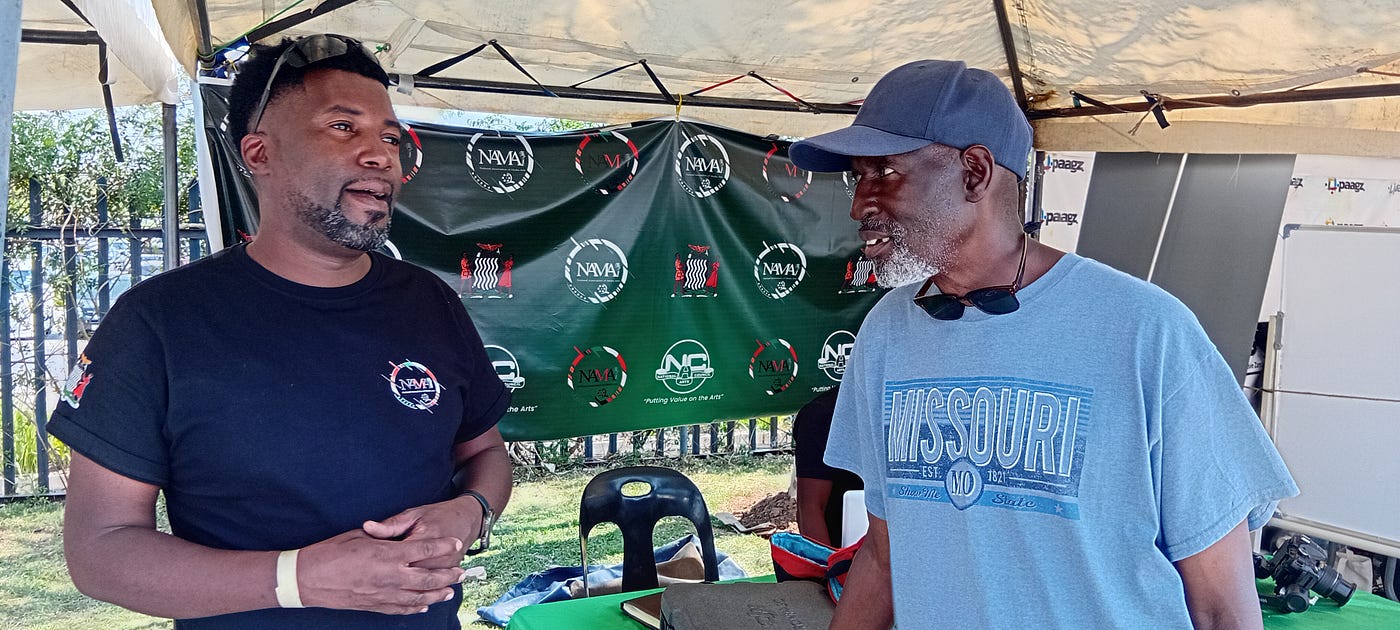
“Ice” Morgan Mbulo conversing with Chande Kapundu during the National Arts Festival (Photo Credit: Andrew-Knox Kaniki)
As the festival grounds were beginning to quiet down, the last echoes of music and laughter fading into the cool night air, I hung out with Chande and Morgan under the glow of lanterns strung between the tents, as they conversed carrying a weight that felt larger than the moment.
“Imagine,” Morgan said, gesturing upward at the dark sky, “if our young people could not only fly drones but build them, service them, and license others to do the same. We’d be unlocking an entire industry.”
This was yesterday, in a chat with Chande Kapundu, a renowned sculptor, and “Ice” Morgan Mbulo, a media expert and current President for NAMA, as we found ourselves drifting into the skies — quite literally. The topic was drones: their growing use, the possibilities they open up, and the urgent need to find solutions for local assembly and affordable training, particularly for the trainers who would shape future operators.
This conversation unfolded on the final day of the Kwimbo National Arts Festival, a fitting backdrop for ideas that bridged art, technology, and innovation, as the choirs sung their songs complimenting the worthy event.
Current Zambian Civil Aviation Authority has a limited number of approved Aviation Training Organisations for Remote Pilot License (RPL) drone training, and a few stood out as a beacon in the discussion. Their role in setting standards sparked a deeper reflection on how Zambia could position itself as a hub for drone technology in the region.
Chande, with his characteristic calm but visionary tone, shared how years ago he had worked on an assembly system for small propeller planes. Morgan leaned forward, eyes bright with possibility, and encouraged him to view that experience as the foundation for something greater — an opportunity to link local media teams with technical knowledge. Trainers, he suggested, could not only assemble and service drones but also ensure that licensed users were nurtured right here in Zambia, perhaps even extending the model to Central and Southern Africa.
The thought lingered like the hum of a distant propeller — Zambia at the center of an aerial revolution, where art, media, and aviation converged to create both opportunity and access.
For a moment, the idea hovered between them like a drone in perfect balance. What began as a casual festival chat was shaping into a vision of the skies, a blueprint for the future.
The conversation reflected a broader vision: integrating technical innovation with media, education, and industry to ensure drones become tools of empowerment rather than imported luxuries.
— END
메타데이터
- post_id
- 2f3dedc8d667
- slug
- wings-of-possibility-from-sculpture-to-skies-2f3dedc8d667
- url
- https://medium.com/@abkaniki/wings-of-possibility-from-sculpture-to-skies-2f3dedc8d667
- canonical_url
- https://medium.com/@abkaniki/wings-of-possibility-from-sculpture-to-skies-2f3dedc8d667
- author_url
- https://medium.com/@abkaniki
- status
- ok
- fetched_at
- 2026-06-25 16:53:31