The Cosmic Savings Account: Why We Misunderstand Karma, Maya, and the Retirement Plan of Life
My understanding of how karma works.
The Cosmic Savings Account: Why We Misunderstand Karma, Maya, and the Retirement Plan of Life
My understanding of how karma works.
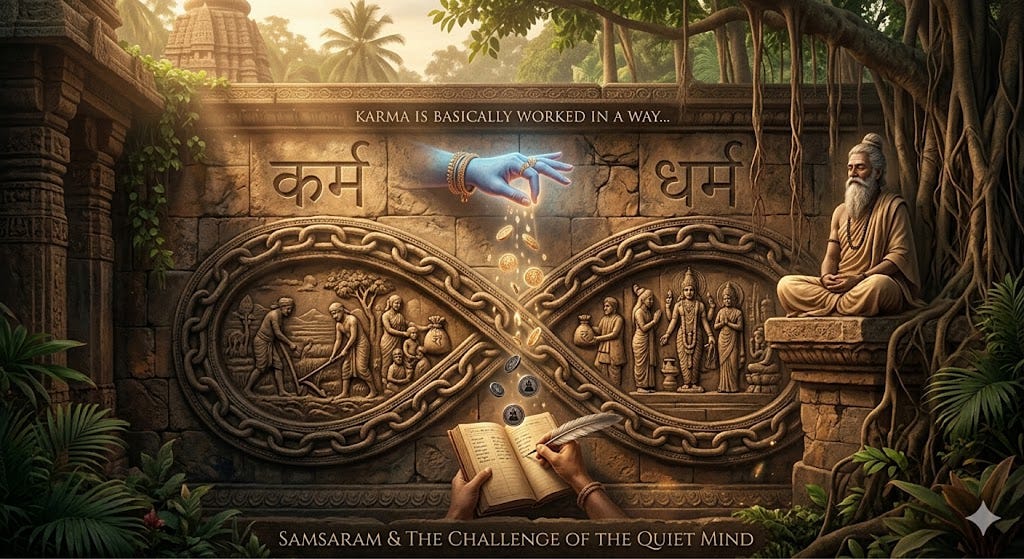
We love a good spreadsheet. As modern human beings, we are obsessed with predictability. We plan our retirement, build our rainy-day emergency funds, track our daily wages, and balance our expenses.
Naturally, we try to apply this exact same accounting logic to the cosmos.
We tell ourselves: “If I do a good deed today, that’s a brownie point deposited into my cosmic savings account. If I suffer tomorrow, well, that’s just a deduction for a past-life debit.” If we build up enough spiritual capital, we expect to withdraw a steady monthly dividend of peace and prosperity for the rest of our lives.
But let’s be honest with ourselves: Is that really how karma works? Or is it simply a comforting fiction we cling to because uncertainty terrifies us? Burdened by the sheer weight of daily needs, we shrink our focus to maintaining the fragile bubbles of immediate control. Yet true spirituality isn’t about balancing a cosmic ledger to buy our own comfort — it begins when we recognize the structural trap of the loop we are all running in.
The Involuntary Karma Loop
In classical Indian philosophy, life is structured around the Purusharthas — the four essential human pursuits: Dharma (righteous duty), Artha (material wealth), Kaama (desire and emotional fulfillment), and Moksha (liberation).
Traditional wisdom tells us we must navigate the first three properly to reach the fourth. We practice Dharma to attain wealth ethically, and use that wealth to satisfy our desires. But here is the ultimate catch-22 of human existence: In the very act of performing our duties and satisfying our desires, we involuntarily build karma all along.
Every action has a reaction. Every desire breeds attachment. Even when you are playing entirely by the rules of society, you are constantly generating new energetic ties. And in trying to resolve one chain of consequence, we often forge another — tightening the very loop we hope to escape.
Navigating this terrain is never a straight, predictable line; it is a constant struggle filled with unexpected obstacles where we often find ourselves relying on something beyond effort alone — what we casually call luck, grace, or divine timing. I am right there in the trenches with you, navigating this exact loop with my own heavy share of daily challenges.
The Illusion of the “Quiet Destination”
We all do it. We look at the chaos of our current responsibilities and we pray for the day it ends. We tell ourselves, “Let me just cross this finish line. Let me get the kids settled, finish my family duties, and then I will finally live a calm, quiet, disciplined life.”
But I believe that after the worldly responsibilities fade, the truly challenging part begins.
We expect the post-responsibility phase of life to be a peaceful harbor. Instead, we are often hit with a whole new battlefield: age-related health issues, physical limitations, and a body that no longer moves the way our mind wants it to.
When the external noise of a busy household finally stops, you are left entirely alone with your own mind. Keeping that mind calm in the face of an aging body and a changing world is a significantly greater challenge than any project or checklist we managed in our youth. A quiet room does not guarantee a quiet mind.
Krishna’s Secret: Finding the Stage
This is precisely why Krishna steps onto the battlefield of the Bhagavad Gita to offer a radical reframe. He doesn’t tell Arjuna to run away to the forest. He acknowledges that our duties and desires happen within Maya — the grand illusion that makes the temporary feel permanent.
Krishna’s solution is profound: Do everything, but keep your mind still.
Act without letting the fruits of the action disrupt your inner equilibrium. Somewhere, at some point in time, even amidst our current family responsibilities, we must start practicing the art of the witness.
Realizing that we are all simply players on a magnificent, complex stage is where true freedom hides. The world is the theater; the roles we play — parent, spouse, professional, provider — are just characters we have been assigned for this act.
Karma isn’t a retirement fund where you store up good deeds to buy a trouble-free life later on. True liberation — Moksha — is the internal shift that happens when we finally have the wisdom to stop fighting the script, look at the stage, and realize we were the silent witness all along.
메타데이터
- post_id
- 2f467cd908b1
- slug
- the-cosmic-savings-account-why-we-misunderstand-karma-maya-and-the-retirement-plan-of-life-2f467cd908b1
- url
- https://medium.com/@ldeviabirami/the-cosmic-savings-account-why-we-misunderstand-karma-maya-and-the-retirement-plan-of-life-2f467cd908b1
- canonical_url
- https://medium.com/@ldeviabirami/the-cosmic-savings-account-why-we-misunderstand-karma-maya-and-the-retirement-plan-of-life-2f467cd908b1
- author_url
- https://medium.com/@ldeviabirami
- status
- ok
- fetched_at
- 2026-06-09 15:37:30