The Essential E-Commerce App Feature Checklist (And What They Cost to Build)
In 2026, the digital storefront has moved far beyond a simple product list and a “Buy” button. Mobile commerce now accounts for over 80% of…
The Essential E-Commerce App Feature Checklist (And What They Cost to Build)
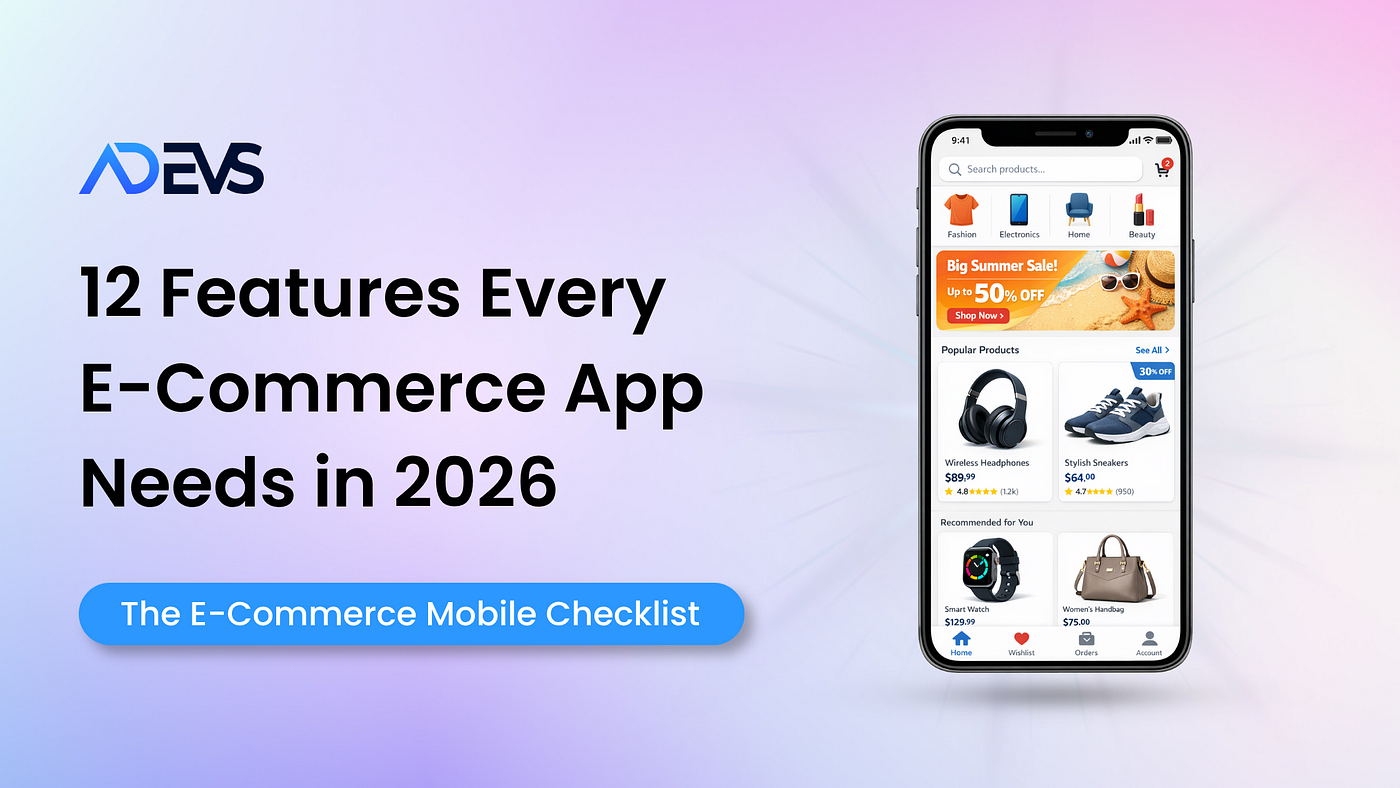
In 2026, the digital storefront has moved far beyond a simple product list and a “Buy” button. Mobile commerce now accounts for over 80% of total digital retail traffic, but the apps capturing that share aren’t winning on price alone. They are winning on experience.
The challenge for founders today isn’t just about building an app; it’s about surviving the competition from global giants who have set an incredibly high bar for personalization. This guide breaks down the 12 non-negotiable features for a modern e-commerce mobile app, ranked by their business impact.
1. Seamless Onboarding & Biometric Security
The first 10 seconds of user interaction define whether your app lives or dies. In 2026, forcing a user to type a manual password on a small screen is a major conversion killer. Modern users expect a “zero-friction” entry point. By integrating Biometric Authentication, you remove the cognitive load of remembering credentials while increasing the user’s sense of security.
- FaceID & TouchID: Instant access that reduces login friction by 60%.
- One-Tap Social Login: Integrating Apple, Google, and LinkedIn for rapid account creation.
- Trust Building: Users are more likely to store credit card data if the app feels “locked” via biometrics.
- Reduced Drop-off: Streamlined onboarding can lead to a 40% increase in successful account setups.
2. AI-Driven Hyper-Personalization
Generic “Recommended for You” carousels are relics of the past. A truly modern e-commerce app uses predictive analytics to dynamically rearrange the entire interface based on real-time intent. This ensures that every time a user opens the app, they see a version of the store curated specifically for them.
- Intent Modeling: Using custom AI development to predict what a user wants before they search.
- Dynamic UI: Changing homepage banners based on local weather or past browsing history.
- Behavioral Triggers: Offering discounts on specific categories only when the user shows a “hesitation” pattern.
- ROI Impact: Personalized experiences typically drive a 15–35% lift in Average Order Value (AOV).
3. Smart Search: Visual & Voice Commerce
Traditional keyword search often fails because users don’t always have the exact words for what they want. In 2026, your search bar must be multimodal. Visual and Voice search allow for a more natural, “human” way of interacting with a digital catalog, especially for users on the move.
- Visual Search: Users upload a photo to find identical or visually similar products in your inventory.
- Voice Search: Hands-free navigation for users who are driving or multitasking.
- Vertical AI Integration: Utilizing vertical AI to understand technical, niche-specific terminology in search queries.
- Search Accuracy: Reduces the “No Results Found” page, which is a primary exit point for shoppers.
4. Augmented Reality (AR) “Try-Before-You-Buy”
AR is no longer a novelty; it is a powerful tool for cutting operational costs. One of the biggest drains on e-commerce profitability is the high rate of returns. AR provides a “spatial” understanding of a product that a 2D photo simply cannot match.
- Virtual Try-On: Seeing how glasses, makeup, or apparel looks on the user’s face or body.
- Spatial Placement: Visualizing furniture or decor in a user’s actual living room via LiDAR.
- Confidence Scores: Users who engage with AR are 11x more likely to complete a purchase.
- Return Reduction: Provides the clarity needed to reduce return rates by as much as 30%.
5. Frictionless One-Click Checkout
Cart abandonment on mobile remains a stubborn hurdle, often caused by overly complex checkout forms. To combat this, your app must support a “one-click” philosophy. Every additional tap between the “Cart” and “Order Success” screens is an opportunity for the user to change their mind.
- Digital Wallets: Integrated support for Apple Pay, Google Pay, and PayPal for zero-form-filling.
- BNPL Options: Offering Klarna or Affirm to remove psychological barriers to high-ticket items.
- Biometric Confirmation: Using FaceID to authorize payments in seconds.
- AOV Boost: Buy Now, Pay Later options can increase order values by 20% or more.
6. Hyper-Targeted Push Notifications
In 2026, push notifications must be treated as a high-value engagement channel, not a spam tool. The key is context and timing. When notifications are genuinely useful such as a price drop or a shipping update, they drive significant ROI and keep your app “top of mind.”
- Geo-Fencing: Triggering a discount when a user walks near your physical store.
- Abandoned Cart Recovery: Sending a reminder with a “One-Click Finish” button.
- Price Drop Alerts: Notifying users when an item in their wishlist becomes cheaper.
- Personalized Timing: AI determines the exact time of day a specific user is most likely to click.

7. Real-Time Order Tracking & GPS
The “Where is my order?” (WISMO) inquiry is the single most common customer support ticket, often accounting for over 35% of all inbound contacts. Transparency is no longer a luxury; it is a requirement for modern customer satisfaction.
- Live Map View: GPS integration so users can see the delivery vehicle’s location.
- Status Automation: Push alerts for “Out for Delivery” or “Delivered” with a photo proof.
- Logistics Sync: Connecting the app to custom logistics software for real-time warehouse data.
- Support Reduction: Significantly lowers the volume of repetitive customer service inquiries.
8. Social Commerce & UGC Integration
Modern shoppers, particularly Gen Z and Alpha, trust peer reviews significantly more than branded marketing. Your app should act as a social proof machine. By integrating the “social loop,” you turn your existing customers into your most effective sales force.
- Shoppable Feeds: Integrating TikTok or Instagram reels directly into the product discovery phase.
- Video Reviews: Allowing customers to upload their own unboxing videos to product pages.
- Authentic Ratings: Displaying verified buyer photos alongside traditional star ratings.
- Conversion Lift: UGC-heavy pages consistently outperform brand photography by 30–50%.
9. 24/7 AI Chatbot & Live Support
Customer service is no longer just a backend function; it is a vital part of the conversion funnel. A user who has a question about sizing or shipping at 2 AM will likely abandon their cart if they can’t get an answer immediately.
- Instant Query Resolution: AI bots that handle 80% of common shipping and product questions.
- Live Agent Escalation: Seamlessly moving the chat to a human for complex issues.
- DevOps Stability: Using expert DevOps solutions to ensure the chat system never goes down during sales.
- Automated Exchanges: Bots that can process returns or exchanges without human intervention.
10. Global Localization (Currency & Language)
If your e-commerce app is locked into a single language or currency, you are artificially capping your revenue. Proper localization makes your brand feel like a local player in every market you enter, significantly lowering the barrier to entry for international customers.
- IP-Based Language: Automatically switching the UI to the user’s native language.
- Currency Conversion: Showing real-time prices in the user’s local currency (USD, EUR, INR, etc.).
- Regional Payments: Integrating local favorites like UPI (India), Pix (Brazil), or iDEAL (Netherlands).
- Tax Calculation: Automatically calculating regional VAT or Sales Tax at checkout.
11. Wishlists & Loyalty Retention Programs
The wishlist is more than just a “save for later” button; it is a passive retention engine. It gives you a roadmap of exactly what your users want to buy, allowing you to re-market to them with extreme precision.
- Wishlist Price Alerts: Nudging users when their saved items go on sale.
- Tiered Loyalty: Rewarding repeat customers with points, free shipping, or early access to drops.
- Gamification: Using badges or “levels” to encourage more frequent app interaction.
- Retention Growth: Loyalty members spend roughly 67% more than one-time shoppers.
12. Advanced Data Privacy & Compliance
In 2026, security is a major selling point. With global regulations like GDPR and CCPA becoming stricter, users are highly conscious of how their data is used. An app that respects privacy is an app that people trust with their money.
- Privacy Dashboards: Giving users a central place to manage their data and consent.
- Encryption: Using comprehensive cybersecurity solutions for end-to-end payment protection.
- Fraud Detection: AI-driven systems that flag suspicious transactions in real-time.
- Compliance: Ensuring the app meets PCI-DSS and regional data residency laws.
What Does This Cost to Build? (2026 Estimates)

Building a high-performance e-commerce app is a strategic investment. The e-commerce app development cost varies based on feature complexity and the technology stack you choose.
Most businesses in 2026 typically fall into one of these three tiers:
- MVP / Starter ($35,000 — $60,000 | 3–5 Months)
- Biometrics login for secure access
- Product catalog for browsing and discovery
- 1-click checkout for faster purchases
- Wishlist feature to save products
This tier is ideal for startups that want to launch quickly and validate their idea in the market.
2. Professional ($75,000 — $140,000 | 5–8 Months)
- Everything in MVP
- AI-powered personalization for smarter recommendations
- Push notifications for user engagement
- Loyalty programs to improve retention
- In-app chat for customer support
Best suited for growing brands that want stronger engagement and repeat customers.
3. Enterprise ($150,000+ | 8–14 Months)
- Everything in Professional
- AR/3D product experiences for immersive shopping
- Visual search for faster product discovery
- Custom ERP integrations for full operational control
Designed for large-scale businesses needing advanced customization and enterprise-level systems.
Framework Strategy: Most brands in 2026 opt for cross-platform development. React Native is the leading choice for those who need rapid scaling and high code reusability (view React Native trends). For those focusing on highly custom, pixel-perfect visuals, Flutter offers an excellent alternative (see Flutter costs).
Conclusion: Balancing Innovation with Budget
The brands winning in 2026 are not the ones with the longest feature list. They are the ones who deeply understand their customer’s journey and remove every point of friction on the path from discovery to repeat purchase.
Start by defining your MVP development budget, ship the features that solve your customers’ biggest pain points, and layer in AI and AR once you have real behavioral data to guide those investments.
If you are still figuring out where your budget fits in all of this, the E-Commerce App Development Cost Guide is a good next stop. It covers regional pricing, technical debt, and how to scope your first build realistically.
메타데이터
- post_id
- 2f4c4641bcea
- slug
- the-essential-e-commerce-app-feature-checklist-and-what-they-cost-to-build-2f4c4641bcea
- url
- https://medium.com/@adevsinc/the-essential-e-commerce-app-feature-checklist-and-what-they-cost-to-build-2f4c4641bcea
- canonical_url
- https://medium.com/@adevsinc/the-essential-e-commerce-app-feature-checklist-and-what-they-cost-to-build-2f4c4641bcea
- author_url
- https://medium.com/@adevsinc
- status
- ok
- fetched_at
- 2026-06-29 01:02:39