Watercolour as Process
Notebook 02, June 19, 2012.
Watercolour as Process
Notebook 02, June 19, 2012.
This text comes from one of my notebooks written in 2012. At the time, I was trying to understand how painting changes when it is approached as a process rather than the pursuit of a finished result.
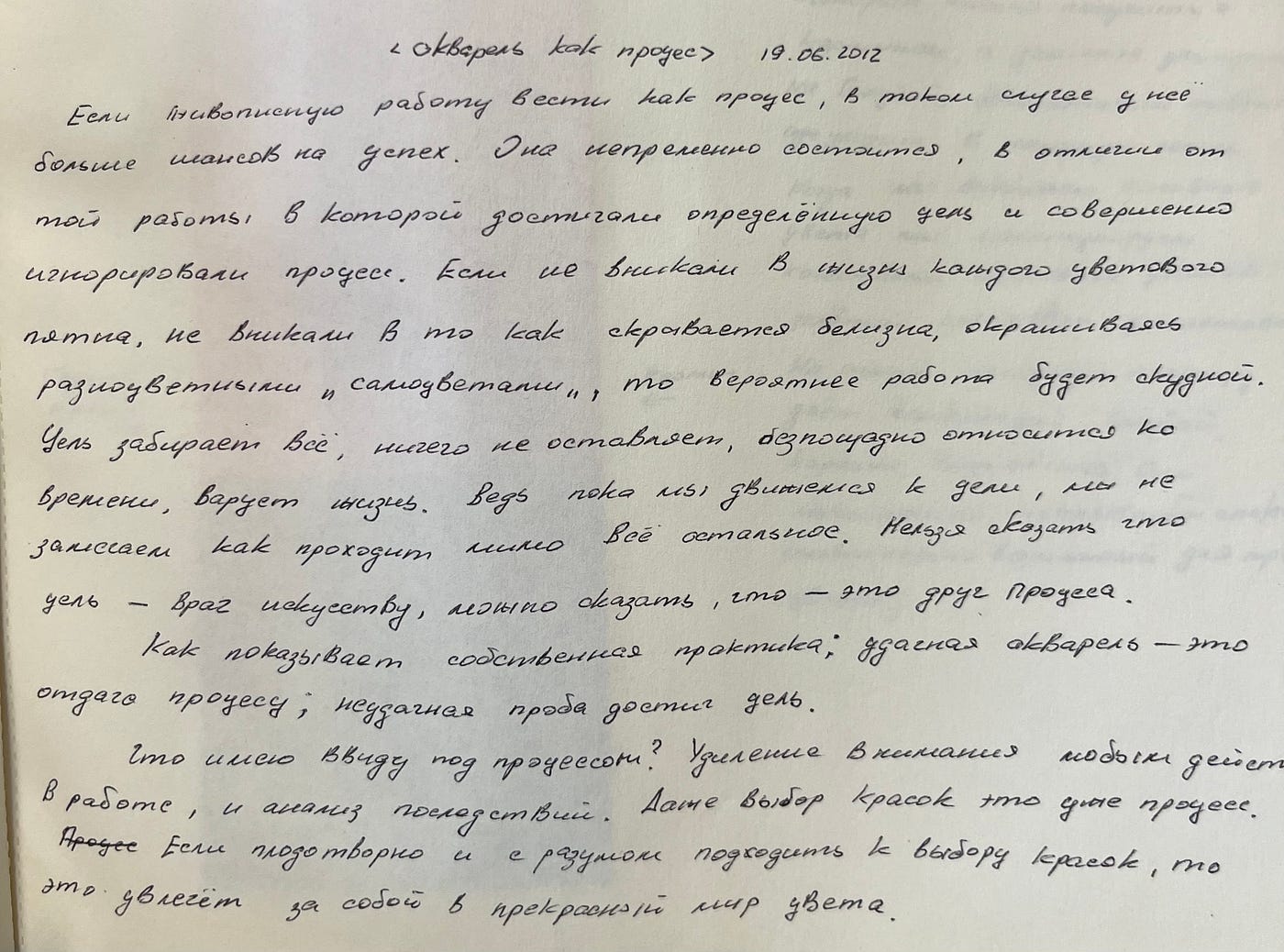
A painting has a greater chance of becoming complete when it is approached as a process rather than as a pursuit of a predetermined goal. Such a work naturally finds its own form. The opposite often happens when every decision is made solely to reach an expected result while the process itself is ignored.
If we fail to enter the life of each colour field — if we do not notice how the whiteness of the paper quietly disappears beneath transparent layers and luminous colours — the painting will most likely remain poor, no matter how carefully it is finished.
A goal demands everything. It leaves nothing behind. It treats time carelessly and steals life itself. While we are moving toward a destination, we often fail to notice everything else unfolding around us.
I would not say that a goal is the enemy of art. Rather, it is a frend of the process.
My own experience has shown that successful watercolours emerge from surrendering to the process, while unsuccessful ones often come from trying too hard to achieve a specific result.
What do I mean by process?
I mean giving full attention to every action that takes place during the work and observing its consequences. Even choosing the pigments is already part of the process.
When colour selection is approached thoughtfully and deliberately, it naturally leads into the remarkable world of colour itself.
One could go even further and say that painting begins not with paint, but with paper.
I believe this is true.
Stretching a sheet of paper onto a board is already part of the creative process. It is a white space preparing itself to receive colour. This is where watercolour — and perhaps painting itself — truly begins. It is a kind of culture.
When the paper has been prepared with care, it gains clarity, resonance, and purity. It ceases to be merely a surface and becomes a participant in the work rather than a passive support.
From that moment onward, the painting can unfold slowly, thoughtfully, and with quiet attention from the first wash to the last. That, too, is part of the process.
Painting should resemble an Eastern tea ceremony.
Not something hurried, swallowed on the run like a meal from a fast-food restaurant, but something lived with presence and care.
Even a single square of transparent colour is already a world of its own, touching another world — another colour field.
Perhaps this sounds poetic.
But sometimes poetry reveals things that explanation cannot.
It reminds us that painting is not about gulping boiling water from a plastic cup. It is about taking part in the tea ceremony.
Looking back today, I can already see the first ideas that would later become Color Script. Today, this research continues through the Color Script project, where I share new paintings and visual fragments on Instagram at @aronetiv

메타데이터
- post_id
- 2f4db30f47e0
- slug
- watercolour-as-process-2f4db30f47e0
- url
- https://medium.com/@alexey.popovtsev/watercolour-as-process-2f4db30f47e0
- canonical_url
- https://medium.com/@alexey.popovtsev/watercolour-as-process-2f4db30f47e0
- author_url
- https://medium.com/@alexey.popovtsev
- status
- ok
- fetched_at
- 2026-08-12 17:13:33




