Constitutional SAFe
Why So Many Agile Transformations Quietly Recreate Waterfall
Constitutional SAFe
Why So Many Agile Transformations Quietly Recreate Waterfall
Most Agile transformations do not fail because people resist change.
They fail because organizations try to scale Agile while preserving management systems designed for predictability and control.
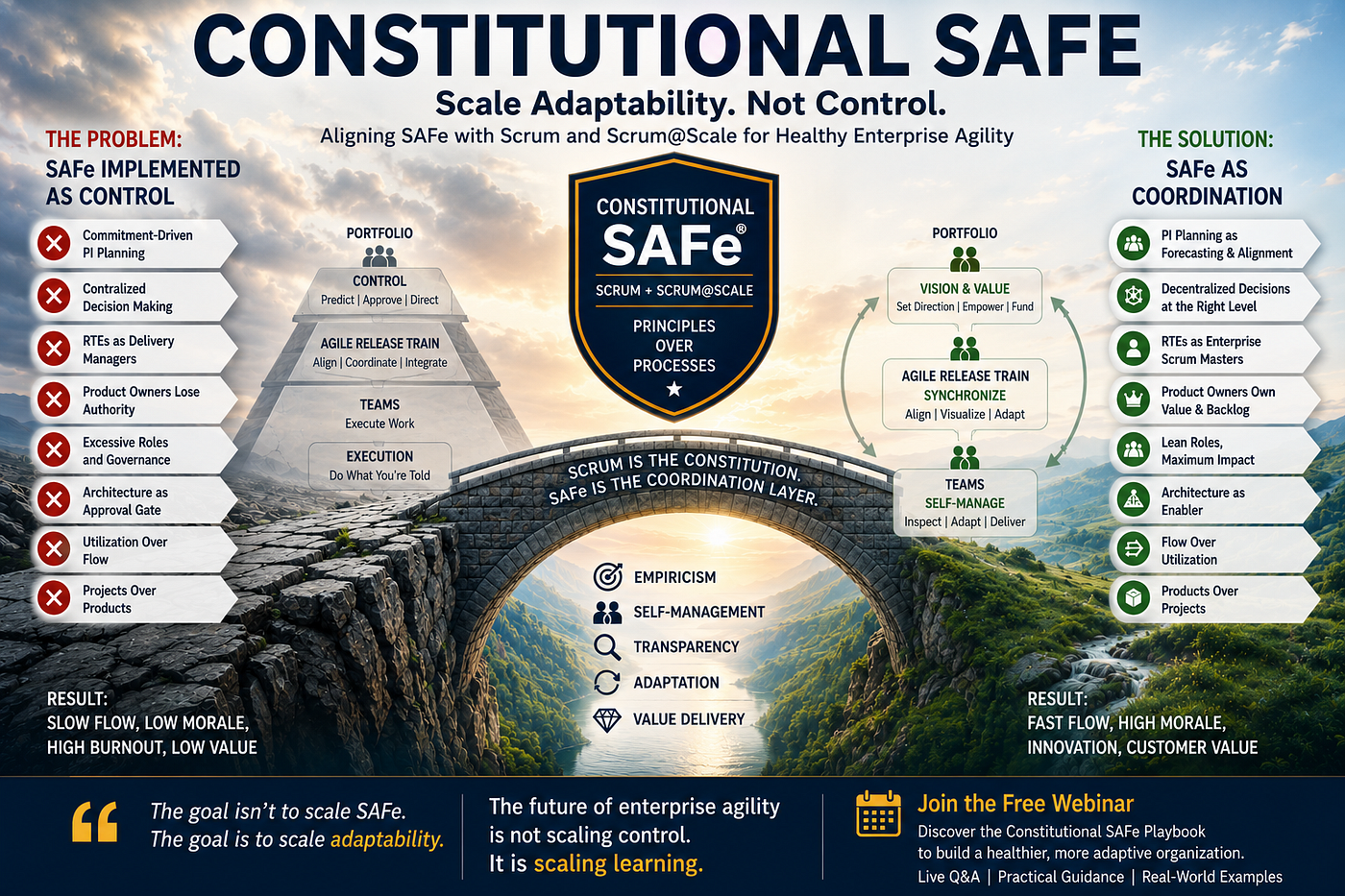
That tension explains why so many enterprise transformations eventually feel:
- heavy,
- bureaucratic,
- exhausting,
- and strangely similar to waterfall.
Teams attend PI Planning.
Agile Release Trains launch.
Hundreds of people become certified.
Executives proudly announce: “We’re Agile now.”
And yet:
- delivery still feels slow,
- dependencies dominate execution,
- planning consumes enormous energy,
- teams feel less empowered,
- and innovation often declines instead of accelerating.
Many practitioners quietly ask themselves:
“Why does this still feel like waterfall?”
That question is more important than most organizations realize.
Because the issue usually is not Agile itself.
And it is not necessarily SAFe either.
The issue is structural.
The Hidden Conflict Inside Enterprise Agility
At the heart of modern Agile transformations is a philosophical collision.
Scrum assumes:
- complexity requires adaptation,
- learning beats prediction,
- and decentralized teams outperform centralized control in fast-changing environments.
Traditional enterprises often assume:
- scale requires governance,
- governance requires centralized coordination,
- and centralized coordination requires hierarchy.
SAFe frequently becomes the place where those worldviews collide.
Not because SAFe is inherently broken.
But because organizations often operationalize it in ways that unintentionally recreate:
- command-and-control management,
- planning theater,
- portfolio bureaucracy,
- and waterfall-style delivery pressure.
The language changes.
The operating system often does not.
The Patterns That Quietly Break Agility
Most unhealthy Agile transformations share similar symptoms.
PI Planning Becomes Contract Negotiation
Instead of forecasting and alignment, teams are pressured into quarterly commitments.
Adaptation becomes psychologically unsafe.
Empiricism weakens.
The organization starts optimizing for predictability optics instead of learning speed.
RTEs Become Delivery Managers
Many Release Train Engineers slowly inherit project management behaviors:
- escalation ownership,
- delivery pressure,
- executive reporting,
- commitment enforcement.
Teams lose autonomy.
Dependencies increase.
Flow slows down.
Product Owners Lose Real Authority
In many enterprises, Product Owners stop functioning as true value owners.
Portfolio structures and centralized governance layers begin dictating priorities.
Product Owners become backlog administrators instead of decision-makers.
That dramatically reduces responsiveness and customer learning.
Architecture Becomes an Approval System
Architecture groups often become centralized control mechanisms designed to reduce risk.
Ironically, they frequently increase organizational friction instead.
Innovation slows.
Experimentation declines.
Decision latency expands.
Utilization Optimization Destroys Flow
One of the most damaging enterprise assumptions is the belief that maximum utilization equals maximum efficiency.
It does not.
High utilization creates:
- bottlenecks,
- context switching,
- coordination overload,
- and burnout.
Stable product teams outperform matrixed resource pools almost every time.
Flow efficiency beats utilization efficiency in complex systems.
Scrum Was Never Just a Framework
This is where many transformations lose the plot.
Scrum is not merely a process model.
It is an empirical operating system rooted in:
- feedback loops,
- systems thinking,
- organizational learning,
- and complexity science.
The entire purpose of Scrum is accelerating adaptation.
The shorter the feedback loop:
- the faster the learning,
- the lower the risk,
- the higher the innovation potential.
That is why healthy Scrum organizations often outperform heavily managed enterprises despite having fewer layers of control.
Adaptation beats prediction in complex environments.
Always.
Constitutional SAFe
This is the core idea behind the playbook I’m releasing.
What if Scrum became the constitutional operating system of the enterprise?
In this model:
- Scrum governs execution,
- Scrum@Scale governs organizational adaptability,
- and SAFe becomes a lightweight coordination layer instead of a command hierarchy.
That changes everything.
PI Planning becomes:
- forecasting instead of contracting.
ARTs become:
- synchronization systems instead of governance systems.
RTEs become:
- enterprise Scrum Masters instead of delivery managers.
Architecture becomes:
- enabling instead of controlling.
Product Owners regain:
- prioritization authority and value accountability.
The goal is not removing coordination.
The goal is ensuring coordination does not suppress empirical learning.
The Real Goal Is Organizational Health
The most important outcome is not process compliance.
It is organizational health.
Because culture does not emerge from motivational slogans.
Culture emerges from system design.
When organizations centralize control:
- trust weakens,
- ownership declines,
- politics increase,
- and adaptation slows.
But when organizations preserve empirical agility:
- transparency improves,
- teams learn faster,
- innovation increases,
- and burnout declines.
Healthy systems adapt faster.
And in modern markets, the fastest learning organization wins.
The Future of Enterprise Agility
The future of Agile is not scaling ceremonies.
It is scaling adaptability.
The organizations that thrive over the next decade will not be the ones with the most process.
They will be the ones capable of:
- learning fastest,
- reorganizing fastest,
- adapting fastest,
- and reducing organizational friction continuously.
That requires a different leadership model.
Not less structure.
But structures designed to improve learning instead of controlling uncertainty.
That is the purpose of Constitutional SAFe.
메타데이터
- post_id
- 2f542e65a2d8
- slug
- constitutional-safe-2f542e65a2d8
- url
- https://medium.com/@todd_51322/constitutional-safe-2f542e65a2d8
- canonical_url
- https://medium.com/@todd_51322/constitutional-safe-2f542e65a2d8
- author_url
- https://medium.com/@todd_51322
- status
- ok
- fetched_at
- 2026-06-09 15:37:30



